
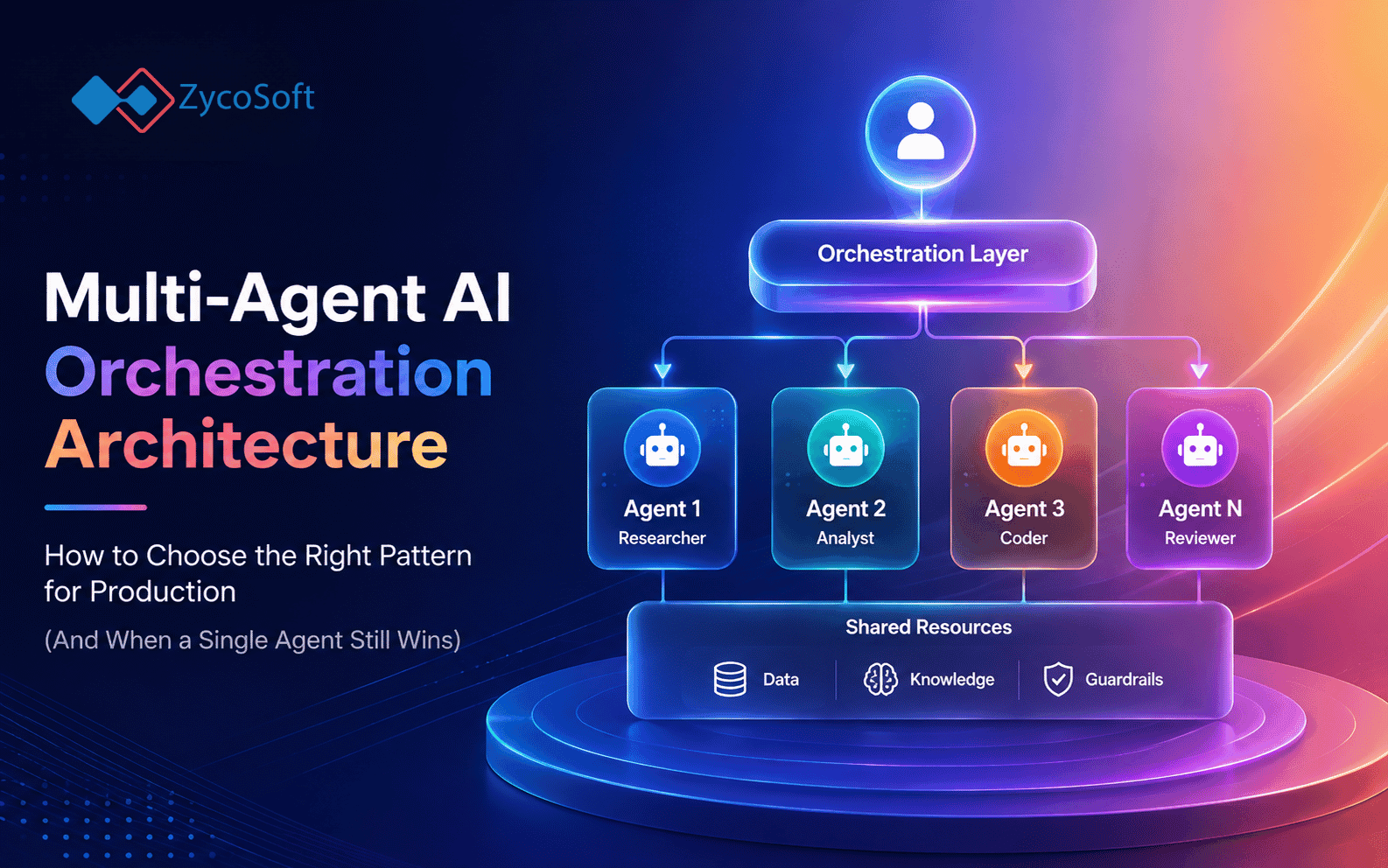
Multi-Agent AI Orchestration Architecture: How to Choose the Right Pattern for Production (And When a Single Agent Still Wins)
Topology choice, not model quality, is the primary determinant of production reliability in agentic AI systems. Google's 2025 scaling study across 180 multi-agent configurations confirmed this, and the cascade failure research published in the same period showed that poorly chosen orchestration patterns amplify errors rather than contain them. Yet the default decision in most teams is still to reach for a multi-agent design because it sounds more capable, without modelling what that decision costs in token spend, observability overhead, or operational complexity.
This post is a practitioner decision framework for engineering leads choosing between four orchestration topologies: sequential pipeline, hierarchical routing, collaborative DAG, and single-agent. It covers when each pattern is justified, what the topology decision actually costs, and the five failure modes that kill multi-agent systems before they reach production.
The Four Orchestration Topologies and What They Actually Buy You :
Each pattern solves a specific class of problem. Choosing the wrong one does not just waste tokens; it creates failure modes that are difficult to diagnose because the errors are distributed across agent boundaries.
Single Agent :
A single LLM with a structured prompt, a defined tool set, and clear output schema. This pattern handles the majority of business automation tasks in production: document classification, structured data extraction, summarisation with conditional routing, and single-turn decision support. It has one call trace, one failure point, and predictable token consumption. If your task can be completed within a single context window with deterministic tool calls, this is the right answer.
Sequential Pipeline :
Agent A produces output, which becomes the input for Agent B, then Agent C. Each agent specialises in one transformation. This is appropriate when steps are genuinely heterogeneous (different models, different tool permissions, or different context requirements) and when strict ordering is required. A UK insurance claims triage workflow, for example, might use a classification agent, then a policy-lookup agent, then a decision-drafting agent in sequence.
Hierarchical Routing :
An orchestrator agent receives the initial input, determines intent or task type, and routes to the appropriate specialist sub-agent. The orchestrator may also aggregate sub-agent outputs. This pattern is well suited to multi-domain systems where a single entry point needs to serve different task types without the caller knowing which specialist handles each one. A US revenue operations automation platform, for instance, might route CRM update tasks, email drafting tasks, and report generation tasks through a single orchestrator to three separate sub-agents.
Collaborative DAG :
Multiple agents execute in parallel with defined dependency edges. Agent C cannot start until Agents A and B both complete, but A and B run simultaneously. This is the most complex and expensive pattern, justified only when subtasks are genuinely independent and latency reduction from parallelism justifies the orchestration overhead. The "From Spark to Fire" cascade paper demonstrated that DAG topologies are also the most vulnerable to cascade amplification if a single agent in the graph fails silently.
The Real Cost of Topology: Token Spend and Observability Overhead
Token cost is not additive; it is multiplicative. Every agent boundary introduces prompt overhead: system prompt tokens, context marshalling, output format enforcement, and retry scaffolding. In a three-agent sequential pipeline, you are paying that overhead three times. In a hierarchical system with an orchestrator and four sub-agents, the orchestrator's prompt and the sub-agents' prompts can mean that the same underlying task consumes 3x to 8x more tokens than a single-agent design handling the same request.
Model that before you commit. Take a representative sample of your production tasks, run them through each candidate topology in a test environment, and measure actual token counts per run. At 10,000 requests per day, the difference between a single-agent and a three-tier hierarchical system can be tens of thousands of pounds per month in API costs at current pricing.
Observability overhead is the less-discussed cost. As covered in detail in our engineering framework for AI agent observability, a distributed agent system requires a trace ID that spans every agent in the call chain, per-agent latency logging, and retry event capture at each boundary. Without this, you cannot reconstruct a failed execution path. Single-agent systems have one trace. A five-agent DAG has five traces that must be correlated, and if your infrastructure does not enforce a shared trace context from the start, debugging production failures becomes an exercise in log archaeology.
The Five Failure Modes That Kill Multi-Agent Systems Before Production :
These failure modes are qualitatively different from single-agent bugs. They are harder to detect in staging, because they often only manifest at production request volumes or under adversarial inputs.
- Cascade amplification. An upstream agent produces a subtly incorrect output. Downstream agents treat it as ground truth and compound the error. By the time the final output is generated, the original error is unrecognisable. This is the failure mode documented in the "From Spark to Fire" research and it is most severe in DAG topologies where no agent has visibility of the full task context.
- Context drift. Each agent in a sequential or hierarchical chain receives a reconstituted version of the original intent. Small reformulations at each boundary accumulate. By Agent C, the task the system is solving may be meaningfully different from the task the user submitted. This is distinct from hallucination; it is structural degradation of the original prompt's intent across transformation steps.
- Infinite retry loops. An agent fails, retries, hits a rate limit or tool error, and retries again, without a depth limit or circuit breaker. In an orchestrated system, the orchestrator may not surface this loop visibly. Production systems must enforce a maximum retry depth per agent and a maximum total execution time per run, with explicit dead-letter handling.
- Dead-letter tasks with no escalation path. A task that no sub-agent can handle, or that fails all retry attempts, must go somewhere. Multi-agent systems without an explicit dead-letter queue and human escalation path silently discard failed tasks. In a regulated environment, that is a compliance failure, not just a UX problem.
- Observability gaps. The most operationally damaging failure mode. If your monitoring covers individual agent calls but not the end-to-end trace, you will see healthy-looking metrics while your system produces consistently wrong outputs. This is especially common when teams instrument agents individually but do not enforce a shared correlation ID across the agent graph.
For a broader taxonomy of how agentic systems fail in production, this technical failure taxonomy covers the full range across memory, tool use, and context management, not just orchestration.
A Decision Framework for Choosing Your Orchestration Pattern :
Use this framework before you write a line of orchestration code. Work through each criterion in order; stop at the first pattern that fits your requirements.
- Does the task fit within a single context window with structured tool calls? If yes, use a single agent. Do not proceed to multi-agent without a specific reason.
- Do different steps require different models, different tool permissions, or different context scopes? If yes, a sequential pipeline or hierarchical pattern is likely appropriate.
- Is the routing logic deterministic (rule-based) or does it require intent classification? Deterministic routing can be handled in a sequential pipeline with conditional branching. Intent-based routing requires a hierarchical orchestrator.
- Are subtasks genuinely independent and does end-to-end latency justify parallelism? If yes and you have the observability infrastructure to instrument a DAG, a collaborative DAG is appropriate. If your latency requirement can be met by a sequential pipeline, prefer it.
- Have you modelled token cost and observability overhead for each candidate topology at your expected production request volume? If no, do this before committing to a pattern.
- Does your system have explicit retry depth limits, circuit breakers, a dead-letter queue, and a human escalation path? If no, you are not ready for any multi-agent pattern in production.
Memory architecture is a parallel decision that significantly affects which topology is viable. A single agent with well-structured episodic and semantic memory can handle tasks that naive implementations push into multi-agent territory. This production memory architecture guide covers that decision in detail.
GDPR and Compliance Considerations Across Agent Boundaries :
For teams building in the UK, EU, or handling EU data subjects from the US or UAE, every agent boundary is a potential data processing point under GDPR and the UK Data Protection Act 2018. This is not a theoretical concern. If personal data is included in the context passed between agents, and each agent call is logged (as it must be for observability), you have created multiple processing records that each require legal basis, purpose limitation compliance, and retention controls.
The architectural implication is data minimisation at the boundary level. Design agent interfaces so that each agent receives only the context it needs, not the full task context from the originating request. In a hierarchical system, the orchestrator should strip personal data from routing context before dispatching to sub-agents that do not require it for their specialist function. This is a structural decision, not a configuration flag.
If any agent in your system calls an external LLM API, you must also satisfy data transfer rules. Under UK GDPR, sending personal data to a non-UK processor requires an adequacy decision or appropriate safeguards. Under EU GDPR, the same applies for transfers outside the EEA. In practice, this means your LLM vendor selection is also a compliance decision, and it should be made before your orchestration topology is finalised. Designing for model portability from the start, as covered in this guide to avoiding LLM vendor lock-in, also reduces your compliance exposure by keeping your architecture model-agnostic.
How ZycoSoft Approaches Multi-Agent Architecture in Production Deployments :
The pattern selection decisions described above are exactly where most teams lose months and significant budget. The engineering instinct is to build the most sophisticated system the problem seems to warrant. The production reality is that a well-designed single agent or a disciplined sequential pipeline outperforms a premature multi-agent system in reliability, cost, and debuggability every time.
ZycoSoft's AI automation practice builds end-to-end workflow automation using LLMs, n8n, and custom AI pipelines, and the topology decision is the first technical question we answer on any agentic engagement, not an afterthought. Our approach starts with task decomposition: we map every subtask, classify which require separate models or tool scopes, model token cost per topology at expected production volumes, and instrument observability before the first agent goes live. We deliberately avoid reaching for hierarchical or DAG patterns until the sequential pipeline or single-agent option has been ruled out by specific, measurable requirements.
We have production deployments across RAG-based agentic systems, hierarchical orchestration for multi-domain automation, and sequential pipelines for regulated document processing workflows in the UK and EU, including systems designed from day one for GDPR-compliant data handling at agent boundaries. Our GDPR-compliant architecture capability is genuinely rare in the agency market, and it matters specifically because the orchestration and compliance decisions are not separable.
If you are evaluating whether a multi-agent design is the right answer for your system, or if you have already built one and it is not behaving the way you expected in production, the conversation is worth having early.
Frequently Asked Questions
Use a multi-agent system when a task genuinely requires parallel execution across independent subtasks, when different steps need different models or tools that conflict in a single context, or when the task exceeds a single context window reliably. If the task can be completed sequentially by one model with structured prompting, a single agent is almost always cheaper and more debuggable.
A sequential pipeline passes output from one agent to the next in a fixed order, suitable for deterministic multi-step workflows. A hierarchical pattern uses an orchestrator agent to route tasks to specialist sub-agents based on intent or content type. A collaborative DAG allows agents to execute in parallel with defined dependencies, suitable for tasks where subtasks are independent and latency matters more than simplicity.
Each agent boundary introduces prompt overhead: system prompt, context marshalling, and output formatting tokens. In a hierarchical or DAG topology, the same underlying task can consume 3x to 8x more tokens than a single-agent design because each sub-agent receives a reconstituted context. Token cost must be modelled per topology before you commit to an architecture, especially at production request volumes.
The five most common production failure modes are: cascade amplification (an upstream agent error propagates and compounds through downstream agents), context drift (each agent reshapes context so downstream agents receive a degraded version of the original intent), infinite retry loops, dead-letter tasks with no human escalation path, and observability gaps where no single trace covers the full agent call chain.
Each agent boundary is a potential data processing point under GDPR. In a multi-agent system, personal data passed between agents must be governed by the same data minimisation and purpose limitation rules as any other processing step. Architecture decisions around where agents run, what context they receive, and whether that context is logged all carry compliance implications. This is especially important if any agent calls an external LLM API.
At minimum: a distributed trace ID that spans the full agent call chain, per-agent latency and token count logging, retry and failure event capture at each agent boundary, and an alerting threshold for cascade retry depth. Without a trace ID that crosses agent boundaries, you cannot reconstruct the execution path of a failed run, which makes debugging multi-agent failures significantly harder than single-agent bugs.
Yes, n8n is well suited to sequential pipeline and hierarchical orchestration patterns, particularly where the orchestration logic involves conditional routing, webhook triggers, and integration with external APIs or data stores. For collaborative DAG patterns requiring high-concurrency parallel agent execution, n8n can be combined with queue-based architectures. It is less suited to fully autonomous agentic loops without careful guardrails.