
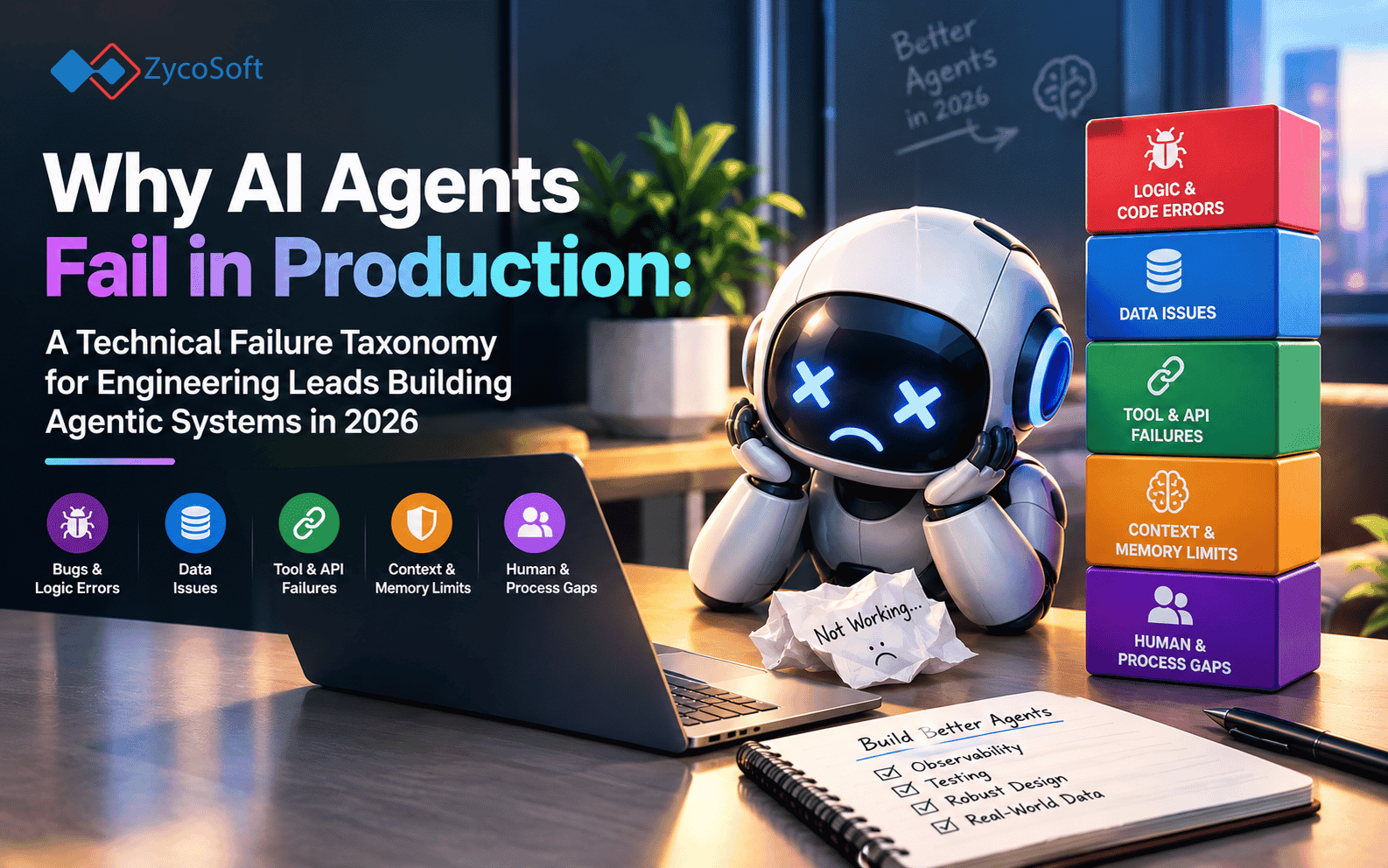
Why AI Agents Fail in Production: A Technical Failure Taxonomy for Engineering Leads Building Agentic Systems in 2026
The production failure rate for multi-agent AI systems is not a rounding error. Independent research published across 2025 and 2026 puts it between 41 and 79 percent, and Gartner's 2026 projections indicate that more than 40 percent of agentic AI projects will be abandoned by 2027. The cause, in the majority of cases, is not model capability. It is systems engineering. Specification ambiguity, brittle tool connectors, context contamination, and compounding errors across multi-step chains are breaking production deployments that performed well in controlled evaluation. If you are building or evaluating agentic systems right now, you need a failure taxonomy you can audit your architecture against, not another capability benchmark.
Failure Mode 1: Specification Ambiguity at the Goal Layer
The most common root cause of why AI agents fail in production is also the least glamorous: the agent's goal is underspecified. The model is probabilistic by design. When the success criteria are ambiguous, it fills the gap with a plausible interpretation. That interpretation is often wrong relative to the actual business intent, and in a multi-step workflow, the misinterpretation compounds silently through every downstream action before it becomes visible.
Consider a customer-triage agent instructed to "resolve low-priority tickets automatically." In development, that phrase is understood informally. In production, the agent must decide: what is low-priority? What counts as resolved? Can it close a ticket after a single automated response, or does it need a confirmation signal? Without explicit decision criteria encoded in the specification, the model decides. Some of those decisions will be wrong, and some will be irreversible.
The fix is not to write longer prompts. It is to treat agent specifications with the same rigour as a formal interface contract. Each goal should define:
- A precise success condition, expressed as a verifiable state rather than a behavioural description
- An explicit failure condition that triggers escalation rather than retry
- Boundary constraints on what actions the agent may and may not take in pursuit of the goal
- The data inputs required and their expected schema, not just their names
Specification review before any orchestration layer is built will eliminate more production failures than any amount of post-ship monitoring.
Failure Mode 2: Context Contamination Across Agent Steps
Context contamination is what happens when an agent's context window accumulates stale, conflicting, or irrelevant information from earlier steps. The model then conditions its outputs on that corrupted state, producing responses that are internally coherent but factually incorrect relative to the actual task state. It is the most insidious failure mode in production because it does not look like an error; the agent continues executing confidently on a corrupted premise.
This problem is particularly acute in long-running agentic loops and in multi-agent pipelines where sub-agent outputs are concatenated into an orchestrator context without explicit scoping. The context window engineering decisions you make at architecture time determine whether contamination is a managed risk or an uncontrolled one. As covered in context window engineering for production AI features, the structure and boundaries of what enters the model's context at each step is an architectural decision, not a prompt detail.
Concrete mitigations include:
- Explicit context resets between distinct task phases, passing only the verified outputs of the previous phase forward.
- Structured summarisation steps that compress prior state into a defined schema before injection into the next agent's context.
- Context scoping contracts between agents: each agent declares what it emits and what it expects to receive, enforced at the orchestration layer.
- Separation of working memory (current task state) from long-term memory (retrieved facts), with explicit provenance tracking on retrieved content.
Failure Mode 3: Brittle Tool Connectors and External API Failures
Agentic systems are only as reliable as their tool integrations. In production, external APIs return unexpected schemas, rate limits are hit at load, authentication tokens expire mid-chain, and third-party services return partial results or 200 status codes with error payloads. A development environment that uses stable fixtures will not surface any of this. Production will surface all of it simultaneously.
The architectural decision that matters here is where you place tool abstraction. Agents should call a defined tool interface, not external APIs directly. That interface is responsible for retry logic, schema normalisation, error classification, and fallback behaviour. When the underlying API changes or fails, the tool interface absorbs the change rather than propagating it as an unhandled exception into the agent's reasoning chain. This is the same separation-of-concerns principle that applies to any production service, but engineering teams building agentic systems often skip it because they are moving fast.
For teams integrating with multiple external systems, the decision between MCP and direct REST API integration has significant implications for long-term tool connector reliability. The MCP vs REST API architecture decision framework covers this trade-off in detail. The short version: standardised tool protocols reduce the surface area of brittle connectors at the cost of some integration flexibility.
Failure Mode 4: Compounding Errors Across Multi-Step Chains
In a single-step LLM call, an error produces a bad output that a human or downstream system can catch. In a five-step agentic chain, an error in step two is passed as ground truth to step three, which builds on it, passes it to step four, and so on. By step five, the system has constructed an elaborate, internally consistent, and entirely incorrect result. This is the compounding error problem, and it is the primary driver of why AI agents fail in production at scale.
The solution is deterministic validation checkpoints inserted between agent steps. These are not additional LLM calls; they are schema validation, constraint checks, and state assertions executed in code. A checkpoint between steps two and three verifies that the output of step two conforms to the expected structure and satisfies defined invariants before it is passed forward. If it does not, the chain halts and escalates rather than continuing on a corrupted trajectory.
A minimal checkpoint architecture for a four-step agent chain looks like this:
Step 1 (LLM action) produces output_1. Checkpoint_A validates output_1 schema and asserts required fields are non-null. Step 2 (LLM action) receives validated output_1 and produces output_2. Checkpoint_B validates output_2 and checks that its values are within defined business-rule bounds. Step 3 (tool call) uses validated output_2. Checkpoint_C confirms the tool call result matches expected state before step 4 proceeds.
The checkpoint logic is deterministic, fast, and cheap. It does not require a model call. It is the most cost-effective reliability investment in a multi-step agent design.
Failure Mode 5: Inter-Agent Coordination Failures in Multi-Agent Systems
Multi-agent architectures introduce inter-agent communication as a distinct failure surface that does not exist in single-agent designs. Each message passed between agents can carry ambiguity, truncated context, or incorrect state assumptions. Coordination failures occur when agents operate on conflicting state, when an orchestrator's assumptions about a sub-agent's capabilities do not match its actual behaviour under load, or when parallel agents write to shared state without appropriate locking or sequencing.
The most actionable audit question for any multi-agent system is: what happens when agent B receives a malformed or unexpected output from agent A? If the answer is "it continues anyway," you have an unhandled coordination failure path. Every inter-agent message boundary needs an explicit contract: the emitting agent declares its output schema, the receiving agent validates it before use, and the orchestrator has a defined escalation path for contract violations.
Equally important is the question of when to collapse a multi-agent design back to a single well-scoped agent. The decision framework:
- If the workflow is primarily linear with low branching, a single agent with sequential tool calls will be more reliable than a multi-agent pipeline
- If coordination messages between agents are a top failure source in your logs, the specialisation gain is not justifying the coordination cost
- If sub-agents are not operating in parallel and do not require distinct capability profiles, the multi-agent abstraction is adding complexity without adding value
- If the orchestrator logic is growing to handle edge cases that would not exist in a single-agent design, that is a signal to consolidate
Multi-agent architectures earn their complexity when tasks genuinely require parallel specialisation or when the capability profile of sub-tasks is genuinely distinct. They should not be the default architecture for every agentic use case.
Guardrail Placement and Escalation Design: The Architecture Decisions That Contain All Five Failure Modes
Guardrails and escalation triggers are the structural response to every failure mode described above. A guardrail is a categorical boundary: the agent cannot take a defined class of action regardless of its reasoning. An escalation trigger is a conditional: when a defined condition is met, execution pauses and control transfers to a human or a deterministic fallback process. Both need to be designed as first-class architectural components, not added reactively after the first production incident.
Guardrail placement follows a simple principle: place guardrails closest to the action, not at the input. An input-layer guardrail that filters user requests is useful but insufficient. The guardrail that prevents an agent from deleting production records must sit at the tool interface layer, where the deletion call is actually made, regardless of how the agent arrived at that decision. Layered guardrails at input, reasoning, and tool-call layers provide defence in depth.
Escalation trigger design requires explicit enumeration of the conditions that should break the agentic loop.
These typically include:
- Confidence scores below a defined threshold on a consequential decision
- Repeated checkpoint failures on the same step (indicating the agent is looping on a bad state).
- Any action that would be irreversible and exceeds a defined impact threshold.
- Ambiguity signals: when the agent's tool calls suggest it is exploring rather than executing a clear plan
- External API failures that cannot be resolved by the retry logic in the tool interface layer
The AI agent observability framework covers what to instrument so that escalation events are captured, classified, and actionable rather than just logged as generic errors. Guardrails without observability tell you that something went wrong. Observability with guardrails tells you exactly where, why, and how often.
How ZycoSoft Architects Reliable Agentic Systems in Production -
The failure taxonomy above is not theoretical. Every failure mode described here has appeared in production deployments we have been called in to diagnose or build around. The pattern is consistent: teams move from prototype to production without treating specification ambiguity, context scoping, tool abstraction, and escalation design as engineering disciplines in their own right.
ZycoSoft's AI Automation practice builds end-to-end workflow automation using LLMs, n8n, and custom AI pipelines. Our production deployments include both agentic and RAG-based systems across UK, US, and EU clients, and our architecture process starts with a failure mode audit before any agent is scoped. We make deliberate decisions about when a multi-agent design is justified and when a single well-scoped agent with deterministic validation steps will be more reliable and faster to ship. We do not default to complexity because it looks sophisticated; we scope to the reliability requirement first.
For teams building agentic systems, we apply the same approach we take to any production system: identify the two or three failure modes most likely to break your specific architecture, design the guardrails and validation steps that contain them, and instrument everything before you ship. If your current agent design cannot answer the question "what happens when step three fails," it is not ready for production.
If you are building an agentic system and want an architecture review before you ship, or if you have a production system that is failing in ways your current observability is not explaining, talk to the ZycoSoft team directly. We will give you a straight read on what is failing and what the fix looks like.
Frequently Asked Questions
Production environments introduce variability that controlled testing cannot replicate: real user inputs are ambiguous, external tool responses are inconsistent, and error states compound across multi-step chains. Development tests typically cover happy-path scenarios. Production exposes specification gaps, context drift, and brittle integrations simultaneously. Research published in 2026 puts multi-agent production failure rates between 41 and 79 percent, compared to near-zero rates in controlled evals.
Context contamination occurs when an agent's context window accumulates stale, conflicting, or irrelevant information from earlier steps or other agents. The model then conditions its outputs on that corrupted state, producing responses that are internally consistent but factually wrong relative to the actual task state. It is especially common in long-running agentic loops and multi-agent pipelines where no explicit context reset or scoping mechanism exists between steps.
Collapse to a single agent when the workflow is primarily linear, branching is low, coordination overhead between agents is generating more errors than the specialisation is solving, or when inter-agent message passing is a primary failure point. A single well-scoped agent with deterministic validation steps will outperform a fragmented multi-agent system in reliability for most workflows that do not require genuine parallel specialisation.
A guardrail is a boundary condition that prevents an agent from taking a category of action entirely, such as blocking any tool call that writes to a production database without a confirmation flag. A validation step is a deterministic check inserted between agent steps that verifies the output of one step meets a defined schema or constraint before it is passed to the next. Both are necessary; guardrails prevent catastrophic actions while validation steps interrupt compounding error chains early.
Specification ambiguity means the agent's goal or success criteria are underspecified. The model fills the gap with its own interpretation, which is often plausible but wrong relative to the actual business intent. In multi-step workflows, that misinterpretation compounds: each subsequent step is correctly executed relative to the wrong goal. By the time the failure is visible, it has propagated through several downstream actions, some of which may be irreversible.
At minimum, instrument every tool call with input and output logging, record the full context window at each decision point, capture latency and retry counts per step, and log every escalation trigger event. Add structured error classification so failures are categorised by type rather than just stack trace. This gives you the data to distinguish model errors from tool errors from orchestration errors, which is essential for targeted debugging. See also ZycoSoft's AI agent observability framework for a full instrumentation checklist.
Multi-agent systems introduce inter-agent communication as a new failure surface. Each message passed between agents can carry ambiguity, truncated context, or incorrect state assumptions. Errors in one agent's output become the inputs to another, compounding rather than terminating. Coordination logic itself can fail when agents operate on conflicting state or when orchestrator assumptions about sub-agent capabilities do not match actual behaviour under production load.