
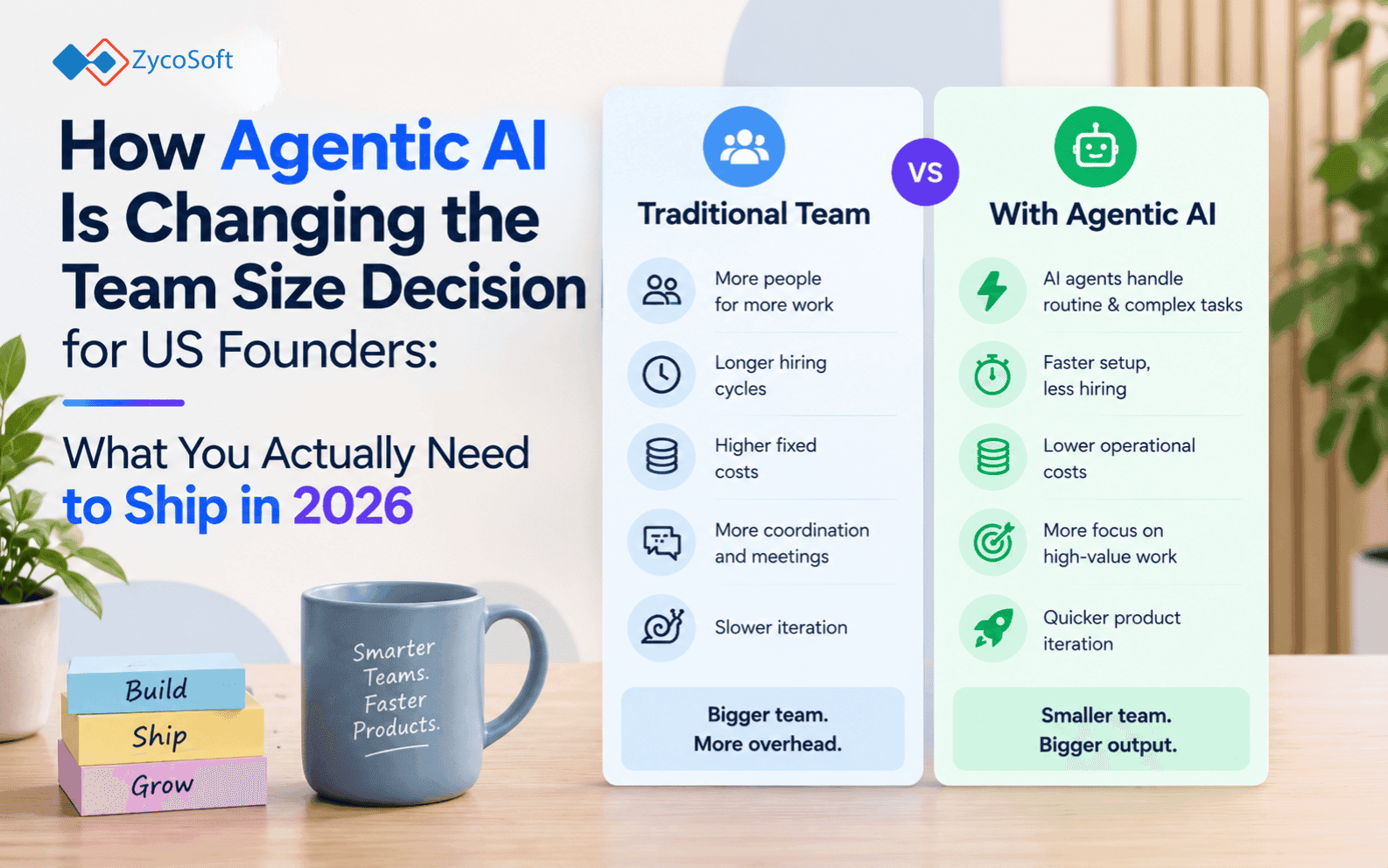
How Agentic AI Is Changing the Team Size Decision for US Founders: What You Actually Need to Ship in 2026 .
The assumption that a serious SaaS product requires 8 to 12 engineers is no longer defensible. Salesforce published output data this year showing 151% engineering output growth without increasing headcount, attributing it directly to agentic coding workflows. Anthropic's agentic coding trends report confirms the same pattern across production teams. US founders and CTOs who are still sizing teams the way they did in 2023 are solving the wrong problem.
The question has shifted. It is no longer "how many engineers do I need?" It is "what work still requires a human, and how do I structure a small, senior team to capture the agentic productivity multiplier without introducing architecture debt or compliance risk?" This post works through that decision framework directly.
What Agentic Tooling Actually Changes About Output Per Engineer:
Agentic coding tools in 2026 do more than autocomplete. They generate full feature implementations, write test suites, produce documentation, handle boilerplate refactoring, and execute multi-step coding tasks with minimal prompting. A senior engineer working with a well-configured agentic workflow can ship in a day what previously took three engineers a week on execution-layer tasks.
The measurable gains cluster in specific areas:
- Boilerplate and CRUD generation: near-complete automation for experienced engineers.
- Test coverage: agentic tools can generate unit and integration tests at a pace that exceeds what most teams previously staffed for.
- Documentation and code review prep: substantially reduced manual effort.
- Repetitive refactoring: pattern-based changes across large codebases now take minutes, not days.
This is not theoretical. Teams using agentic workflows as a core part of their delivery model are consistently reporting output multipliers of 2x to 4x per engineer on execution-heavy work. For a pre-Series A SaaS company that previously assumed it needed 10 engineers to ship a credible product, this changes the founding maths significantly.
What Agentic Tooling Does Not Change (And Where Founders Get This Wrong) :
The productivity gain is real, but it applies to execution work, not to the decisions that determine whether your product will survive contact with production. Founders who treat agentic tools as a replacement for senior engineering judgment are building a different kind of risk into the product, not eliminating risk.
The roles that remain irreplaceable in 2026 are precisely the ones that are hardest to hire for in the US market:
- Architecture ownership: deciding how the system is structured, how it will scale, and where the fault lines are.
- AI-generated code review: agentic output requires experienced engineers to validate correctness, security, and fit with the existing codebase.
- GDPR and data compliance: particularly relevant for any US SaaS product serving European customers, which most B2B SaaS products do
- Production governance: incident response, observability instrumentation, and failure triage cannot be delegated to an agent.
- Product judgment: translating business requirements into engineering decisions that do not create compounding technical debt.
The mistake US founders make is assuming that because agentic tools generate code quickly, they can staff a team of junior engineers to manage the output. This does not work. Reviewing and governing AI-generated code at speed requires more senior judgment, not less. As we cover in detail in our post on AI-generated code and technical debt governance, the debt that accumulates when AI output is not reviewed by experienced engineers compounds faster than debt from purely manual coding, because the volume is higher.
The Lean Team Model That Actually Works in 2026 :
A well-structured dedicated remote engineering team for a US startup in 2026 does not look like a scaled-down version of a traditional engineering org. It is built around senior engineers who can each operate across a wider surface area, using agentic tooling to handle execution volume while retaining full ownership of architecture and quality.
The 3 to 5 Engineer Configuration -
For a serious SaaS product build, the functional structure that consistently delivers looks like this:
- 2 to 3 senior full-stack or backend engineers who own architecture decisions and review all AI-generated output before it merges.
- 1 DevOps and infrastructure engineer who owns CI/CD pipelines, observability, and deployment architecture.
- 1 technical lead who communicates directly with the founder or CTO, owns production governance, and makes the final call on scope trade-offs.
This configuration, working with agentic coding workflows, can reliably ship what a 10-person team built purely on manual coding would ship, with lower coordination overhead and a substantially smaller hiring and payroll burden for the founder.
Why Seniority Is the Non-Negotiable Variable :
The agentic multiplier is not evenly distributed. A junior engineer using agentic tools outputs more code, but the review burden that creates falls on senior engineers anyway. A team of 8 juniors with agentic tools does not outperform a team of 4 seniors with agentic tools. The seniors are faster at reviewing, faster at identifying architectural problems in generated code, and faster at making decisions that prevent rework.
For US founders, this is where the dedicated remote engineering partner model solves a genuine problem. Hiring 4 to 5 senior engineers in San Francisco or New York at market rates, with benefits and equity, represents a cash burn that most pre-Series A companies cannot sustain. An embedded team of equivalent seniority, operating with Western work practices and direct communication channels, delivers the same quality bar at a structure that fits the funding stage.
How to Evaluate a Remote Engineering Partner for Agentic Workflows :
Not every remote engineering partner is structured to capture the agentic productivity gains. Most traditional software agencies are still staffed as they were in 2019: large teams of mid-level engineers working sequentially through a ticket queue. That model does not benefit from agentic tooling in the same way a senior-led embedded team does.
When evaluating a dedicated remote engineering team for US startups, ask specifically about:
- Whether they have production deployments using agentic coding workflows, not just pilot experiments.
- How they handle code review of AI-generated output, and who is responsible for architecture sign-off.
- What their approach is to GDPR-compliant data handling, particularly if your product will process European user data.
- Whether they have delivered full SaaS lifecycle work: architecture, build, launch, and scale, not just initial development.
- How communication and escalation work in practice, specifically whether you have direct access to the engineers, not just a project manager layer.
- The technical due diligence checklist for evaluating a software development agency covers this evaluation process in full and is worth running before any engagement.
The Actual Decision Framework for US Founders Sizing a Team in 2026 :
The headcount decision in 2026 is not a fixed formula. It depends on product complexity, compliance requirements, and where you are in the funding cycle. But the starting point has changed. The default should no longer be "how many engineers does a product like this usually need?" It should be "what is the minimum senior team that can own this architecture and govern agentic output at the pace we need to ship?"
For most pre-Series A and early Series A SaaS companies, that answer is 3 to 5 senior engineers working as a dedicated team extension, not 8 to 12 engineers on a traditional delivery model. The founders who are moving fastest right now are not the ones who hired the largest teams. They are the ones who hired the most senior small teams and gave them the agentic tooling and the authority to move.
For Series A companies with more complex compliance requirements, particularly those handling regulated data or serving enterprise customers with SOC 2 or GDPR obligations, the governance layer becomes thicker. But even here, the answer is more senior engineers per headcount, not more headcount overall. How US SaaS founders are restructuring their engineering teams around agentic AI workflows covers the specific org design implications in more detail.
The old playbook said you needed a team of 8 to 12 to ship something serious. The new reality is that a dedicated remote engineering team of 4 to 5 senior engineers, properly structured and equipped with agentic workflows, is the more competitive configuration for most US startups building in 2026. The founders who recognise this early will spend less, ship faster, and arrive at their Series A with cleaner architecture than the ones who hired to the old assumptions.
If you are currently sizing an engineering team for a SaaS product build and want to work through the structure with a team that has production agentic deployments and a full SaaS delivery track record, speak to ZycoSoft directly.
Frequently Asked Questions
For a well-scoped SaaS product, a team of 3 to 5 senior engineers working with agentic coding workflows can now deliver what previously required 8 to 12. The critical factor is seniority and workflow design, not headcount. Junior-heavy teams do not capture the same productivity multiplier because agentic tools require strong architectural judgment to use safely at speed.
Agentic coding tools handle code generation, test writing, documentation, and repetitive refactoring tasks at speed. This collapses the number of engineers needed for execution-layer work. What it does not change is the need for senior engineers who can review AI-generated output, make architecture decisions, enforce GDPR-compliant data handling, and maintain production governance.
A dedicated team extension operates as an embedded part of your product organisation, with fixed senior team members, consistent communication rhythms, and shared ownership of architecture decisions. Traditional outsourcing typically involves rotating contractors, output-based contracts, and limited accountability for long-term code quality. For agentic workflows, the embedded model is essential because AI-assisted output requires consistent human oversight from engineers who understand the full codebase.
Architecture ownership, security and compliance review, production incident response, and product judgment cannot be safely delegated to agentic tools in 2026. Someone must review AI-generated code before it ships, evaluate whether the architecture will hold at scale, and ensure data handling meets GDPR or other regulatory standards. These roles require senior engineers, not coordinators or project managers.
Structure the team around 2 to 3 senior full-stack or backend engineers who own architecture and review AI-generated output, one engineer responsible for DevOps, CI/CD, and observability, and one senior engineer or technical lead who owns production governance and communicates directly with the founder or CTO. Avoid building a pyramid of junior contributors, as this negates the agentic productivity gain and adds coordination overhead.