
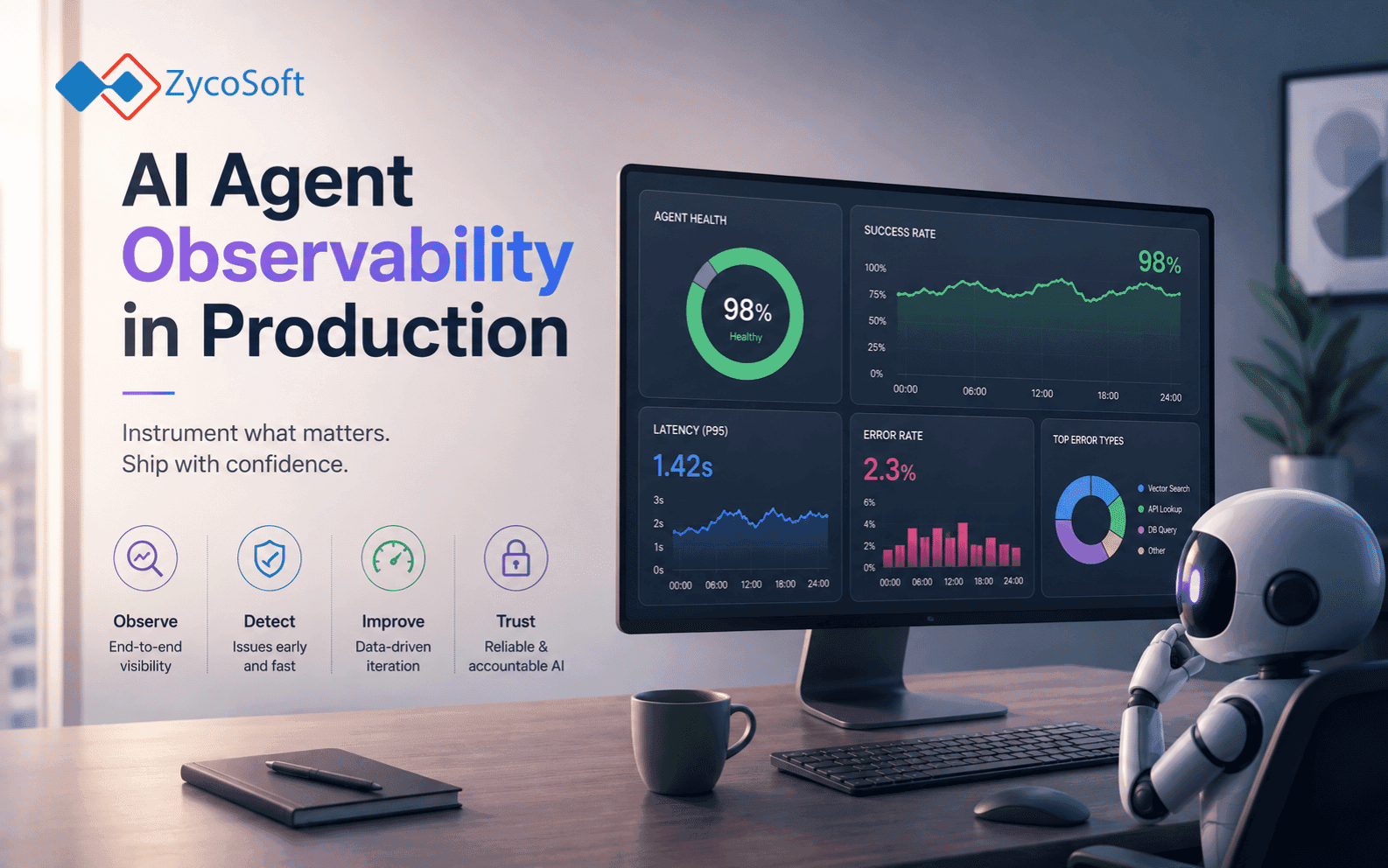
AI Agent Observability in Production: What Engineering Leads Must Instrument Before They Ship
The gap between a working AI agent prototype and a reliable production system is not a model quality problem. LangChain's State of Agent Engineering survey, covering more than 1,300 respondents in 2026, found that the primary bottleneck for teams scaling agentic AI is not model intelligence; it is the evaluation, observability, and governance layer that most teams bolt on after their first production incident rather than designing in from the start. That order of operations is the single biggest source of avoidable downtime, trust erosion, and runaway inference costs in production LLM systems.
This post gives engineering leads a concrete framework for what to instrument, how to evaluate at scale, and which tooling to use, before a single user hits your production agent.
The Three Observability Layers Every Production AI Agent Needs :
AI agent observability in production requires three distinct instrumentation layers. Each answers a different question. Missing any one of them leaves a blind spot that will surface at the worst possible moment.
Traces -
A trace captures the full execution graph of a single agent run: every LLM call, tool invocation, retrieval step, and branching decision, with latency recorded at each node. In an agentic system, a single user request might trigger four to twelve LLM calls and several external API calls. Without a trace, you see a slow or incorrect final output but have no way to locate where in the chain the problem occurred.
Instrument traces using OpenTelemetry spans where your agent framework allows it, or use an SDK from your chosen observability platform. The key fields to capture at each span are: model name and version, prompt token count, completion token count, latency in milliseconds, tool name if applicable, and any structured metadata such as user ID or session ID. That last point matters for GDPR audit trails as well as debugging.
Metrics -
Metrics are aggregated time-series data that give you operational visibility. The minimum viable set for a production AI agent includes:
- Cost per run (total input plus output tokens multiplied by model pricing, aggregated by day and by agent type)
- P50, P90, and P99 latency across full agent runs and per LLM call
- Error rate (tool call failures, context length exceeded errors, API timeout rate)
- Task completion rate (the proportion of agent runs that reach a terminal success state rather than a fallback or error state)
- Retry rate (how often your retry logic fires, which is an early signal of upstream model or tool instability)
Logs -
Structured logs are the raw evidence layer. Every production agent run should log the exact prompt sent, the model version used, the raw completion returned, any tool call arguments and responses, and the final output delivered to the user. Logs need to be queryable, not just stored. If your logs are in an unstructured blob store, debugging a hallucination report from a user three days later becomes a manual archaeology exercise.
Store logs with a minimum 30-day retention in a queryable system such as Elasticsearch, Loki, or BigQuery. For systems handling personal data, apply field-level pseudonymisation before storage to maintain GDPR compliance without losing debugging capability.
LLM-as-Judge Evaluation at Scale :
Human review of agent outputs does not scale past a few hundred runs per day. LLM-as-judge is the production-viable alternative, and it is now standard practice in serious LLMOps teams.
The pattern is straightforward. You take every (input, output) pair from your production agent, or a sampled subset, and send it to a separate grading model with a structured evaluation prompt. The grading model scores the output against a rubric you define.
A typical rubric for a customer-facing agent might score across:
- Factual accuracy relative to retrieved context (faithfulness)
- Instruction following (did the agent do what the user asked?)
- Tone and format compliance :
- Hallucination risk (did the agent assert something not grounded in its context?)
- Task completion (did the agent reach a useful terminal state?)
Each criterion returns a score from one to five and a short reasoning string. You aggregate these scores into a daily dashboard. A drop in average faithfulness score from 4.2 to 3.6 over 48 hours is a signal worth investigating before users start filing support tickets. For teams building RAG-based agents, faithfulness evaluation is especially critical because retrieval quality directly determines whether the model has the grounding it needs to answer accurately.
One practical note: use a different model for judging than the one you are evaluating. Using GPT-4o to judge GPT-4o outputs introduces systematic self-preference bias. Use a model from a different provider or a fine-tuned evaluation model for your most critical rubric dimensions.
Evaluation-in-CI for Non-Deterministic Agents :
Standard software CI breaks on non-deterministic systems because you cannot assert exact output equality. The solution is probabilistic evaluation against behavioural criteria, run on every merge.
The architecture is a four-step pipeline:
- Maintain a golden dataset. A fixed set of 50 to 200 representative input scenarios with defined expected behaviours, not exact expected strings. For example: "Given this product return request, the agent must acknowledge the request, state the policy, and not promise a refund timeline it cannot fulfil."
- Run the agent at temperature 0. Fix the temperature for CI runs to reduce variance. This does not eliminate non-determinism entirely but reduces it enough to make pass/fail thresholds meaningful.
- Score outputs with your judge model or deterministic assertions. For structured outputs, use assertion-based checks (does the JSON contain a required field?). For natural language outputs, use the judge model with a binary pass/fail rubric per scenario.
- Gate the merge on pass rate. Set a threshold, typically 88 to 95% depending on agent criticality. A build that drops below threshold blocks the merge and notifies the team with the specific failing scenarios attached.
This pattern catches prompt regression, model version drift, and tool integration breaks before they reach production. The investment to build it is roughly one to two engineering days. The cost of not having it is typically discovered during a late-night incident. Teams shipping agentic workflows at scale are increasingly treating this the same way they treat unit test coverage: a non-negotiable gate, not an optional extra.
Drift Detection, Hallucination Alerting, and Cost Controls :
LLM hallucination detection in production cannot be fully automated, but it can be systematically reduced and rapidly surfaced. The three-layer approach that works in practice is:
- Sampled judge evaluation on production traffic. Run your faithfulness rubric on 5 to 10% of all production outputs in near-real-time. Alert when the rolling 24-hour average drops more than 0.5 points from the established baseline.
- Citation grounding checks for RAG agents. After each retrieval step, verify programmatically that every factual claim in the completion maps to a retrieved chunk. This is deterministic and catches the most dangerous hallucination pattern, fabricated citations, without needing an LLM judge.
- Model version change alerting. Many teams miss this. When your LLM provider silently rolls a model update, your agent's behaviour can shift without any code change on your end. Log the model version returned in every API response and alert on any first-seen version string.
Cost controls are equally critical and frequently ignored until an invoice arrives. Token costs compound quickly in agentic systems because multi-step agents invoke the model several times per user request. Instrument cost per run from day one, set a per-run budget threshold in your orchestration layer, and implement a circuit breaker that degrades gracefully (returning a cached or simplified response) rather than allowing a runaway loop to generate a four-figure daily bill. A hard token cap per session, enforced at the orchestration layer rather than relying on the model provider's rate limits, is the minimum viable control.
Tooling Comparison: Langfuse, LangSmith, Arize Phoenix, and Confident AI
Each of the major observability platforms makes different trade-offs. Here is a direct comparison across the dimensions that matter most for an engineering lead choosing a production stack:
- Langfuse. Open-source (MIT licence), self-hostable, framework-agnostic. Supports traces, datasets, LLM-as-judge evaluation, and prompt management. The strongest choice for teams with GDPR or data residency requirements who cannot route trace data through US-hosted infrastructure. Actively maintained with strong community adoption in 2026.
- LangSmith. LangChain's native observability platform. Tightest integration if your agent is built on LangChain or LangGraph. Excellent dataset and evaluation UI. The practical downside is ecosystem lock-in and the fact that trace data is hosted on LangChain's cloud by default, which creates friction for EU data residency compliance.
- Arize Phoenix. Strong on ML monitoring lineage and particularly good for teams that run both traditional ML models and LLM-powered agents from a single platform. Open-source core with a hosted tier. Best suited to organisations with existing Arize investment or teams that need unified model monitoring across LLM and non-LLM systems.
- Confident AI. Focused specifically on LLM evaluation pipelines rather than full observability. Its DeepEval library is widely used for evaluation-in-CI because it ships with 15-plus pre-built evaluation metrics and integrates cleanly with pytest. Not a replacement for a full observability platform, but an excellent complement for the evaluation layer specifically.
The pragmatic recommendation for most engineering teams in 2026 is to use Langfuse for traces and production monitoring (self-hosted if GDPR is a constraint), DeepEval from Confident AI for evaluation-in-CI, and to treat LangSmith as the better default only if the team is already deeply invested in the LangChain ecosystem.
How ZycoSoft Designs Observability Into Agentic Pipelines From Day One :
The pattern that creates the most painful production incidents is building an AI agent, shipping it, and then trying to retrofit observability after the first unexplained failure. By that point, you have no baseline to compare against, no trace history to debug from, and no evaluation dataset to verify a fix against. The instrumentation work takes the same amount of time either way; the difference is whether you have data when you need it.
ZycoSoft's AI Automation service, covering end-to-end workflow automation using LLMs and custom AI pipelines, is built around the principle that observability is not a phase that follows the build. Every agentic pipeline we ship includes trace instrumentation from the first integration, an LLM-as-judge evaluation framework scoped to the specific use case, and a golden dataset built during the acceptance testing phase rather than assembled retroactively. For teams with EU data residency obligations, we deploy Langfuse self-hosted rather than routing trace data through third-party cloud infrastructure, which matters as soon as personal data touches the pipeline.
We have deployed production AI automation across n8n-based workflow orchestration, custom LLM pipelines, and RAG-based document intelligence systems. The evaluation and monitoring layer is not a consulting deliverable we hand over at project close; it is part of the running system. Engineering leads who have previously shipped an agent without this infrastructure tend to notice the difference within the first two weeks of a production incident, usually when they realise they cannot answer the question "what exactly did the model receive and return at 14:37 on Tuesday?" If you are restructuring your engineering team around agentic AI workflows, getting this layer right from the start is the decision that separates teams that scale confidently from teams that spend engineering cycles firefighting regressions they cannot explain.
The cost of building observability in from day one is roughly 15 to 20% of initial build time. The cost of the first production incident without it is typically measured in days of engineering time and, in customer-facing systems, in user trust that does not come back quickly.
If you are building or scaling an AI agent and want observability and evaluation designed in rather than retrofitted, talk to ZycoSoft. We scope projects to avoid both over-engineering an MVP and under-architecting a system that needs to hold up in production.
Frequently Asked Questions
AI agent observability is the practice of capturing traces, metrics, and logs across every step of an LLM-powered workflow so you can understand why an agent produced a given output. In production, agents can fail silently, hallucinate plausibly, or drift over time as model versions change. Without observability, debugging a production failure can take hours or days because you have no record of what the model received or returned at each step.
The three layers are distributed traces (capturing the full chain of LLM calls, tool invocations, and retrieval steps with latency at each node), metrics (token counts, cost per run, latency percentiles, error rates, and task completion rates aggregated over time), and structured logs (the exact prompt sent, model version used, raw completion returned, and any downstream tool call results, stored in a queryable format for debugging and audit).
LLM-as-judge uses a second language model, usually a larger or separately prompted model, to score the outputs of your production agent against a defined rubric. You define criteria such as factual accuracy, instruction following, tone, and citation quality, then send each (prompt, response) pair to the judge model with a structured scoring prompt. The judge returns a score and reasoning. This scales to thousands of evaluations per day, far beyond what human review can cover.
You maintain a fixed golden dataset of representative input scenarios with expected output characteristics, not exact strings, but criteria such as 'must include a price', 'must not fabricate a source'. On every merge to main, you run the agent against this dataset and score outputs with your judge model or a deterministic assertion layer. You set a minimum pass rate threshold, for example 90%, and fail the build if the agent drops below it. Temperature is typically fixed to 0 for CI runs to reduce variance.
LangSmith is tightly integrated with LangChain and offers the smoothest onboarding if your agent is already built on that framework. It has strong dataset and evaluation tooling but ties you to LangChain's ecosystem. Langfuse is framework-agnostic, self-hostable under an MIT licence, and increasingly preferred by teams with GDPR or data residency requirements who cannot send trace data to a US-hosted SaaS. Both support LLM-as-judge and dataset management; the decision usually comes down to framework lock-in and data sovereignty needs.
You cannot catch every hallucination in real time, but you can instrument several detection layers. First, use an LLM-as-judge with a factual grounding rubric on a sampled subset of production outputs, for example 5-10% of all runs. Second, implement retrieval citation checks in RAG-based agents to verify that every factual claim maps to a retrieved chunk. Third, set up anomaly alerts on judge score distributions so that a sudden drop in average faithfulness score triggers a PagerDuty or Slack alert before users report the problem.