
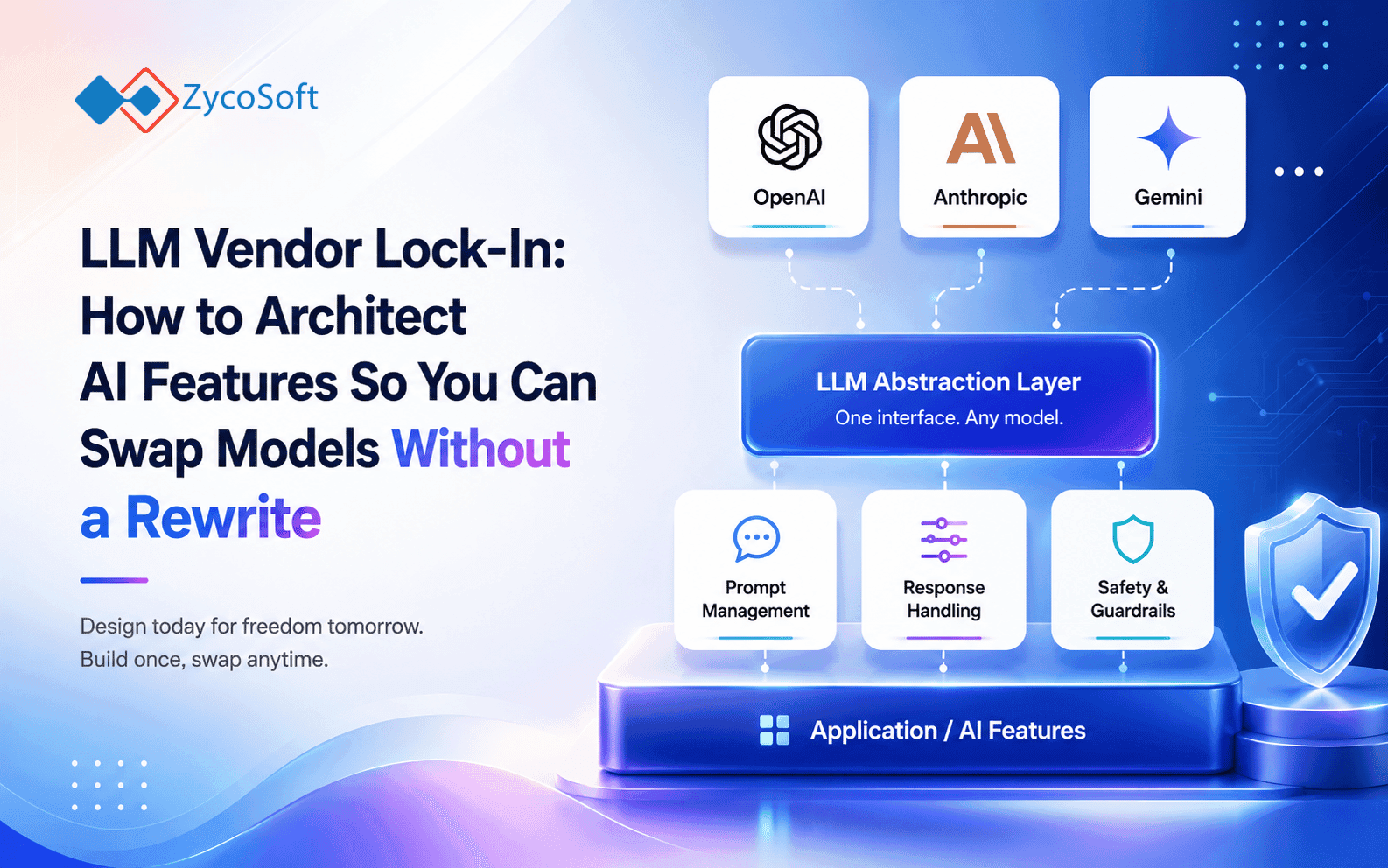
LLM Vendor Lock-In: How to Architect AI Features So You Can Swap Models Without a Rewrite.
The real LLM vendor lock-in problem is not that OpenAI and Anthropic use slightly different API formats. That is a one-hour adapter job. The harder problem is that most production AI stacks accumulate lock-in silently across five distinct layers, and engineering teams only discover it when a pricing change, a deprecation notice, or a capability gap forces a migration under pressure. By that point, what looked like a config change turns out to require a prompt rewrite, a re-embedding campaign, and a three-week eval rebuild.
This is the LLM vendor lock-in architecture problem that engineering leads are actually facing in 2026, and the patterns that prevent it are specific, implementable, and not particularly complex if you put them in place before the stack hardens.
Where Lock-In Actually Lives in a Production AI Stack
Lock-in occurs in five places. Most teams audit only the first one and consider the problem solved.
- SDK and client coupling. Your application code imports the OpenAI Python SDK directly, calls client.chat.completions.create() in twenty places, and handles the response object structure inline. Switching providers means touching every one of those call sites.
- Prompt layer tuning. Prompts written against GPT-4o's reasoning style, output formatting behaviour, and instruction-following conventions frequently produce degraded results against Claude or Gemini without significant reworking. The more carefully a prompt has been tuned to one model's behaviour, the less portable it is.
- Embedding pipeline dependencies. If you generate and store vector embeddings using a specific provider's model (OpenAI's text-embedding-3-large, for example), switching embedding providers requires re-embedding your entire corpus and repopulating your vector store. At scale, this is a multi-day operation with non-trivial cost and risk.
- Fine-tuned model weights. Fine-tuning conducted inside a vendor's platform (OpenAI fine-tuning jobs, for example) produces weights you cannot export or run elsewhere. The training data is portable; the resulting model artefact often is not.
- Eval datasets tied to vendor consoles. If your evaluation suite lives inside a vendor's platform (Braintrust, OpenAI Evals, or similar), migrating to a new model means rebuilding your eval infrastructure, not just your API client. This is the most underestimated migration cost.
Teams that focus exclusively on the API client and ignore the other four layers are building technical debt that compounds.
The most common failure modes in production AI systems follow exactly this pattern: invisible structural dependencies that only surface under operational pressure.
The Provider-Agnostic Client Interface Pattern:
The foundational mitigation for SDK coupling is a provider-agnostic client interface. The principle is straightforward: your application code should never import a vendor SDK directly. Instead, it calls an internal interface that you own, and that interface handles the provider-specific translation.
A minimal implementation looks like this in plain terms. Define an internal interface with a single method signature:
generate(prompt: str, model_config: ModelConfig) returns LLMResponse
The ModelConfig object carries provider name, model identifier, temperature, max tokens, and any other parameters. The LLMResponse object carries the completion text, token counts, and latency. Your application code depends only on these two types. Behind the interface, you write thin adapter classes: OpenAIAdapter, AnthropicAdapter, GeminiAdapter. Swapping providers means changing the ModelConfig value that gets passed in, not modifying application logic.
This pattern also makes it straightforward to run A/B tests across providers, which matters when you are evaluating a new model's performance on your specific workload before committing to a switch. Keep the interface stable, let the adapters evolve independently.
The AI Gateway Layer: When a Thin Abstraction Is Not Enough
A provider-agnostic client interface handles the coupling problem. An AI gateway layer handles the operational concerns that accumulate as soon as you are running more than one model or more than one request type in production.
An AI gateway sits between your application services and the provider APIs. Its responsibilities include:
- Provider-specific authentication and credential management.
- Request formatting and response normalisation across providers.
- Retry logic and fallback routing on provider errors or rate limits.
- Latency and cost logging at the per-request level.
- Model selection routing based on request metadata.
- Data-classification tagging for GDPR-sensitive requests (covered below):
Open-source options include LiteLLM, which provides a unified API across most major providers, and Portkey, which adds gateway features on top. If you are building a multi-model routing strategy, running these through a self-hosted gateway instance keeps your routing logic under your control rather than delegating it to a third-party service that itself becomes a dependency.
For teams at early MVP stage with a single model and no immediate routing requirements, a thin adapter class is sufficient. Introduce the full gateway when you have two or more distinct task types, when you are operating across multiple providers simultaneously, or when your cost structure demands granular per-request visibility. The architectural decision here follows the same logic as the monolith-first principle in SaaS architecture: do not build the gateway until the routing complexity justifies it, but design your adapter layer so the gateway can be introduced without touching application code.
Config-Driven Model Selection and Multi-Model Routing :
Config-driven model selection means that no model identifier is hardcoded in application logic. Every model reference resolves from configuration at runtime. A minimal config structure looks like this:
models: { classification: { provider: "anthropic", model: "claude-haiku-3-5", max_tokens: 256 }, summarisation: { provider: "openai", model: "gpt-4o-mini", max_tokens: 1024 }, reasoning: { provider: "openai", model: "gpt-4o", max_tokens: 4096 } }
Changing the model for any task type is a config file edit and a deployment. It does not touch code. This is the minimum bar for a model-portable AI stack, and it is also the foundation for multi-model routing.
Multi-model routing extends this by making model selection dynamic at runtime based on request attributes.
Common routing strategies include:
- Cost routing: Route short, simple requests to a cheaper model (Claude Haiku, GPT-4o mini, Gemini Flash) and reserve frontier models for requests that genuinely require them. A 60/40 split between cheap and frontier models on a production workload typically reduces inference costs by 40 to 60 percent without measurable quality degradation on the cheaper route.
- Capability routing: Route structured extraction tasks to models with strong JSON mode reliability, and open-ended generation tasks to models with stronger creative or reasoning capability.
- Fallback routing: On provider error, rate limit, or latency threshold breach, automatically route to a secondary provider. This requires your response normalisation layer to handle both providers transparently.
- Data-residency routing: For EU and UK SaaS products processing personal data under GDPR, route requests containing personal data only to providers operating under EU data processing agreements with EEA-resident infrastructure. This is not optional. Tag requests at the application layer with a data classification (personal, sensitive, or non-personal) and enforce routing rules in the gateway layer based on that tag.
The GDPR angle is material and often missed in US-centric architecture discussions. Building GDPR-compliant architecture from day one means your AI gateway must understand data classification, not just model capability and cost.
Embedding Portability and Eval Independence :
Embedding portability is a separate problem from LLM API portability and is typically harder to solve retrospectively. The key practice is to store, alongside every embedding vector in your vector database, the provider name and model version that produced it. This metadata makes incremental re-embedding feasible: you can re-embed new documents with the new model and run both indexes in parallel during a migration rather than doing a single high-risk cutover.
Abstracting your embedding generation behind its own interface (separate from your LLM completion interface) lets you swap embedding models independently of your completion models. These two concerns evolve at different rates and should not be conflated in your architecture.
For eval independence, the principle is simple: your evaluation datasets and scoring logic must live in your own infrastructure, not inside a vendor's console. Store eval cases as structured JSON in your own repository. Run scoring using provider-agnostic libraries. If your evals currently live inside OpenAI Evals, Braintrust, or a similar platform, treat that as a portability risk equivalent to SDK coupling. Migration is straightforward once you have decided to do it, but it needs to be a deliberate decision before you have accumulated thousands of vendor-locked eval cases.
Is Your Current AI Stack Already Locked In?
A Practical Audit Run through this checklist against your current codebase. Each "no" answer identifies a portability gap :
- Does your application code import vendor SDKs only through an internal adapter or interface layer, with no direct SDK imports in business logic? Yes / No
- Are all model identifiers and provider names resolved from configuration rather than hardcoded in application or pipeline code? Yes / No
- Do your prompt templates include explicit output format instructions that are not specific to one model's default formatting behaviour? Yes / No
- Does your embedding generation code record the provider name and model version alongside each stored vector? Yes / No
- Do your evaluation datasets and scoring scripts live in your own repository, runnable without a vendor console? Yes / No
- If you have fine-tuned a model, does your training data exist independently of the vendor platform where training was conducted? Yes / No
- For EU or UK products: does your gateway layer enforce data-residency routing rules for requests containing personal data? Yes / No
Four or more "no" answers indicates a stack with material lock-in risk. Two or three "no" answers is manageable but worth addressing in your next architecture sprint before the stack hardens further.
How ZycoSoft Approaches LLM Portability in Production AI Stacks :
The architectural patterns above are not theoretical. They emerge from building and maintaining production AI automation pipelines where model pricing, capability, and availability change faster than most engineering teams can react to if the architecture is not deliberately portable from the start.
ZycoSoft's AI automation practice builds end-to-end LLM integration pipelines, including n8n-based orchestration, agentic systems, and RAG-based retrieval architectures, with provider-agnostic client interfaces and AI gateway layers as a default, not an afterthought. In practice, this means clients can trial a new model against their specific workload in a staging environment, evaluate it using their own eval suite, and promote it to production through a config change rather than a deployment. We have run this process for clients switching between OpenAI and Anthropic, and for clients adding EU-hosted inference endpoints to meet GDPR data-residency requirements without restructuring their application logic.
On the custom SaaS development side, we treat model portability the same way we treat any other architectural longevity decision: the goal is to avoid the two failure modes we see most often, over-engineering an MVP with premature abstraction, and under-architecting a product that then cannot adapt when the underlying infrastructure changes. A thin adapter layer at MVP stage costs one engineer-day. Refactoring twenty direct SDK call sites across a production codebase, while simultaneously migrating an unlabelled embedding corpus, costs considerably more.
If your team is starting to feel pressure from model pricing changes or deprecation notices, the right time to audit your portability posture is before the next migration, not during it.
Talk to the ZycoSoft team about your AI stack architecture. We scope projects to preserve switching freedom from day one, and we can assess your current portability posture in a single technical conversation.
Frequently Asked Questions
LLM vendor lock-in occurs when your application becomes structurally dependent on a single model provider, making it costly or risky to switch. In 2026 this matters because model pricing changes, deprecations, and capability gaps are frequent. Gartner projects 60% of organisations will face a painful LLM migration by 2027. Lock-in now lives in your prompt layer, embedding pipeline, and eval datasets, not just your API client.
The core pattern is a provider-agnostic client interface that abstracts all model calls behind a stable internal API, combined with an AI gateway layer that handles routing, retries, and provider-specific formatting. Model selection is driven by configuration, not hardcoded logic. This means swapping from GPT-4o to Claude 3.5 or Gemini Pro requires a config change, not a code change. Prompt templates, embedding pipelines, and eval suites must also be maintained independently of any single provider.
Lock-in occurs in five places: direct SDK coupling in application code, prompts tuned to one model's reasoning behaviour and output format, embedding vectors tied to a single provider's model, fine-tuned model weights that live inside a vendor's platform, and eval datasets stored inside vendor consoles. Most teams focus only on the API client and miss the other four, which are typically harder to migrate than the client itself.
An AI gateway sits between your application logic and the model provider APIs. It handles provider-specific authentication, request formatting, response normalisation, retry logic, rate limiting, and routing decisions. If you are calling more than one model or anticipate switching providers, an AI gateway prevents those concerns from leaking into your application code. Open-source options include LiteLLM and Portkey. If you are at early MVP stage with a single model, a thin abstraction class is sufficient until routing complexity justifies a full gateway.
Embedding lock-in is more severe because it affects your stored data, not just your API calls. If you generate and store vector embeddings using OpenAI's text-embedding-3-large, switching to Cohere or a self-hosted model requires re-embedding your entire corpus and re-populating your vector database. This can be a multi-day operation at scale. The mitigation is to abstract embedding generation behind its own interface and track which model version produced each vector, so you can re-embed incrementally rather than in a single high-risk batch.
Multi-model routing means sending different requests to different models based on rules: cost, latency, capability, or data-residency constraints. For example, routing classification tasks to a smaller, cheaper model and complex reasoning tasks to a frontier model. Teams should implement routing when they have two or more distinct task types with materially different cost or quality requirements, or when GDPR data-residency rules require EU-hosted inference for certain request types. Routing without an AI gateway layer typically produces unmaintainable conditional logic scattered across services.
GDPR requires that personal data processed by an LLM is handled under an adequate legal basis, with data-residency constraints applying when providers route requests through non-EEA infrastructure. This affects which providers you can use for features that process user personal data. EU-hosted inference options (Azure OpenAI in EU regions, Mistral on EU infrastructure, self-hosted open-weight models) give you data-residency control. Your AI gateway routing layer should include a data-classification tag on each request so that requests containing personal data are routed only to compliant endpoints.