
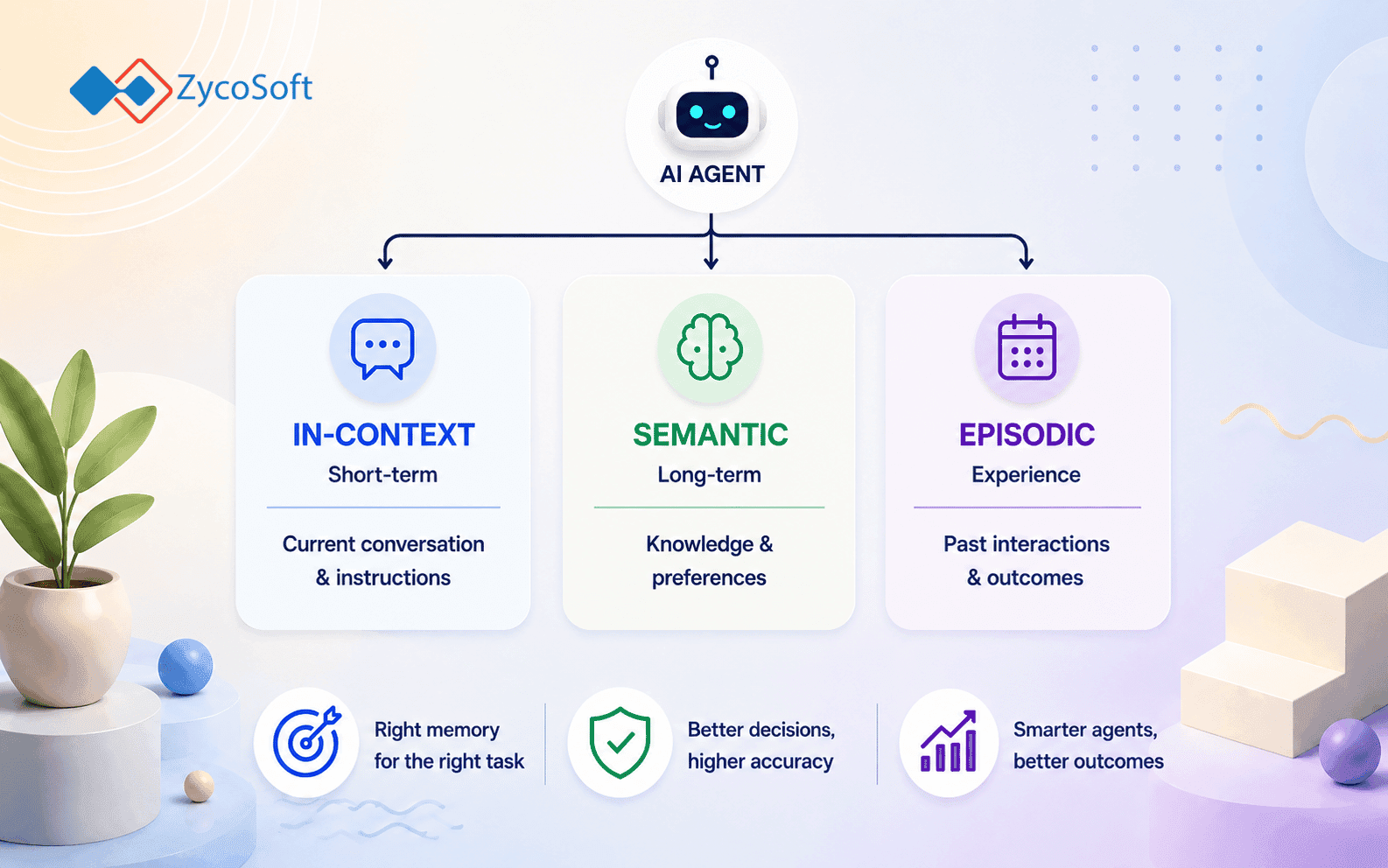
AI Agent Memory Architecture for Production: How to Choose Between In-Context, Semantic, and Episodic Memory Tiers
The statelessness problem in production AI agents is not subtle. Your prototype worked because every test session started fresh. In production, users return, context accumulates, and the agent that cannot remember yesterday's conversation is actively worse than a search bar. The question engineering leads face in 2026 is not whether to add memory, but which tier to reach for first and what each one costs you in latency, storage, retrieval complexity, and GDPR exposure.
This post gives you a practitioner decision framework across the three tiers that matter in production deployments: the in-context buffer, vector-backed semantic memory, and persistent episodic memory. It also covers the real trade-offs in the four frameworks that have moved from experiment to production this year: Mem0, Zep, Letta, and LangMem.
Why In-Context Memory Is Always Your First Layer:
In-context memory is the token window the model processes during a single inference call. It requires no retrieval infrastructure, adds zero latency overhead, and is the only memory tier with perfect recall within its bounds. For many production agents, it is the only tier you need.
The boundary condition is straightforward: when a conversation or task fits inside your model's context window without truncation, in-context memory is both sufficient and optimal. A GPT-4o session with a 128k token window can hold roughly 90,000 to 100,000 words of conversation history. Most single-session support agents, code assistants, and structured data tasks never breach that limit.
The failure mode arrives when you try to stretch in-context memory across sessions, or when you stuff retrieval results so aggressively into the prompt that the model's attention degrades on the content that actually matters. Context window engineering is where most teams hit their first production scaling wall, and it is the trigger that should push you to evaluate the next tier, not a premature architectural decision made during prototyping.
Vector-Backed Semantic Memory: When and How to Layer It
Semantic memory gives your agent access to facts, knowledge, and prior context that would not fit in a single token window, retrieved by similarity search at inference time. It is the right tier to add when your agent needs cross-session recall of factual content: user preferences, product knowledge, document corpora, or prior decisions.
The retrieval pattern is: embed the current query, search a vector store for semantically similar stored content, inject the top-k results into the in-context prompt, and proceed with inference. A well-configured retrieval call against Pinecone, Qdrant, or pgvector adds approximately 20 to 80 milliseconds at production scale for indexed collections under a few million vectors. That is acceptable for most agent workflows.
The hidden costs are less obvious:
- Embedding generation adds latency on the write path, typically 5 to 30 milliseconds per chunk depending on model and batch size.
- Retrieval accuracy degrades with poorly chunked documents or mismatched embedding models. A vector store is only as good as the pipeline that populates it.
- Top-k retrieval does not guarantee relevance. Hallucinated context injected from a bad retrieval is worse than no retrieval at all.
- Storage costs scale with embedding dimensionality and collection size. A 1536-dimension OpenAI embedding for one million chunks costs roughly 6 GB of dense vector storage before indexing overhead.
For teams building semantic memory into a production agent, the most important architectural decision is to keep the memory interface decoupled from the vector backend. Write an abstraction layer that exposes search, upsert, and delete operations. This lets you swap from pgvector (cheap, co-located with your Postgres database) to a dedicated vector store like Qdrant when scale requires it, without rewriting agent logic. This is the kind of architectural separation that prevents expensive rewrites at the six-month mark.
Episodic Memory: The Tier You Should Add Last, and Why
Episodic memory is a structured, time-stamped log of past interactions that lets an agent reason about the sequence and context of prior events, not just retrieve relevant facts. It is the right choice when your agent needs to answer questions like "what did this user ask for last Tuesday" or "what was the outcome of the last three support escalations for this account".
Episodic stores are typically implemented as structured databases (relational or document stores) with temporal indexing, sometimes augmented with a graph layer for relationship tracking. Retrieval is either time-bounded (give me the last N sessions for this user), query-driven (find all sessions where the user mentioned billing), or graph-traversal-based (find sessions connected to a specific entity).
The GDPR exposure here is significant, particularly for UK and EU deployments. Episodic memory stores contain personal data tied to identifiable users across timestamped interactions.
This triggers:
- Article 13/14: Transparency obligations. Users must be told their interactions are stored and for how long.
- Article 17: Right to erasure. You need a per-user deletion mechanism that propagates through every layer of the episodic store, including any cached or derived representations.
- Article 5(1)(e): Storage limitation. You must define a retention period and enforce it programmatically, not just as a policy document.
Most open-source episodic memory implementations do not handle this by default. If you are building for EU or UK users, you need to architect erasure support before you go to production, not after. Building GDPR-compliant architecture from the start is significantly cheaper than retrofitting deletion pipelines into a live memory store.
Framework Comparison: Mem0, Zep, Letta, and LangMem
The four frameworks that have reached production maturity in 2026 each make a different trade-off between integration speed, control, and compliance flexibility.
Here is the honest comparison:
- Mem0: Managed API with automatic memory extraction from conversation history. Fastest integration path, typically two to three days to working prototype. The trade-off is vendor dependency, data leaving your infrastructure, and limited control over what gets stored. Not appropriate for EU/UK deployments without a Data Processing Agreement and careful scope review.
- Zep: Self-hostable, with strong session management, temporal context, and built-in user-level data deletion. The best default choice for UK and EU teams who need episodic and semantic memory with GDPR compliance as a first-class concern. Adds operational overhead to run, but that overhead is worth it for regulated use cases.
- Letta (formerly MemGPT): Treats memory as an OS-level abstraction with in-context paging, giving the agent itself control over what moves in and out of active memory. Suited for complex, long-horizon agents with hierarchical memory needs. Higher implementation complexity, not the right starting point for most production teams.
- LangMem: Native to the LangChain ecosystem. Lowest friction if your agent stack is already LangChain-based, but carries framework lock-in risk. If LangChain's memory abstractions shift (and they have done, repeatedly), your memory layer moves with them.
The general recommendation: start with Zep if you need self-hosted persistence with GDPR compliance. Use Mem0 only if you are in a US-only context, have reviewed the data processing implications, and need to ship in days rather than weeks. Avoid LangMem unless you are deeply committed to the LangChain stack and have accepted that dependency.
The Decision Matrix: Which Tier to Implement First
The right memory tier is determined by your agent's session pattern, retrieval requirements, and compliance obligations. Work through this in order:
- Does your agent complete its task within a single session? If yes, in-context memory alone is sufficient. Add semantic or episodic tiers only when production logs show retrieval gaps.
- Does your agent need to recall facts or preferences across sessions, but not the sequence of past interactions? Add semantic memory with a vector store. Start with pgvector if you already run Postgres. Migrate to a dedicated store when collection size or query volume demands it.
- Does your agent need to reconstruct the history of past interactions in sequence, or do users expect the agent to remember what they asked last week? Add episodic memory. Choose Zep for self-hosted GDPR-compliant deployments. Define your retention period and erasure mechanism before writing the first record.
- Does your agent operate across multiple users in a multi-tenant SaaS product? All memory tiers must implement tenant isolation at the storage layer. This is not an optional concern, and it is worth reading how agent failure modes in production often trace back to missing isolation boundaries.
- Are you evaluating a framework for long-term use? Separate your memory interface from the framework implementation on day one. A thin abstraction layer (search, upsert, delete) costs a day to write and saves weeks of migration work later.
A minimal interface in plain text terms looks like this: define a MemoryStore class with three methods: search(query, user_id, top_k), upsert(content, user_id, metadata), and delete(user_id). The underlying implementation calls Zep, Mem0, or a raw vector store. Your agent logic never imports the framework directly. When you need to switch, you change one file.
How ZycoSoft Approaches Memory Architecture in Production AI Pipelines
Memory architecture is where most AI agent projects stall between prototype and production. The prototype worked with a flat prompt. The production system needs retrieval, persistence, multi-user isolation, and in EU and UK deployments, a defensible GDPR position before a single user record is written.
At ZycoSoft, our AI automation work covers end-to-end workflow automation using LLMs and custom AI pipelines, including production deployments with n8n, agentic systems, and RAG-based architectures. We have shipped agents with all three memory tiers in live production environments, and the pattern we follow is consistent: in-context first, semantic memory when retrieval gaps appear in logs, and episodic memory only when the use case explicitly requires interaction history and the GDPR obligations have been designed in from the start.
We also build the memory abstraction layer as a first-class component, not an afterthought. That means framework decisions are reversible and storage backends can be swapped as scale or compliance requirements evolve. For UK and EU clients, GDPR-compliant architecture is part of the technical design, not a checkbox after launch. For US clients, we scope the memory tier decisions against the actual retrieval requirements rather than adding all three layers because they exist.
If you are an engineering lead or CTO who has shipped a prototype and is now designing the production memory system, the scoping conversation is the most valuable hour you can spend before writing any framework-specific code. Getting observability in place before you ship is equally important: you cannot tune a memory retrieval system you cannot measure.
If you want a direct technical conversation about your agent's memory architecture, including which tier to implement first and how to handle GDPR obligations in your specific deployment context, get in touch with the team at zycosoft.com/contact.
Frequently Asked Questions
In-context memory is the live token window the LLM processes during a single session. Semantic memory is a vector-backed store of facts and knowledge retrieved by similarity search across sessions. Episodic memory is a structured, time-stamped record of past interactions or events. Each tier serves a different retrieval pattern and carries different latency, cost, and compliance implications.
Use episodic memory when your agent needs to reconstruct the sequence of past interactions, not just retrieve relevant facts. Typical triggers include multi-session personalisation, audit trail requirements, and scenarios where the order of events changes the correct response. Episodic stores add retrieval latency and GDPR data-retention obligations that semantic stores do not, so only add this tier when the use case explicitly requires it.
Episodic memory stores contain personal data tied to identifiable users and timestamped interactions. Under UK GDPR and EU GDPR, this triggers Article 13/14 transparency obligations, Article 17 right-to-erasure requirements, and Article 5(1)(e) storage-limitation principles. Most open-source memory frameworks do not implement per-user deletion by default. You need a data-retention policy, a purge mechanism, and a lawful basis for processing before deploying episodic memory in production for EU or UK users.
Mem0 offers a managed API with automatic memory extraction and cross-session retrieval, best for teams who want fast integration but accept vendor dependency. Zep is self-hostable with strong temporal context and session management, better for EU/UK GDPR compliance. Letta (formerly MemGPT) treats memory as an OS-level abstraction with in-context paging, suited for research-grade or complex hierarchical agents. LangMem is LangChain-native and easiest if you are already in that ecosystem, but carries framework lock-in risk.
A well-optimised semantic retrieval call against a vector store such as Pinecone, Qdrant, or pgvector typically adds 20 to 80 milliseconds per query at production scale, assuming indexed collections under a few million vectors. Retrieval latency rises with collection size, embedding dimensionality, and network round-trips to a hosted store. For latency-sensitive agents, run the vector store close to your inference endpoint and cap retrieved chunks to avoid compounding context-window costs downstream.
Use an existing framework if your team is still characterising retrieval patterns in production. Build a custom layer only when you have specific retrieval logic, compliance requirements, or multi-tenant isolation needs that off-the-shelf frameworks cannot satisfy cleanly. The more common mistake is building a custom layer prematurely. Start with the thinnest abstraction that separates your agent logic from the memory backend, then swap implementations as requirements sharpen.