
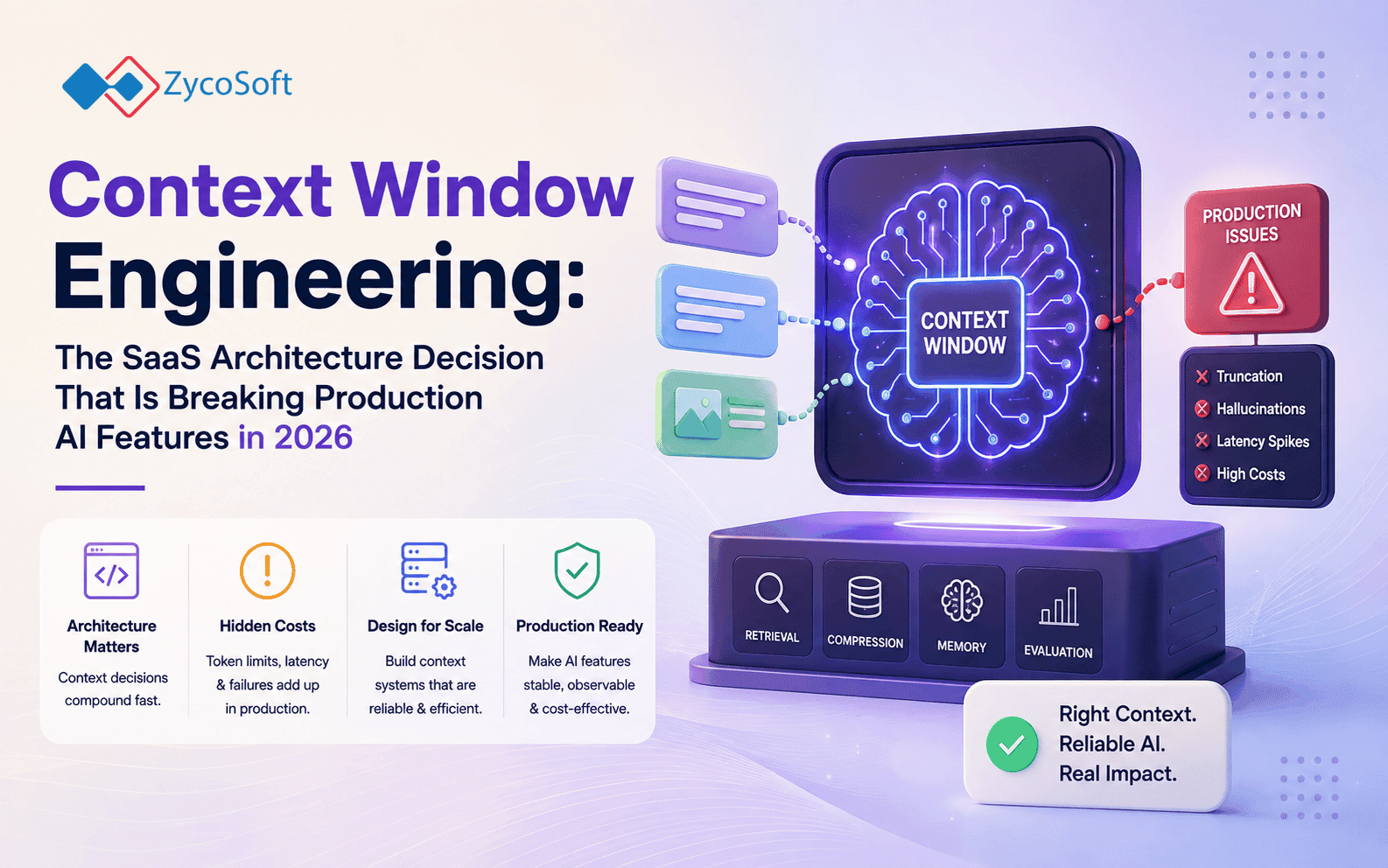
Context Window Engineering: The SaaS Architecture Decision That Is Breaking Production AI Features in 2026.
Growth-stage SaaS teams are shipping LLM-powered features faster than at any point in the industry's history, and a significant number of them are discovering the same failure mode three to six months after launch. The AI feature works in demos. It degrades in production. Users get hallucinated answers, truncated outputs, or responses that ignore the most relevant part of their query. The cause, in the majority of cases, is not the model. It is how the product was architected to manage context.
Context window engineering is not an LLM research problem. It is a product architecture decision that must be made before development starts. Founders and CTOs who treat it as a detail to be handled by the engineering team during sprint work are the ones facing expensive rewrites when their product reaches scale. This post sets out the decisions you need to make upfront and the failure patterns that result when you do not.
Why Context Window Mismanagement Causes Silent Failures at Scale.
The core problem is that LLMs do not fail the way deterministic software fails. A broken database query raises an exception. An LLM given incomplete or misaligned context returns a confident, fluent, plausible-sounding response that is simply wrong. No error log. No stack trace. No alert fires. Your monitoring dashboard stays green while your users receive subtly incorrect information.
This failure pattern is compounded by the fact that most SaaS teams build and test AI features against short, clean, single-turn inputs. In production, users submit long queries, resume incomplete sessions, reference earlier conversation turns, and operate on messy, real-world data. The context your model receives in production bears little resemblance to the context it received during QA, and the gap between the two is where failures live.
The practical result is a class of bugs that are statistically significant but individually invisible. A US B2B SaaS product serving 10,000 active users, where 3% of AI responses are subtly incorrect, generates 300 bad answers per day. Most users will not report them. A few will churn quietly. None of this surfaces as a production incident under standard monitoring. This is why AI feature architecture for SaaS products must address output validation and fallback behaviour from day one, not as an afterthought.
The Chunking Decision: Where RAG Pipelines Break Before They Start
Retrieval-augmented generation is now the dominant architecture for knowledge-intensive AI features in SaaS products. The premise is straightforward: retrieve the most relevant segments of your data, inject them into the prompt, and let the model reason over grounded context rather than its training weights. In practice, the retrieval quality determines the output quality, and retrieval quality starts with how you chunk your data.
Fixed-Size vs Semantic vs Hierarchical Chunking :
Most teams default to fixed-size chunking because it is the simplest to implement. Split documents into 512-token or 1,024-token blocks, embed them, store them in a vector database. This works at low volume and degrades visibly at scale, because fixed-size splits routinely cut across sentence and paragraph boundaries, destroying the semantic continuity that makes a chunk useful for retrieval.
The three chunking strategies you should evaluate before committing to a schema are:
- Fixed-size chunking: fast to implement, low retrieval precision, breaks semantic meaning at boundaries.
- Semantic chunking: splits on paragraph or section breaks, preserves meaning, requires more preprocessing but significantly improves retrieval accuracy.
- Hierarchical chunking: stores both summary-level and detail-level representations, allowing the retrieval layer to match at the right granularity depending on query type.
The right choice depends on your data structure and query patterns. A SaaS product built around long-form legal documents has different requirements from one built around structured CRM records. Define your primary query types before you design your chunking strategy, and test at least two approaches against real user queries before locking your embedding store schema. Changing chunking strategy after you have indexed millions of documents is a material engineering effort.
Stateful vs Stateless Session Design: The Decision Most Teams Get Wrong
LLM APIs are stateless by default. Each API call is independent. The model has no memory of prior interactions unless you explicitly pass prior context in the prompt. This is a sensible default for the API layer. It is a catastrophic default for multi-step SaaS workflows if your product architecture does not account for it.
The question of whether your AI feature requires stateful session management is a product decision, not an engineering preference. If your feature involves a single, bounded task (summarise this document, classify this record, extract these fields), stateless design is appropriate and simpler to operate. If your feature involves multi-turn interaction, progressive refinement, or any scenario where a user's earlier input should influence a later response, you need an explicit session memory strategy.
How to Design Session Memory Without Ballooning Token Costs :
The naive approach is to append the full conversation history to every subsequent prompt. This works for short sessions and becomes expensive and eventually impossible as sessions grow. Token costs scale linearly and context windows, however large, have limits. The production-grade approaches are:
- Sliding window memory: retain only the last N turns of conversation, dropping older turns beyond a defined threshold
- Summarised memory: periodically compress earlier conversation turns into a summary that preserves intent without retaining verbatim text
- Entity-extracted memory: identify and persist only the structured facts established in prior turns (user preferences, confirmed parameters, referenced entities) rather than the raw conversation
- Hybrid RAG-plus-summary: combine a retrieved context layer with a compressed session summary, so the model has both relevant knowledge and conversational continuity
The architecture you choose needs to be defined before your engineers write a single session management function. Retrofitting session memory into a stateless integration is one of the most common causes of the rewrites we see at Series A, and it is entirely avoidable. Teams who are restructuring their engineering processes around agentic AI workflows are finding that session state design is one of the first decisions that needs to be formalised at the architecture level.
Context Budget Management: Treating Token Limits as a First-Class Constraint
Every LLM call has a context budget: the total number of tokens available for your system prompt, retrieved chunks, conversation history, user input, and model output combined. Most teams discover they are over-budget not during architecture review but when a production request returns a truncated response or a 400 error at 2am on a Tuesday.
Define your context budget explicitly before development starts. A practical framework for allocating tokens across a single inference call looks like this:
- System prompt and instructions: 10-15% of total budget
- Retrieved context (RAG chunks): 40-50% of total budget
- Session memory or conversation history: 15-20% of total budget
- User input: 10-15% of total budget
- Reserved for model output: 15-20% of total budget
These allocations will vary by feature type, but the discipline of defining them upfront forces your product and engineering teams to make explicit trade-offs rather than discovering implicit ones in production. It also enables you to build a prompt construction layer that is testable, observable, and adjustable without touching application logic. This is the foundation of maintainable AI feature architecture for SaaS products.
Model abstraction deserves equal attention here. SaaS products that hard-code a specific LLM provider into their application logic create a dependency that is painful to change. Building a thin abstraction layer that separates prompt construction and context management from the underlying model call means you can switch providers, adjust to new context window sizes, or run model comparisons without rewriting your product. Given how rapidly model capabilities are shifting this year, that flexibility is not optional.
Why Getting This Wrong at MVP Stage Creates Rewrites at Series A :
The economics of context window mismanagement follow a predictable curve. At MVP stage, the failure modes are hidden: user volumes are low, sessions are short, and the edge cases that expose architectural weaknesses have not yet occurred. The product feels stable. The AI feature gets included in the pitch deck.
Between MVP and Series A, usage scales. Session lengths increase. Power users push the product in directions no one anticipated. Token costs grow faster than revenue. The retrieval layer starts returning irrelevant chunks as the data volume increases beyond what the original chunking strategy was designed for. The engineering team patches each failure individually, and the LLM integration becomes a tangle of conditional logic that nobody fully understands.
By the time a Series A investor asks about AI feature reliability and cost per query, the honest answer is that neither number is known with confidence. The rewrite is not a technical failure. It is the consequence of treating context window management for LLMs in production as an implementation detail rather than an architecture decision. Teams who choose a tech stack and product architecture designed to scale without a rewrite understand that AI integration is no different: the structural decisions made at week two determine what is possible at month eighteen.
The good news is that none of this requires solving research-level problems. It requires asking the right questions before development starts: What is the maximum context budget per request? How will session memory be managed? What chunking strategy fits our data model? What output validation layer will catch silent failures? What does the model abstraction layer look like? These are product architecture questions, and they have clear, implementable answers if they are asked at the right moment in the development lifecycle. That moment is before the first sprint, not after the first customer complaint.
If you are building AI-native features into a SaaS product and want an architecture review before development begins, speak to the ZycoSoft team directly. We have delivered production AI automation systems and custom SaaS platforms where context design was treated as a first-class requirement from day one.
Frequently Asked Questions
Context window engineering refers to the deliberate architectural decisions that control what information is passed to a large language model during each inference call. In SaaS products, this includes chunking strategies, retrieval logic, session memory design, and prompt construction. Getting these decisions wrong causes hallucinations, silent failures, and inconsistent UX at scale, problems that are expensive to fix after launch.
Silent failures occur when an LLM receives incomplete or misaligned context and returns a plausible-sounding but incorrect response without throwing an error. Because LLMs do not raise exceptions the way deterministic code does, SaaS products need explicit output validation, confidence scoring, and fallback logic built into the architecture. Most MVP builds skip these layers entirely, which is why failures only surface at scale.
A stateless LLM session passes only the current request to the model, with no memory of prior interactions. A stateful session preserves conversation history or user context across multiple turns. Most LLM APIs are stateless by default, so SaaS products that need multi-step AI workflows must engineer session memory explicitly, either through a managed context store or a retrieval-augmented design that reconstructs relevant history on each call.
Use retrieval-augmented generation when your product operates on a large or dynamic knowledge base that cannot fit within a single context window, or when precision and source traceability matter to your users. RAG reduces hallucination risk by grounding model outputs in retrieved documents. A large context window is preferable for shorter, bounded tasks where latency and simplicity outweigh retrieval overhead, but it becomes impractical and costly at scale.
The right chunking strategy depends on your data structure and query patterns. Fixed-size chunking is simple but breaks semantic continuity. Semantic chunking, splitting on paragraph or section boundaries, preserves meaning and improves retrieval accuracy. Hierarchical chunking stores both summary and detail levels, allowing your retrieval layer to match at the right granularity. SaaS teams should test at least two strategies against real user queries before committing to an embedding store schema.
When context handling is not architected before development starts, it gets patched incrementally as edge cases surface. By Series A, the LLM integration is typically woven into application logic without clear separation, making it resistant to model upgrades, provider changes, or scaling adjustments. Rewrites become necessary not because the core product is wrong but because the AI layer was never designed to be maintainable, testable, or independent of the surrounding application.
Before integrating any LLM into a production feature, a CTO should define the maximum context budget per request, the session memory strategy, the retrieval architecture if the feature is knowledge-intensive, the output validation and fallback behaviour, the observability layer for prompt and response logging, and the model abstraction layer that allows provider switching without application rewrites. These decisions should be documented before development begins, not inferred from vendor documentation.