
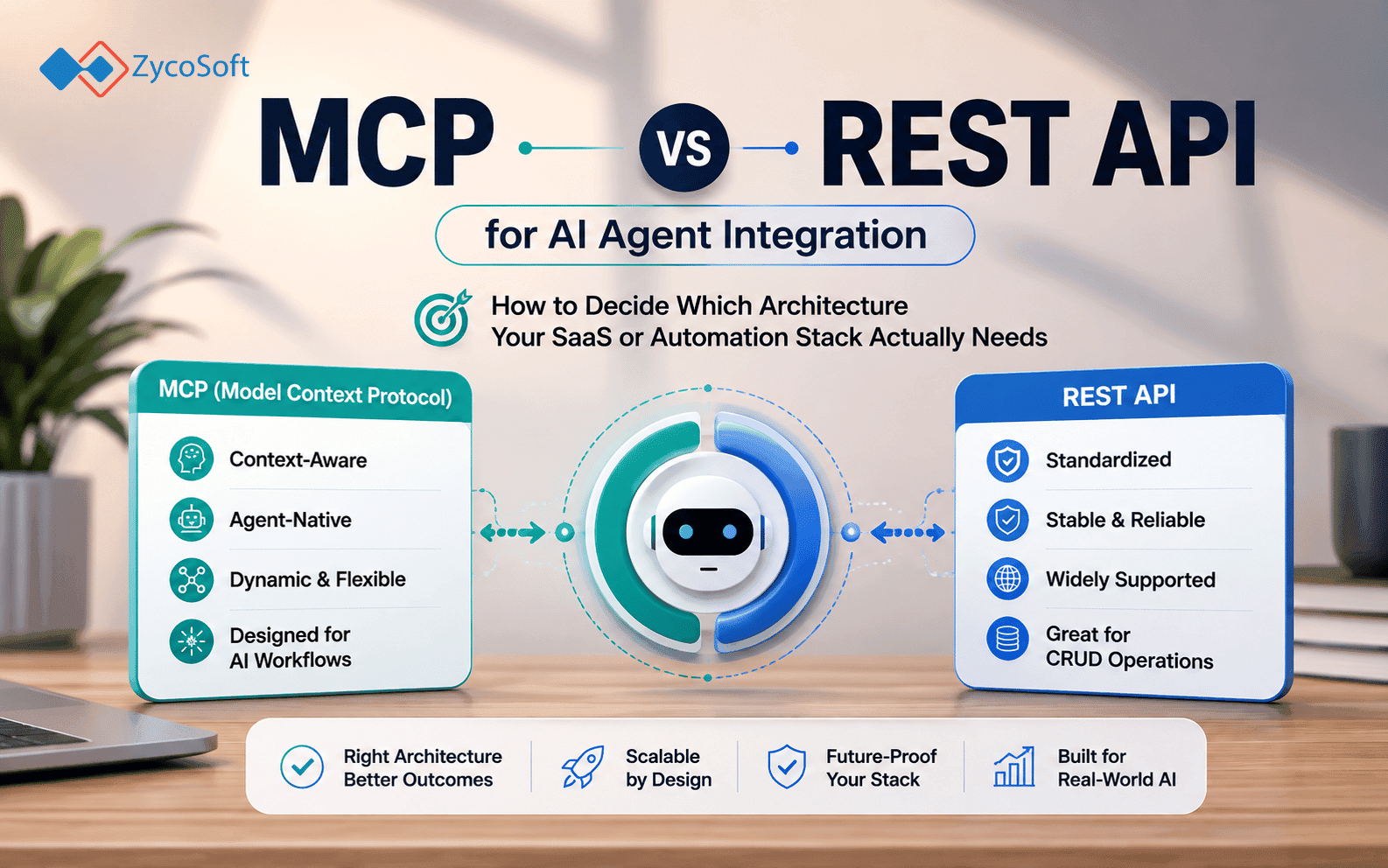
MCP vs REST API for AI Agent Integration: How to Decide Which Architecture Your SaaS or Automation Stack Actually Needs.
The question landing on engineering leads' desks in 2026 is not whether to build AI features. It is which protocol layer those features should sit behind. Model Context Protocol (MCP) reached a significant specification milestone on 26 July 2026, adding stateless architecture, Amazon Bedrock AgentCore support, and the AWS Tasks extension. SDK downloads hit 97 million per month by March 2026, a 970x increase from launch. And yet 41% of software organisations now in some stage of production deployment are still making the same architecture mistake: treating MCP vs REST API AI agent integration as an either-or choice rather than a use-case routing decision.
This piece maps each approach to the scenarios where it genuinely belongs, gives you a decision framework, and explains the trade-offs that matter at the CTO or engineering lead level: latency, governance, agent discovery, and maintenance overhead.
What MCP Actually Does (and Does Not Replace):
MCP is a standardised protocol that lets an LLM or autonomous agent discover what tools are available, understand what each tool does, and invoke it at runtime without bespoke integration code. Think of it as a structured conversation layer between an AI model and your services, where the model can ask "what can you do?" and receive a machine-readable answer it can act on.
REST APIs do not offer that. A REST API assumes the calling application already knows which endpoint to hit, what parameters to send, and how to interpret the response. That assumption is completely reasonable when the caller is a human-facing frontend, a mobile app, or a deterministic backend service. It breaks down when the caller is an LLM that needs to make a runtime decision about which tool to use, in what order, and why.
What MCP does not do is replace general API communication. It does not improve latency. It does not simplify authentication for human users. It does not solve webhook delivery, rate limiting for third-party consumers, or any of the integration patterns your existing REST layer already handles. Understanding this boundary is the starting point for every architecture decision in this space.
The Core Decision: Who Is Calling Your Service?
The single most important question in MCP vs REST API AI agent integration is not about the protocol. It is about the consumer. Every other consideration follows from this.
If the caller is a human application (a frontend, a mobile client, another SaaS product, a webhook consumer), REST is the correct default. It is well-understood, has mature tooling across every language and framework, and the operational patterns for security, versioning, and monitoring are settled.
If the caller is an LLM or an autonomous agent that needs to make runtime decisions about which tools to invoke, MCP reduces the amount of bespoke glue code your team writes and maintains. Without MCP, every new tool an agent needs access to requires a custom wrapper, a prompt-engineering description of what the tool does, and often a fragile JSON schema the model must interpret correctly. MCP standardises that contract.
A practical way to route this decision is to ask three questions before committing to either protocol:
- Is the primary consumer of this integration an AI model or a human-facing application?
- Does the consumer need to discover available tools dynamically, or does it know at build time which endpoints it will call?
- Is the call sequence determined by an LLM at runtime, or is it hardcoded in application logic?
If your answers are "AI model," "dynamically," and "LLM at runtime," MCP belongs in your stack. If any answer points toward a deterministic caller, stay with REST for that integration path.
When REST API Is the Right Choice
REST remains the right default for the majority of integrations most SaaS products need to support. It is not a legacy choice. It is the appropriate protocol for deterministic, latency-sensitive, or human-driven integration patterns.
Concrete scenarios where REST is correct:
- Frontend applications fetching and submitting data, where the call sequence is defined by UI interactions -
- Third-party integrations where external partners need predictable, versioned endpoints.
- Webhook delivery and event-driven notification patterns.
- Mobile clients where bandwidth efficiency and predictable response shapes matter.
- Payment and financial workflows (Stripe, Mollie, Razorpay) where the call sequence must be deterministic and fully auditable.
- Any integration where GDPR compliance or financial regulation requires a clear, logged, deterministic call chain.
- Latency is also a practical consideration.
MCP adds a negotiation step: the agent queries available tools before it calls one. For high-frequency, time-sensitive operations, that overhead matters. A checkout flow, a real-time pricing call, or a fraud check should not route through an MCP layer.
When MCP Is the Right Choice:
MCP becomes the correct architectural choice when your integration consumer is an agent that makes runtime decisions. The July 2026 specification update makes this clearer in production terms, because stateless MCP architecture resolves one of the earlier operational objections: you no longer need to maintain server-side session state across agent calls.
Scenarios where MCP delivers genuine value:
- Multi-step agentic workflows where an LLM decides at runtime which internal services to query and in what order.
- RAG-based systems where the agent selects context sources dynamically based on the query
- AI assistant products (internal or customer-facing) that need to call business tools without a hardcoded menu of API calls in the prompt.
- Automation pipelines built in tools like n8n where an LLM node needs to discover and call downstream services without a custom integration for each one.
- Products exposed to Amazon Bedrock AgentCore or similar managed agent runtimes, where MCP is now the first-party integration contract.
If you are building vertical AI agents rather than traditional SaaS workflows, MCP is likely the right integration layer for the tool-calling surface of those agents. The question is whether you have confirmed that agentic use case before you start building the protocol layer.
The Hybrid Architecture: When You Need Both
Most production architectures in 2026 run both REST and MCP, and this is not a compromise. It is a deliberate separation of concerns. REST serves conventional integrations; an MCP server exposes a curated subset of your capabilities to AI agents and LLM-powered workflows.
A realistic hybrid layout for a SaaS product looks like this:
- Your core REST API remains the integration surface for frontends, mobile clients, and third-party partners.
- An MCP server sits alongside (not on top of) the REST layer, exposing only the tools relevant to agent consumption.
- The MCP server calls your existing internal services, so you are not duplicating business logic.
- Governance, audit logging, and access control are applied at both layers independently.
The governance point deserves attention. When an LLM decides at runtime which tools to invoke and in what sequence, your standard API audit logs may not capture the full decision chain. You need agent-aware logging that records which model made a decision and why, not just which endpoint was called. This is especially relevant for UK and EU products subject to GDPR, and for UAE financial services firms operating under Central Bank AI governance frameworks. Building GDPR-compliant architecture from day one matters as much for your MCP layer as it does for your REST layer.
Maintenance overhead in a hybrid architecture is real but manageable. The risk is treating the MCP layer as a second REST API and duplicating endpoint logic. The correct approach is to build MCP as a thin invocation and discovery layer over existing internal services, not as a parallel API surface.
The Decision Framework: Five Criteria That Determine Your Protocol Choice
Before committing to MCP, REST, or a hybrid layer, work through these five criteria in order:
- Consumer type. Is the integration consumer an AI agent or a human application? Agents point toward MCP. Human applications point toward REST.
- Discovery requirement. Does the consumer need to discover available tools at runtime, or does it know what to call at build time? Runtime discovery points toward MCP.
- Latency sensitivity. Is this a real-time, user-facing operation? High latency sensitivity points toward REST. Async agent workflows tolerate MCP negotiation overhead.
- Governance and auditability. Do you need deterministic, per-call audit trails for regulatory compliance? If yes, REST is easier to govern. MCP requires additional agent-aware logging to meet the same standard.
- Team familiarity and operational maturity. MCP tooling is maturing fast but is not yet as operationally settled as REST. If your team has no prior exposure to MCP server architecture, factor in the ramp-up cost before committing to it for a production launch.
If criteria one and two point toward MCP but criteria four and five point toward REST, the answer is almost always a hybrid architecture with a governance layer applied explicitly to the MCP surface.
How ZycoSoft Architects This Decision:
The MCP vs REST API AI agent integration decision is one we make at the architecture stage of every AI automation and custom SaaS engagement, before a single line of code is written. The cost of getting this wrong is not a refactor. It is a rebuild of your integration layer six months after launch, when your agent use case has evolved and your REST-only or MCP-only layer cannot support it.
Our approach to AI automation, which spans end-to-end LLM pipeline design, agentic workflow architecture using tools like n8n, and RAG-based systems in production, starts with the consumer type question above. Understanding what is genuinely different about AI agents versus traditional workflow automation determines whether your integration layer needs MCP at all, and if it does, how narrow or broad that MCP surface should be.
On the custom SaaS side, we apply the same principle we use across our full product lifecycle: avoid over-engineering an MVP with protocol layers it does not need yet, and avoid under-architecting a product that will need to expose tool-calling surfaces to agents within twelve months. That means scoping MCP adoption to confirmed agentic use cases, building the REST API in a shape that an MCP layer can wrap without duplication, and applying GDPR-compliant audit logging at both surfaces from the start. That last capability is rare in the agency market and directly relevant to UK, EU, and UAE clients operating under data governance frameworks that are increasingly extending to AI decision trails.
If you are at the point where your engineering team is debating this architecture and you want a senior-level view before committing, that is exactly the conversation we have at the start of an engagement.
Frequently Asked Questions
MCP gives LLMs a standardised way to discover what tools are available, understand their inputs and outputs, and invoke them at runtime without bespoke integration code for each tool. REST APIs require the calling application to know in advance exactly what endpoints exist and how to call them. MCP shifts that knowledge into the protocol itself, which matters when an autonomous agent is deciding which tool to use dynamically.
Use MCP when your primary integration consumer is an LLM or autonomous agent that needs to discover and call tools dynamically at runtime. Concrete cases include multi-step agentic workflows, RAG-augmented pipelines where the agent selects context sources, and internal tooling exposed to AI assistants. If the caller is always a deterministic application or a human-facing frontend, REST is simpler, faster, and requires less infrastructure.
No. MCP and REST APIs address different integration layers. REST remains the correct protocol for user-facing frontends, third-party webhooks, mobile clients, and any integration where the caller is a human application rather than an AI agent. Most production architectures in 2026 run both: REST for conventional integrations and an MCP server layer that exposes a subset of capabilities to AI agents and LLM-powered workflows.
The main risks are premature complexity and maintenance overhead. Building an MCP server before you have a confirmed agentic use case means maintaining an additional protocol layer with no clear beneficiary. The MCP specification also matured relatively recently, meaning tooling, developer familiarity, and operational patterns are still evolving. Organisations that adopt it before their agent architecture is defined often rebuild the integration layer within twelve months.
The July 2026 specification introduced stateless MCP architecture, Amazon Bedrock AgentCore support, and the AWS Tasks extension. These changes directly address two blockers that slowed enterprise adoption: session state management overhead and the absence of first-party support from major cloud AI platforms. With Bedrock support confirmed, MCP is now viable infrastructure for enterprise AI agent integration rather than an experimental protocol.
MCP introduces governance complexity that REST does not have by default. When an LLM decides at runtime which tools to invoke and in what sequence, your standard API rate limiting, audit logging, and access control patterns may not capture the full call chain. You need agent-aware logging that records which model made a decision, why, and what tools it called. REST integrations are deterministic and easier to audit against existing compliance frameworks, including GDPR and financial services regulations.