
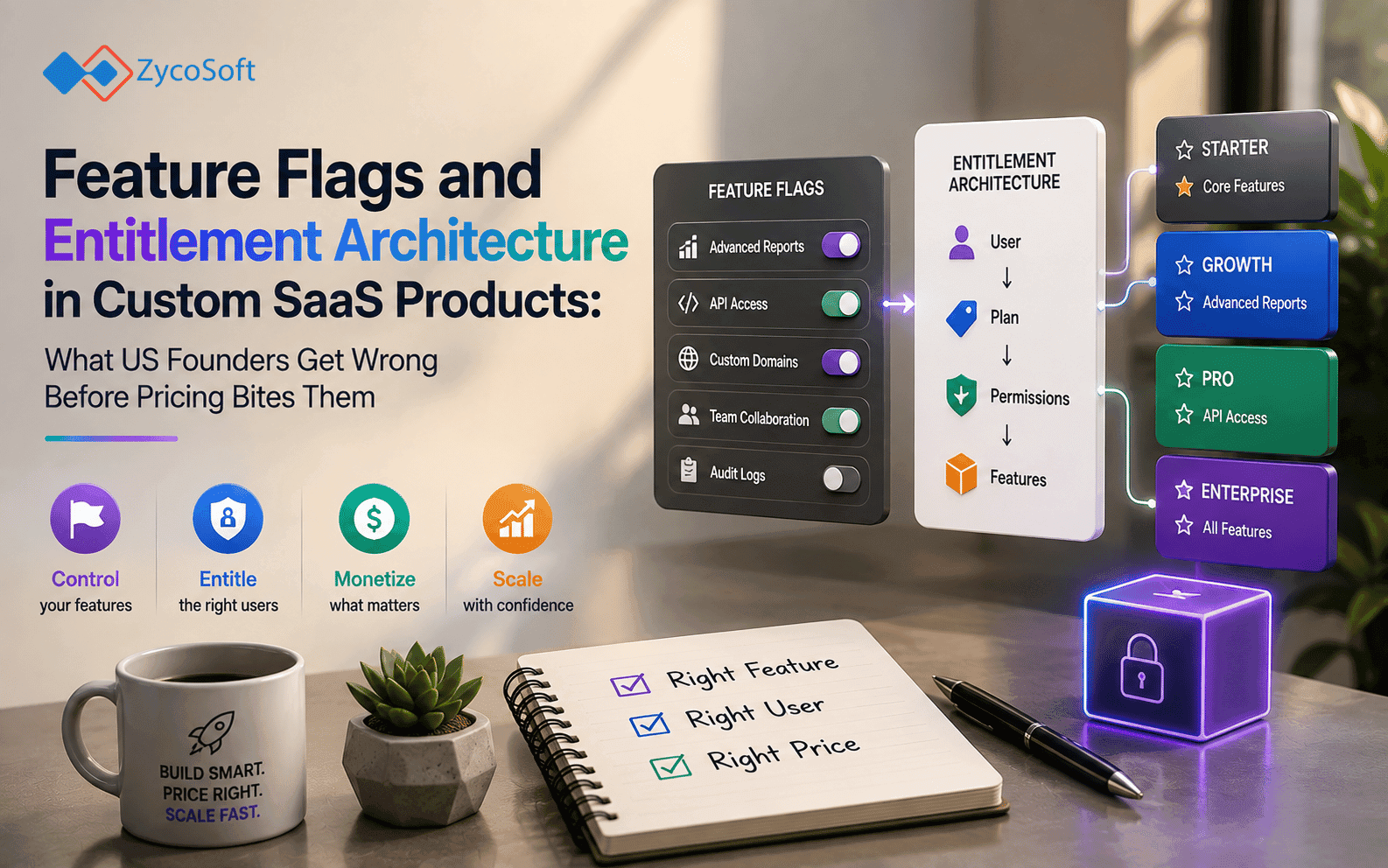
Feature Flags and Entitlement Architecture in Custom SaaS Products: What US Founders Get Wrong Before Pricing Bites Them
The majority of US SaaS founders shipping their first product treat feature flags as a DevOps convenience and entitlement logic as a billing side-effect. Both assumptions are wrong, and both produce the same outcome: a codebase that cannot support real pricing tiers without a partial rewrite at the worst possible time, usually just before an enterprise deal closes or a Series A is in progress.
Feature flag SaaS architecture and entitlement management are not two separate concerns. They are one architectural decision that must be resolved before the first paid tier ships. Getting that decision right costs almost nothing at the start. Getting it wrong costs weeks of engineering time and significant product risk at scale.
Why Most SaaS Codebases Have Entitlement Debt Before They Know It -
Entitlement debt accumulates quietly. A founder ships an MVP with one plan, adds a "Pro" tier six months later, and the engineering team gates the new features with a simple conditional: check the user's plan string, return early if it does not match. That pattern, repeated across twenty features over twelve months, produces an entitlement system that is scattered across hundreds of components, impossible to audit, and tightly coupled to whatever plan names existed when each feature shipped.
The problem surfaces when the business model changes. A usage-based add-on, a grandfathered cohort, an enterprise pilot with custom permissions, a promotional trial for a specific feature subset. None of these fit cleanly into a plan-string conditional. Each one requires touching every affected feature gate in the codebase, which is exactly the kind of work that delays product velocity and introduces regression risk.
The root cause is not laziness. It is that most early-stage engineering teams, and many custom SaaS builds that start without a clear architecture brief, were never asked to separate entitlement logic from feature delivery logic. The two look identical at small scale. They diverge catastrophically at medium scale.
The Four Flag Types Every SaaS Product Needs to Separate -
A well-structured feature flag SaaS architecture distinguishes between four flag types. Mixing them in a single undifferentiated system is the second most common source of entitlement debt, after hardcoded plan conditionals.
Release Flags -
Release flags control whether a feature is live in production for a given rollout cohort. They are temporary by design. Once a feature is fully rolled out, the flag should be removed. Release flags have no relationship to pricing and should never query billing data.
Experiment Flags -
Experiment flags support A/B and multivariate testing. They are also temporary, but they produce data before removal. Like release flags, they should be entirely decoupled from entitlement logic. Mixing experiment and entitlement flags means your analytics cannot distinguish between a user who saw a variant and a user who paid for a tier.
Operational Flags -
Operational flags are circuit breakers, kill switches, and performance throttles. A SaaS product under load needs the ability to disable a specific integration or degrade gracefully without a deployment. These flags need to resolve in milliseconds and should never depend on a database call to a billing system.
Entitlement Flags -
Entitlement flags are the only flag type that interacts with your subscription and pricing data. They answer one question: is this account or user permitted to access this capability, based on their current plan, contractual agreement, or trial state? This is the flag type that most codebases get wrong, because it is the only one that carries commercial and legal weight.
The practical implementation rule is simple. Each flag type should have a clearly defined owner in your architecture. Release and experiment flags live in a feature management tool. Operational flags live close to your infrastructure layer. Entitlement flags are resolved by a dedicated entitlement service, which is the component most SaaS products at seed stage fail to build.
Entitlement Management Is a Product Architecture Problem, Not a Billing Problem -
Stripe, Paddle, and Chargebee record what a customer has paid for. They do not enforce what that customer can access inside your product. That enforcement is your application's responsibility, and if it lives inside a Stripe webhook handler or a billing event listener, you do not have an entitlement system. You have a race condition waiting to happen.
A sound entitlement architecture centres on a single resolver: a service or module that accepts an account or user identity and a capability identifier, and returns a structured permission response. Every feature gate in your product, whether in the frontend, the API layer, or a background job, queries this resolver. Nothing reads plan data directly.
This matters for three specific reasons:
Testability. An entitlement resolver can be unit tested against every permission scenario without spinning up a billing integration.
- Auditability. Every access decision flows through one place, which is essential for enterprise compliance requirements and, in regulated industries, a hard requirement.
- Flexibility. Trial access, enterprise overrides, promotional grants, and plan downgrades are all handled by updating the resolver's data, not by touching feature code.
This is also the architecture that enables an enterprise sales motion. When a prospect asks whether you can turn on a specific capability for a 30-day pilot without upgrading their account, the answer should be a configuration change, not a sprint. If your entitlement logic is embedded in application code, that answer is always a sprint, and enterprise deals close on configuration timelines, not engineering timelines.
The Four Build Points Where Getting This Wrong Becomes Expensive -
Entitlement debt does not cost evenly across a SaaS lifecycle. It accumulates at specific architectural decision points, and missing any one of them raises the cost of correction significantly.
- First paid tier. This is when entitlement logic first appears. If it is hardcoded as a plan-string conditional rather than routed through a resolver, every subsequent tier inherits that pattern and the debt compounds.
- Second pricing dimension. The moment a product moves from flat-tier pricing to anything with a usage component, seat limit, or add-on, scattered entitlement conditionals break. A resolver handles this cleanly. Hardcoded conditionals require a full audit.
- First enterprise deal. Enterprise accounts require custom permission bundles, single-tenant overrides, and contractual capability definitions that standard tier logic cannot accommodate. Without a dedicated entitlement layer, every enterprise deal is a custom engineering task.
- Multi-tenant architecture expansion. As covered in depth in our post on multi-tenant SaaS architecture and data isolation strategies, tenant-level permission isolation requires a clean separation between identity, tenancy, and entitlement. If entitlement logic is baked into application components rather than resolved centrally, tenant isolation becomes structurally difficult to enforce.
The common thread across all four points is that the cost of correction scales with the number of features that have entitlement logic embedded in them. A product with 10 features and hardcoded plan conditionals can be refactored in a week. A product with 60 features and the same pattern takes two engineers a month and introduces significant regression risk.
How to Structure the Architecture Decision Before Your First Tier Ships -
The correct sequence is not complicated, but it must happen before feature development begins in earnest. Retrofitting it later is always more expensive than building it correctly at the start.
The steps, in order, are these:
- Define your capability model first. List every discrete capability your product exposes, not features, but the underlying permissions: can create reports, can export data, can add team members, can access API. These become your entitlement identifiers.
- Build the entitlement resolver as a first-class service before any gating logic is written elsewhere. It should accept an identity and a capability identifier, resolve the current permission state from your subscription data, and return a structured result.
- Separate your flag types in your tooling. Use a dedicated tool for release and experiment flags. Route all entitlement checks through your resolver, never through the same flag evaluation path.
- Instrument the resolver for observability from day one. Every entitlement check should be loggable, traceable, and auditable without modifying feature code.
- Design your billing integration to write to your entitlement data model, not the other way around. Billing events update entitlement state; they do not own it.
This architecture also integrates cleanly with subscription billing implementations. As we have outlined in our analysis of SaaS subscription billing architecture at scale, the billing layer should be a writer to your data model, not the source of truth for product access decisions. Entitlement state and billing state are related but distinct, and treating them as the same thing is a reliable path to data inconsistency under plan change events.
Founders working with a remote engineering partner should raise this architecture discussion before the first sprint, not after the first paid tier is live. The conversation costs an hour at planning stage. At scale, missing it costs weeks.
Build the Entitlement Layer Before Your Pricing Tier Does -
Feature flag SaaS architecture and entitlement management are one decision. Treat them as two and you will revisit that choice under pressure, when you have paying customers, active pricing tiers, and an enterprise pilot on the table. The architecture cost is low at the start and high at every subsequent inflection point.
If you are building a custom SaaS product and want to get this right before your first tier ships, our engineering team works with US founders to design entitlement and feature flag architecture as part of the initial product build, not as a retrofit after pricing bites.
Talk to us about your SaaS architecture before development starts.
Frequently Asked Questions
Feature flags control whether a feature is visible or active for a given user or cohort, typically for release, experiment, or operational purposes. Entitlement management controls what a user or account is contractually permitted to access based on their pricing tier or subscription. They overlap in implementation but serve fundamentally different business purposes, and conflating them in the same code layer is a common source of technical debt at scale.
Before the first pricing tier ships. Retrofitting an entitlement layer after tier expansion requires touching every feature gate in your codebase, which becomes expensive at scale. The correct sequence is to define your entitlement model during initial architecture, implement a dedicated service or API to resolve entitlements, and then have all feature access checks query that service rather than hardcode tier logic into component or route code.
The four types are release flags (controlling rollout of new features to production), experiment flags (A/B or multivariate testing), operational flags (circuit breakers, kill switches, and performance throttles), and entitlement flags (access gates tied to pricing tier or contractual permissions). Only entitlement flags should interact with your billing and subscription data. Mixing flag types in a single system without type separation creates audit and compliance risk as you scale.
Billing systems record what a customer has paid for. Entitlement management enforces what they can access, and that enforcement must happen at the application layer, not inside your payment processor. If your entitlement logic lives in Stripe webhook handlers or billing event listeners, you have no clean way to grant trial access, apply enterprise overrides, or handle plan downgrades without race conditions and data inconsistency across your product.
A sound tier gating architecture centralises all access decisions in a single entitlement resolver, which accepts a user or account identity and a capability identifier and returns a boolean or a structured permission object. Feature UI components and API routes query this resolver rather than reading tier data directly. This means tier logic is testable in isolation, auditable, and can be updated without touching individual features across the codebase.
Enterprise deals frequently require custom capability bundles, single-tenant overrides, and trial-to-paid transitions that standard tier logic cannot accommodate. If entitlement logic is hardcoded into application code rather than managed through a dedicated layer, every enterprise customisation becomes a bespoke engineering task. A clean entitlement architecture allows sales and customer success teams to configure capability access without engineering involvement, which directly shortens your sales cycle.
Tools such as LaunchDarkly, Flagsmith, or Unleash handle release and experiment flags well, but they are not designed as entitlement systems. Using them for entitlement management works at low scale but breaks down when you need to enforce seat limits, usage-based access, or complex enterprise permission hierarchies. Most mature SaaS products use a dedicated flag tool for release and experiment flags, and a separate entitlement service, sometimes custom-built, for tier and capability access control.