
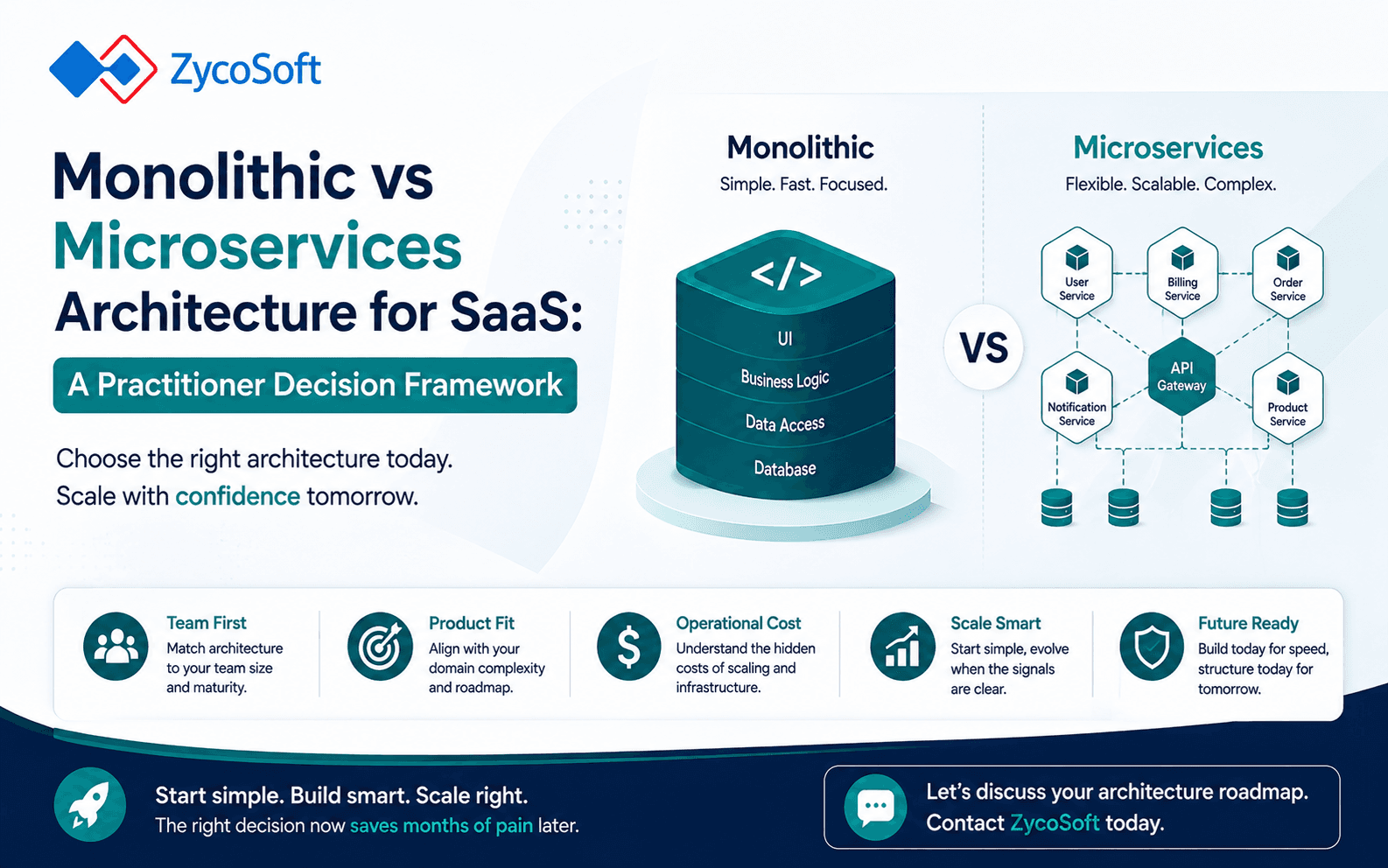
Monolithic vs Microservices Architecture for SaaS: A Practitioner Decision Framework
The question of monolithic vs microservices architecture for SaaS is not primarily a technology question. It is a team, product, and operational readiness question. Most early-stage teams choose microservices because it sounds like the right answer in 2025, then spend the next 12 months managing infrastructure complexity instead of shipping product. The correct starting point is not the architecture that scales best in theory. It is the architecture that gives your specific team the fastest path to a working, maintainable product today.
This guide gives CTOs, technical founders, and engineering leads a concrete decision framework, grounded in the signals that actually matter, not the ones that sound impressive in a pitch deck.
What Each Architecture Actually Means in Practice
A monolith is a single deployable application. All your features, business logic, and data access live in one codebase and are deployed together. A microservices architecture splits that application into independent services, each with its own codebase, database, and deployment pipeline, communicating over a network.
The practical difference is not just technical. It determines how your team works, how you debug failures, how you onboard new engineers, and how much infrastructure you need to run before a single user touches your product.
A third option sits between the two and is frequently underused: the modular monolith. This is a single deployable unit whose internal code is organised into clearly bounded domain modules. You get the deployment simplicity of a monolith with the structural discipline that makes future decomposition possible when the time is right.
The Hidden Operational Cost Most Teams Underestimate
Before evaluating signals and trade-offs, you need an honest accounting of what microservices actually cost to run. Most technical founders underestimate this by a significant margin, and it is the single most common reason architecture decisions go wrong at seed to Series A stage.
When you move to microservices, you take on the following overhead that a monolith simply does not require:
- A service mesh or API gateway to route traffic between services
- Distributed logging and tracing so you can follow a request across service boundaries
- Inter-service authentication, because services cannot trust each other by default
- Independent CI/CD pipelines for each service
- A dedicated platform or DevOps engineer to maintain the infrastructure layer
- Significantly more complex debugging when a transaction fails across two or three services
In practical terms, this overhead can consume 30 to 50 percent of your engineering capacity before you write a single line of business logic. For a team of four to eight engineers at seed stage, that is not an acceptable trade-off. The cost is real, recurring, and compounds as you add services.
Signals That Tell You to Stay Monolithic
For most SaaS products at seed to early Series A, the right answer to the SaaS architecture decision is a well-structured monolith. The following signals confirm that choice.
Your team is fewer than three autonomous squads
The classic threshold for microservices is often described as the point where a single team can no longer own the full codebase without constantly blocking each other. In practice, that means roughly three or more squads working on genuinely separate domains. Below that threshold, splitting services creates coordination overhead without removing the organisational friction it is supposed to solve.
Your domain boundaries are still changing
If you are still discovering what your product actually does, splitting into services is premature. Every time a domain boundary shifts, in a microservices architecture, you are refactoring service contracts, APIs, and data schemas across multiple repositories. In a monolith, a refactor stays internal. The cost difference is significant.
You deploy infrequently or as a single unit
Microservices deliver value when different parts of your system need to be deployed independently and at different frequencies. If your team deploys the whole product together once or twice per week, microservices give you the complexity without the benefit. The monolith-first approach for SaaS preserves deployment simplicity until you genuinely need independent release cadences.
You do not yet have a dedicated platform engineer
Running microservices in production without someone whose primary responsibility is infrastructure health is a significant operational risk. If your engineering team are all product engineers, a monolith is almost certainly the right call.
Signals That Tell You Decomposition Will Actually Help
The decision to split a monolith should be driven by evidence, not aspiration. These are the signals worth paying attention to.
You have stable, distinct data ownership boundaries
The strongest signal for decomposition is when two areas of your product have genuinely different data ownership with minimal overlap, and those areas are unlikely to change significantly. For example, a billing engine that owns subscription state and a document processing module that owns user files. When data does not naturally cross between domains, splitting services reduces coupling rather than just moving it.
One part of your system needs to scale independently
If your analytics pipeline needs to handle ten times the load of your core product, or your video processing queue has completely different resource requirements from your API, independent scaling becomes valuable. Scaling a monolith means scaling everything together, which is wasteful and increasingly expensive at that point.
Multiple squads are blocked by a shared codebase or deployment pipeline
When two teams consistently block each other's releases, or when a bug in one domain forces a full redeployment that affects unrelated features, decomposition starts paying for its operational cost. This is the organisational signal that most reliably justifies the architectural shift.
Your deployment frequency for specific domains is materially higher
A US-based SaaS product we have seen in practice ran its marketing and onboarding surface at 20 deploys per week while its billing engine was deliberately stable at one deploy per month. In that situation, coupling them in a single deployment unit creates genuine release risk. Independent services solve a real problem.
A Decision Framework: Five Questions Before You Commit
Use this framework before making any SaaS architecture decision about decomposition. Answer each question honestly based on where your product and team are today, not where you expect to be in 18 months.
- How many autonomous squads do you have today? Fewer than three is a strong signal to stay monolithic.
- Are your domain boundaries stable and well understood? If you are still refining your core product, premature decomposition creates structural debt.
- Do you have a platform engineer or dedicated infrastructure ownership? If no, microservices operational cost will fall on product engineers and slow delivery.
- Does any single component have scaling requirements an order of magnitude different from the rest? If yes, identify that component specifically and consider extracting only that service.
- Are your teams actively blocked by shared deployments today? If no, the pain that microservices solve does not yet exist in your organisation.
If your answers point toward staying monolithic, the correct path is to invest in modularity inside your monolith, not to defer decomposition indefinitely with a messy codebase. A well-organised modular monolith is a legitimate long-term architecture. Shopify, Stack Overflow, and Basecamp all demonstrated this at scale.
If you are evaluating how to structure your product thinking before development begins, scoping the project before you talk to any developer is the step that most commonly prevents the wrong architecture decision from being baked in before anyone writes a line of code.
The Middle Path: Modular Monolith as a Deliberate Strategy
The modular monolith deserves more attention than it typically receives in architecture discussions. It is not a compromise or a temporary state. It is a deliberate strategy that many mature SaaS products use successfully at significant scale.
In a modular monolith, each domain of your product (billing, user management, core features, integrations) lives in its own internal module with enforced boundaries. Modules cannot directly access each other's data. They communicate through defined internal interfaces. This gives you the organisational clarity of microservices without the distributed systems complexity.
When and if your product reaches the point where decomposition is justified, a well-structured modular monolith makes that extraction straightforward. The boundaries are already drawn. You are extracting a module into a service rather than untangling years of cross-cutting concerns from a poorly structured codebase.
For most SaaS products at seed to Series A, this is the architecture we recommend as the default starting position. It is not the most exciting answer, but it is consistently the one that results in faster delivery, lower operational cost, and a cleaner path to scaling SaaS architecture when genuine growth signals emerge.
How ZycoSoft Approaches This Decision for SaaS Clients
At ZycoSoft, the monolith-first approach is not a philosophical preference. It is a scoping discipline we apply at the start of every custom SaaS development engagement, because the two most common failure modes we see in early-stage products are over-engineering an MVP into a distributed system it does not need, and under-architecting a product that later cannot scale without a full rebuild.
When we scope an MVP development project, we identify the domain boundaries that are likely to be stable, the components that might need independent scaling within 18 months, and the team structure the client expects to have at each growth stage. That analysis determines whether we build a modular monolith, a monolith with one extracted service, or (rarely, at this stage) a small set of well-defined services.
We have built and launched SaaS products across UK, EU, and US markets, integrated payment infrastructure including Stripe and Mollie, and handled GDPR-compliant data architecture from the ground up. The architecture decision is always made in the context of the full product lifecycle, not just the first release. As described in our post on what US founders get wrong before SaaS development starts, the most expensive mistakes happen before the first line of code is written, and architecture is at the top of that list.
Our embedded team model means the engineers who make the architecture decision are the same engineers who build, maintain, and scale the product. There is no handoff to a separate delivery team. That continuity is what allows us to make deliberate, long-term architectural choices rather than optimising only for launch speed.
If you are evaluating architecture strategy for a SaaS product at seed to Series A stage and want a direct, honest assessment of where your product sits on this spectrum, get in touch with the ZycoSoft team. We scope engagements to answer exactly this question before any development begins.
Frequently Asked Questions
For most SaaS products at seed to Series A stage, start with a well-structured monolith. The operational overhead of microservices, including service discovery, distributed tracing, inter-service authentication, and independent deployments, requires engineering maturity and team size that early-stage products rarely have. A modular monolith delivers speed to market without accumulating structural debt.
A commonly cited threshold is the two-pizza team rule: when a single team can no longer own the full codebase without stepping on each other, decomposition starts paying off. In practice this means roughly three or more autonomous squads, each with a distinct product domain. Below that threshold, the coordination cost of microservices typically outweighs the benefits.
A modular monolith is a single deployable unit whose internal code is organised into clearly bounded domain modules with enforced separation. It is a legitimate long-term architecture used by many successful SaaS companies. It gives you the deployment simplicity of a monolith with the domain clarity that makes future decomposition straightforward if growth ever requires it.
The most commonly underestimated costs include: running and maintaining a service mesh or API gateway, distributed logging and tracing infrastructure, inter-service authentication overhead, the engineering time spent debugging failures that cross service boundaries, and the need for a dedicated platform or DevOps engineer. These costs can add 30 to 50 percent to your engineering overhead before you write a single line of business logic.
Split when you have clear, stable domain boundaries with distinct data ownership, when independent deployment of specific components would materially reduce release risk, when one part of the system has scaling requirements an order of magnitude different from the rest, and when your team is large enough that multiple squads are actively blocked by sharing a single codebase or deployment pipeline.
Yes. Shopify, Stack Overflow, and Basecamp all scaled to significant revenue on monolithic or near-monolithic architectures. The monolith-first approach does not mean staying monolithic forever. It means deferring decomposition until you have real evidence of where your domain boundaries lie and where independent scaling is genuinely required, rather than guessing those boundaries up front.