
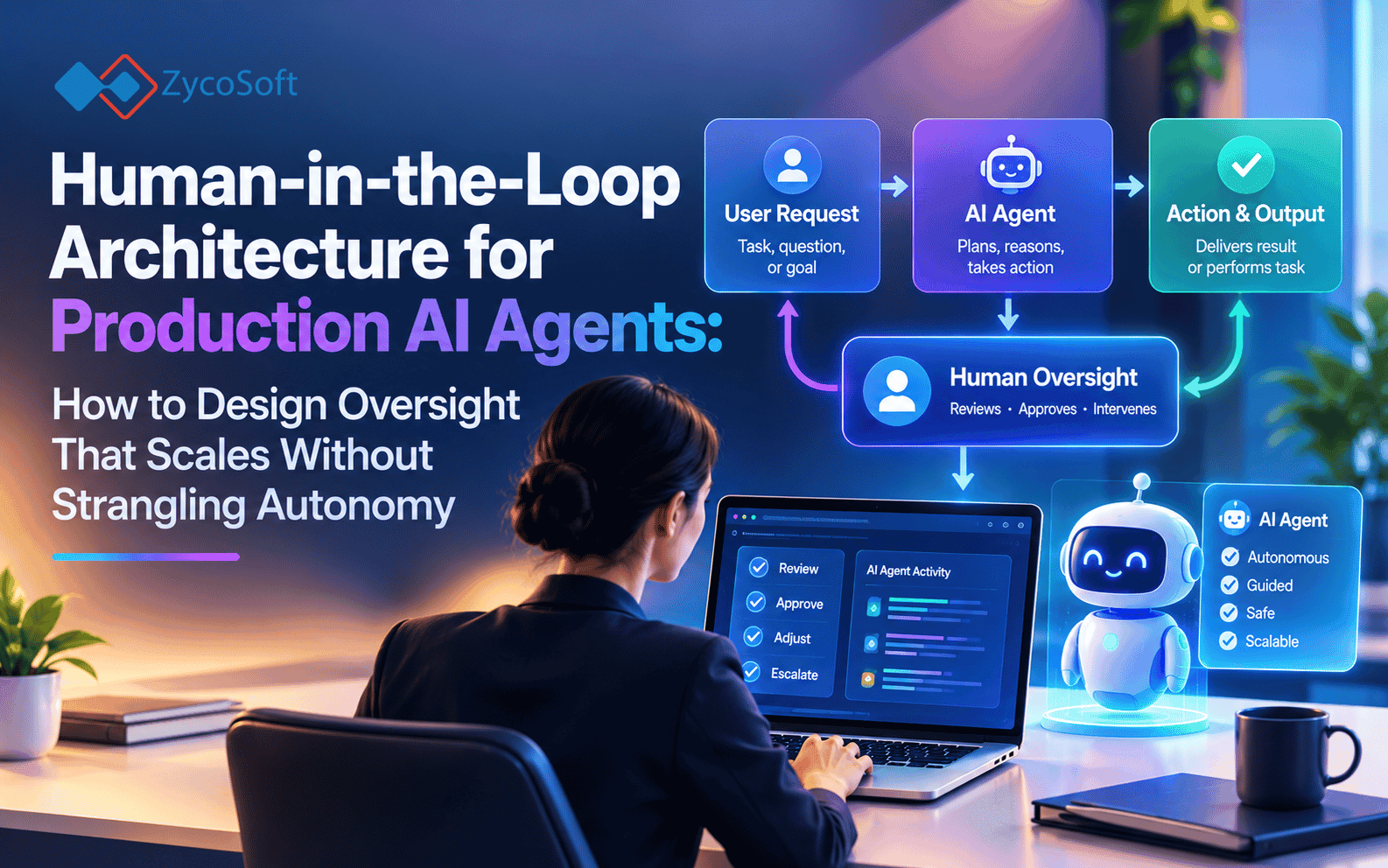
Human-in-the-Loop Architecture for Production AI Agents: How to Design Oversight That Scales Without Strangling Autonomy .
The default instinct when shipping a production AI agent is to gate everything or gate nothing. Teams that have been burned by hallucinations add an approval step to every agent action. Teams chasing throughput remove human review entirely and discover their failure modes the hard way. Neither approach is a human in the loop AI agents production architecture: one is a bottleneck dressed up as safety, and the other is an automation system with no observable failure surface. The actual engineering problem is designing oversight as a spectrum, placing it at the right layer, and making it comply with EU AI Act Article 14 before the system ships, not after the regulator asks.
Why HITL Is an Architecture Decision, Not a Feature Toggle :
Most teams reach for a single approval queue and call it done. That is not oversight architecture: it is a queue that will either be ignored under pressure or become a production bottleneck within weeks of launch.
The correct framing is that human oversight in agentic systems has three distinct modes, each appropriate for a different risk profile:
- Synchronous checkpoint: The agent pauses execution and waits for explicit human approval before proceeding. Appropriate for irreversible, high-stakes, or regulated actions.
- Asynchronous audit trail: The agent proceeds autonomously, but every decision is logged with sufficient context for post-hoc human review. Appropriate for high-volume, recoverable actions.
- Confidence-based routing: The agent evaluates its own certainty (or an external classifier evaluates it) and routes low-confidence actions to a human queue while high-confidence actions proceed uninterrupted. Appropriate for workflows where throughput matters but failure cases are non-trivial.
Choosing between these is not a product decision. It is an architectural decision that should be made at design time, anchored to the blast radius and reversibility of each agent action in your workflow. As a reference, the failure taxonomy for production AI agents makes clear that the majority of agent failures are not model failures: they are orchestration and oversight failures that a well-placed checkpoint would have caught.
Synchronous vs Asynchronous Oversight: When to Use Each
Synchronous checkpoints are the right choice when an action meets any of the following criteria:
- It is irreversible: sending an email to a customer list, initiating a bank transfer, modifying production records.
- It has a high financial or legal consequence threshold: a contract generation step, a credit decision, a regulatory filing.
- It is explicitly covered by EU AI Act Article 14 or equivalent regulation for your sector.
The implementation pattern here is a durable task queue (not an in-memory flag). The agent emits an approval request event, execution suspends at that step, and resumes only when a human reviewer acts. Tools like Temporal, Step Functions, or a custom Postgres-backed task table all work. What does not work is a synchronous HTTP call to a Slack webhook with a five-minute timeout: that is not an architecture, it is a workaround.
Asynchronous audit trails are appropriate for high-volume workflows where the cost of halting per action would exceed the risk of the action itself. An agent that triages 2,000 support tickets per day and routes them to queues does not need a human to approve each routing decision. It does need a structured log of every routing decision, the input context that drove it, the model's confidence score, and the outcome, so that a human reviewer can spot systematic drift within hours rather than weeks.
The key engineering requirement here is that the log must be queryable. An append-only event log written to a data store that supports structured queries (not just a log aggregator like Datadog used in isolation) gives you the ability to surface patterns: "routing decisions made at confidence below 0.6 had a 22% incorrect classification rate." That is actionable oversight. A wall of JSON blobs is not.
Confidence-Based Routing: The Architecture That Actually Scales
Confidence-based routing is the pattern that resolves the throughput-vs-oversight tension for most production agentic workloads. The core idea is simple: define a confidence threshold per action type, evaluate every agent decision against it, and route below-threshold decisions to a human queue rather than blocking the entire workflow.
The implementation has three components that must be wired at the orchestration layer, not inside the LLM prompt:
- Confidence scoring: Either use the model's own log-probability output as a proxy, or train a lightweight classifier on your own agent's historical decisions and their outcomes. The latter is significantly more reliable in production.
- Routing logic: A deterministic rule that maps confidence score to one of three paths: autonomous proceed, human review queue, or hard stop (for actions below a minimum floor regardless of other context).
- Threshold calibration: Set thresholds against real production data, not intuition. A common starting point is to review the first 500 agent decisions manually, tag them as correct or incorrect, and set the threshold at the confidence score below which your error rate exceeds your acceptable tolerance.
A simplified routing rule expressed as plain logic: if confidence score is above 0.85, proceed autonomously and log. If confidence is between 0.55 and 0.85, enqueue for async human review with a 4-hour SLA. If confidence is below 0.55, halt and escalate synchronously. Those thresholds are illustrative; calibrate them against your actual error distribution.
This approach integrates naturally with the observability instrumentation that production agents require: confidence scores become a first-class metric in your dashboards, and threshold drift is a signal that your agent's input distribution has shifted.
Guardrail Placement: Tool-Call, Chain Boundary, or Terminal Output
The most common guardrail architecture mistake is placing all validation at the terminal output layer. That catches bad outputs before they reach users, but it does nothing to prevent an agent from calling a destructive API mid-chain, corrupting state that a clean final output cannot recover.
A production-grade AI agent guardrails architecture has three distinct layers:
Layer 1: Tool-Call Guardrails
Every tool the agent can invoke should have a validation wrapper that checks inputs before the tool executes. This is where you enforce parameter bounds, validate that the agent is not about to call a write endpoint when it should only be calling a read endpoint, and log the intent before the action.
A minimal pattern: wrap each tool function with a pre-execution hook that validates the input schema, checks against an allowed-action policy for the current agent role, and emits a structured event before proceeding. If the validation fails, return a structured error to the agent rather than raising an exception, so the agent can attempt a corrective action rather than crashing the chain.
Layer 2: Chain Boundary Guardrails
Between agent steps in a multi-step workflow, check that the output of step N is a valid input for step N+1. This is where you catch error propagation: an agent that produces a malformed intermediate result should be stopped at the boundary, not allowed to carry corrupted state forward through three more tool calls.
For teams building multi-agent systems, the orchestration architecture decisions covered here directly determine how much surface area exists at each chain boundary and how complex your guardrail logic needs to be.
Layer 3: Terminal Output Guardrails
The final validation before output reaches a user or downstream system. This layer handles content policy checks, PII detection, format validation, and any domain-specific business rules that apply to the completed result. It is necessary but not sufficient on its own.
EU AI Act Article 14: Compliance by Design, Not Retrofit
EU AI Act Article 14 requires that high-risk AI systems include human oversight measures enabling operators to understand, monitor, and intervene in system outputs. The August 2026 enforcement threshold means that agentic systems deployed to EU-market users in regulated categories (employment, credit, critical infrastructure, law enforcement, and others listed in Annex III) are now subject to active scrutiny, not just advisory guidance.
What Article 14 requires in practice, expressed as architectural constraints:
- Override mechanisms must be technically reachable, not just documented in a policy PDF. A human reviewer must be able to halt or correct an agent decision without requiring a code deployment.
- Decision logs must include sufficient context for a human to reconstruct the agent's reasoning at the time of the decision, not just the final output. This means logging the input state, the tool calls made, the intermediate outputs, and the confidence scores alongside the final result.
- Oversight must be proportionate to risk. Article 14 does not require synchronous human approval for every action; it requires that the oversight mechanism is appropriate to the risk profile of the system. Confidence-based routing with a well-calibrated threshold and a complete audit trail satisfies this for most agentic workflows outside the highest-risk categories.
UK teams operating post-Brexit are not directly subject to the EU AI Act but should note that systems serving EU-market users are covered regardless of incorporation location. Many UK engineering teams are voluntarily aligning with the EU framework given the likely trajectory of UK AI regulation and the practical reality of serving cross-border user bases.
For teams building GDPR-compliant systems alongside this, the intersection with AI agent logging is non-trivial: audit logs that capture user data for oversight purposes need their own retention and access control design.
How ZycoSoft Architects Production HITL Systems :
The gap between a demo-quality agent and a production-grade agentic system is almost always in the oversight layer. Demo agents work because someone is watching them run. Production agents need to work when nobody is watching, and surface the right signal when something goes wrong.
At ZycoSoft, our AI automation work covers the full agentic lifecycle: from initial architecture (where we make deliberate decisions about which actions get synchronous checkpoints, which get confidence-based routing, and which proceed with async audit trails) through to deployment and calibration against real production data. We instrument confidence scoring as a first-class metric from day one, not as an afterthought. We place guardrails at tool-call, chain boundary, and terminal output layers as a baseline, not a premium add-on.
We have built production AI automation pipelines using n8n and custom LLM orchestration for clients in the UK, EU (including Austria and DACH-region businesses where regulatory alignment with the EU AI Act is a hard requirement), and the US. The HITL architecture decisions described in this post are not theoretical: they come from systems that are running at production load with real oversight requirements.
We scope every agentic engagement to avoid the two failure modes that cost teams the most: over-engineering the oversight layer to the point where it kills automation value, and under-architecting it to the point where the first production incident is also the first time anyone asks where the guardrails are.
If you are building or evaluating a production agentic system and need the oversight architecture designed correctly from the start, talk to our team directly.
Frequently Asked Questions
HITL refers to architectural patterns that route agent actions or outputs to a human for review, approval, or correction at defined points in an agentic workflow. In production systems, HITL is not a single gate but a spectrum ranging from synchronous approval checkpoints to asynchronous audit trails, selected based on action risk, confidence scores, and regulatory requirements such as EU AI Act Article 14.
Use synchronous checkpoints when an agent action is irreversible, high-value, or regulated, for example sending a legal document, initiating a financial transaction, or modifying production data. Use asynchronous audit trails for high-volume, low-risk actions where throughput matters and failures are recoverable. The choice should be driven by blast radius and reversibility, not by how technically convenient it is to wire up an approval queue.
Article 14 requires that high-risk AI systems include human oversight measures that allow operators to understand, monitor, and intervene in AI system outputs in real time. For agentic systems, this means oversight must be architecturally embedded, not manually bolted on. Systems must log agent decisions with sufficient context for a human reviewer to reconstruct reasoning, and override mechanisms must be technically reachable, not just documented in policy.
Confidence-based routing evaluates an agent's self-assessed certainty score or an external classifier's score against a defined threshold before allowing the agent to proceed autonomously. Actions above the threshold proceed without human review. Actions below it are routed to a human queue or a fallback deterministic path. The routing logic sits at the orchestration layer, not inside the LLM prompt, and thresholds should be calibrated against production failure data, not set arbitrarily at launch.
Guardrails should be placed at three distinct layers: at the tool-call level to validate inputs before any external system is touched, at the chain boundary between agent steps to prevent error propagation across the workflow, and at the terminal output layer to validate the final response before it reaches a user or downstream system. Placing all guardrails at a single layer, typically the output layer, is the most common architectural mistake and the most expensive to fix in production.
Article 14 applies specifically to high-risk AI systems as defined in Annex III of the EU AI Act, which includes systems used in employment decisions, credit scoring, critical infrastructure, law enforcement, and similar domains. If you are serving EU-market users with an agentic system in any of these categories, Article 14 applies regardless of where you are incorporated. UK teams operating post-Brexit should monitor UK AI regulation separately, though many are voluntarily aligning with the EU framework.
The two most common failure modes are opposite ends of the same mistake. The first is gating every agent action with a synchronous approval step, which destroys throughput and makes the human reviewer a bottleneck rather than a safeguard. The second is shipping with no structured oversight at all, relying on post-hoc monitoring to catch failures. Both stem from treating HITL as a binary switch rather than a multi-tier design decision calibrated to action risk and reversibility.