
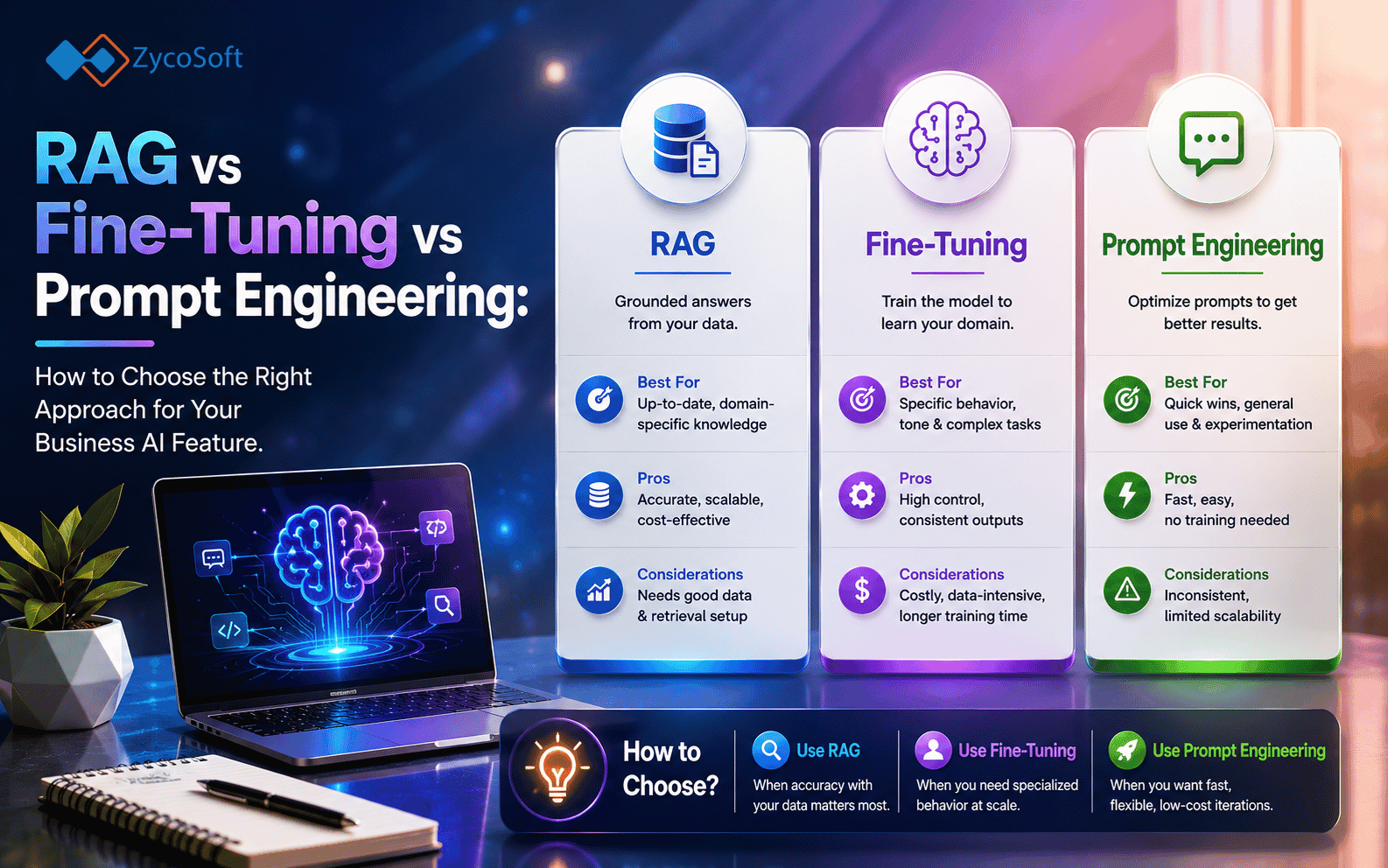
RAG vs Fine-Tuning vs Prompt Engineering: How to Choose the Right Approach for Your Business AI Feature.
The most expensive AI architecture mistake teams make is not choosing the wrong model. It is choosing the wrong customisation strategy before they understand what the model actually needs to do. Most teams jump straight to fine-tuning because it sounds like the serious, technical choice. In practice, it is often the slowest, most expensive, and hardest-to-maintain path to a result that a well-structured prompt could have delivered in a week.
This post is a plain-language decision framework for CTOs, technical founders, and engineering leads who are evaluating RAG vs fine-tuning vs prompt engineering for a production AI feature. The goal is not to pick a winner in the abstract. It is to give you a clear, ordered sequence for making this decision without wasting budget or months of engineering time on the wrong approach.
What Each Approach Actually Does (In Plain Language) :
Before choosing a strategy, it helps to understand what each one changes about how the model behaves, and what it does not change.
Prompt engineering is the practice of crafting the instructions, context, and examples you send to the model to shape its output. The model itself is unchanged. You are controlling its behaviour through what you say to it, not through retraining it. Think of it as writing a very precise brief for a capable contractor who already knows the domain.
Retrieval-augmented generation (RAG) connects the model to an external knowledge base at the moment a query arrives. When a user asks a question, the system retrieves the most relevant documents or data records and places them into the context window alongside the user's question. The model then generates an answer grounded in that retrieved content. The model's weights are still unchanged. RAG gives the model access to information it was not trained on, without retraining it.
Fine-tuning involves actually retraining the model's internal weights on a dataset you provide. It permanently changes how the model responds, across all queries, not just when specific context is present. It is the most expensive approach to implement, the hardest to update, and the most difficult to audit. It is also occasionally the right answer, but far less often than most teams assume.
Start Here: When Prompt Engineering Is Enough
Prompt engineering should always be the first approach you test, because the cost is near-zero and the time-to-result is measured in hours, not weeks. A large share of AI features that teams initially design as RAG or fine-tuning projects can be fully resolved with a carefully structured system prompt and a small set of few-shot examples.
Prompt engineering is likely sufficient when:
- The task involves classifying, summarising, reformatting, or extracting information the model already understands:
- The failure mode is inconsistent tone, format, or style rather than missing knowledge.
- Your use case does not require the model to reference proprietary or frequently updated data.
- You need to ship something testable within one to two weeks.
- You are still validating whether the AI feature solves the user problem at all.
A US SaaS team building a support ticket classifier, a UK professional services firm building a contract summariser, or a UAE fintech building a customer query router will often find that a disciplined prompt engineering process gets them 80 to 90 percent of the way there. The failure cases that remain then tell you precisely what the next layer of the architecture needs to address. That is the right time to evaluate RAG.
RAG: The Right Default for Most Business AI Features
When prompt engineering hits a ceiling because the model lacks knowledge your product requires, RAG is almost always the correct next step. It is not a stepping stone to fine-tuning. For the majority of production business AI features, RAG is the destination.
RAG is the right choice when:
- Your AI feature needs to answer questions about proprietary data: internal documents, product catalogues, support history, policy documents, or client records .
- That data changes regularly and needs to be current at query time.
- You need to cite sources so users or auditors can verify the model's answer.
- You are operating under GDPR or equivalent data regulations and need to control exactly what information enters the model's context.
- Different users should see different data, enforced at the retrieval layer through role-based access control.
The GDPR point deserves specific attention for UK and EU product teams. Building GDPR-compliant software architecture requires that you can honour right-to-erasure requests, enforce data access boundaries, and demonstrate to a regulator exactly what data influenced an automated decision. RAG gives you all three capabilities. A fine-tuned model gives you none of them cleanly, because knowledge baked into model weights cannot be selectively removed or audited at the record level.
RAG is also significantly cheaper and faster to ship than fine-tuning. A well-designed RAG pipeline can be in production in two to six weeks. Fine-tuning a model to equivalent knowledge depth typically takes several months, requires thousands of high-quality labelled examples, and needs to be re-run every time the underlying data changes significantly. The maintenance burden alone makes fine-tuning a poor fit for most dynamic business contexts.
When Fine-Tuning Is Actually Justified:
Fine-tuning is the right choice in a narrow set of specific circumstances. The key discipline is to reach this decision only after you have exhausted prompt engineering and RAG, not before.
Fine-tuning is justified when:
- You need the model to produce output in a highly specific format or style that prompt. engineering cannot reliably enforce, even with extensive few-shot examples.
- You have a closed, stable dataset that is fully licensed for training purposes and will not change frequently.
- Latency constraints make a large system prompt impractical (fine-tuned models can respond with less contextual instruction).
- You are building a domain-specific capability where the base model's general knowledge actively interferes with the desired output, such as highly specialised legal, medical, or engineering terminology with precise meaning.
- Your volume is high enough that inference cost savings from a smaller, fine-tuned model justify the training investment
Notice that "we want the model to know about our company" is not on that list. That is a RAG problem. "We want the model to always respond in a specific structured format" is usually a prompt engineering problem. Fine-tuning is the right answer when the task genuinely cannot be solved any other way, and when you have the data quality and engineering capacity to do it properly.
One common mistake in the UK and EU market specifically is attempting to fine-tune on customer data without fully working through the GDPR implications. Training data used for fine-tuning is not trivially removable from a model once training is complete. If a customer later exercises their right to erasure, you have a compliance problem that is very difficult to resolve without retraining the entire model from scratch.
The Decision Tree: A Plain-Language Framework
Use this sequence when evaluating which approach to build first. Work through each question in order and stop when you have your answer.
- Is the failure a behaviour problem or a knowledge problem? If the model produces the wrong tone, structure, or style, start with prompt engineering. If it produces confidently wrong answers because it lacks specific information, move to question two.
- Does the required knowledge already exist in documents, databases, or records you control? If yes, build a RAG pipeline. Connect those sources to the model's context window. Test whether retrieval quality solves the problem before going further.
- Does the knowledge change frequently, or do GDPR data access rules apply? If yes to either, RAG is not just preferred, it is the architecturally correct choice. Fine-tuning would undermine both freshness and auditability.
- Has prompt engineering plus RAG genuinely failed to meet a specific, measurable requirement? Document exactly what fails and why. If the root cause is that the model's base behaviour actively conflicts with the required output in a way that retrieval and instruction cannot fix, you have a legitimate fine-tuning case.
- Do you hold sufficient, high-quality, licensed training data? If not, fine-tuning is not yet on the table. Invest in data curation before investing in training infrastructure.
Teams that follow this sequence consistently avoid the two most expensive failure modes: over-engineering a feature that needed a good prompt, and shipping a fine-tuned model into a GDPR-regulated environment without a clear data governance strategy.
How ZycoSoft Approaches LLM Customisation in Production :
At ZycoSoft, our AI Automation practice covers the full LLM pipeline from architecture decision through to production deployment and ongoing maintenance. When a client comes to us with an AI feature brief, the first question we ask is not which model to use. It is which customisation layer the feature actually needs, and what the data governance requirements are for the market they are operating in.
We have deployed RAG-based systems for clients across the UK, EU, US, and UAE, including agentic workflows where the retrieval layer is integrated into multi-step automation pipelines built on n8n. We have also helped teams who arrived having already committed to fine-tuning diagnose whether that decision was correct, and in most cases, a well-architected RAG layer with a refined system prompt has resolved the problem faster and at lower ongoing cost.
Our Custom SaaS Development work applies the same principle: context window engineering and retrieval architecture are first-class design decisions, not afterthoughts. For clients operating under GDPR (the majority of our UK and EU engagements), we architect RAG systems with role-based access control at the retrieval layer, source citation built into every response, and data pipelines that make right-to-erasure requests tractable. Fine-tuning enters the conversation only when there is a documented, specific requirement that RAG cannot meet.
We scope AI feature work to avoid both failure modes: the team that spends three months fine-tuning when a prompt would have shipped in a week, and the team that bolts a naive RAG layer onto a product without considering how AI capability fits the broader product workflow. Getting this architectural decision right at the start is what determines whether the AI feature becomes a product differentiator or an expensive maintenance burden.
If you are at the point of making this decision for your SaaS product or business automation stack and want a direct assessment of which approach fits your specific use case, get in touch with the ZycoSoft team. We will tell you plainly what we think the architecture needs, not what sounds most impressive.
Frequently Asked Questions
Prompt engineering shapes model behaviour through carefully written instructions, with no additional training. RAG connects the model to an external knowledge base at query time, so it can answer questions about your specific data. Fine-tuning retrains the model's weights on your own dataset, permanently altering its behaviour. Each approach carries different cost, complexity, and maintenance implications for a production AI feature.
RAG is the right choice when your AI feature needs to answer questions about data that changes frequently, such as product documentation, support tickets, or internal policies. It is also the default for GDPR-sensitive deployments because you can control exactly which data enters the context window and can enforce role-based access. Fine-tuning cannot selectively restrict knowledge once training is complete.
A production RAG pipeline can be built and deployed in two to six weeks for a fraction of the cost of a fine-tuning engagement. Fine-tuning requires curated training data (often thousands of high-quality examples), compute costs for training runs, re-training cycles when the model drifts, and ongoing evaluation infrastructure. For most SaaS AI features, RAG delivers better results faster and at lower total cost.
Yes, in specific circumstances. Fine-tuning is justified when you need the model to adopt a highly specific output format or domain vocabulary that prompt engineering cannot reliably enforce, when latency constraints make a large system prompt impractical, or when you have a closed, stable, and fully licensed training dataset. It is rarely the right starting point and should only follow exhausting prompt engineering and RAG first.
RAG keeps your data in a retrieval layer that you control, rather than baking it into model weights. This means you can enforce access controls so users only retrieve data they are authorised to see, you can delete records from your knowledge base to honour right-to-erasure requests, and you can cite the exact source documents the model used to generate an answer. None of these capabilities are straightforward with a fine-tuned model.
The most common mistake is treating fine-tuning as the default for any domain-specific AI feature, without first testing whether a well-structured system prompt solves the problem. Teams also underestimate RAG infrastructure: chunking strategy, embedding quality, and retrieval relevance all require careful design. A third mistake is conflating style or tone problems (solvable with prompt engineering) with knowledge gaps (solvable with RAG).
For a surprising number of business use cases, yes. If your AI feature needs to classify, summarise, extract, or reformat information that the base model already understands well, a thoughtfully structured system prompt with few-shot examples will outperform a hasty RAG or fine-tuning implementation. The key test is whether the model's failure is a knowledge gap or a behaviour gap. If it is behaviour, start with prompts.