
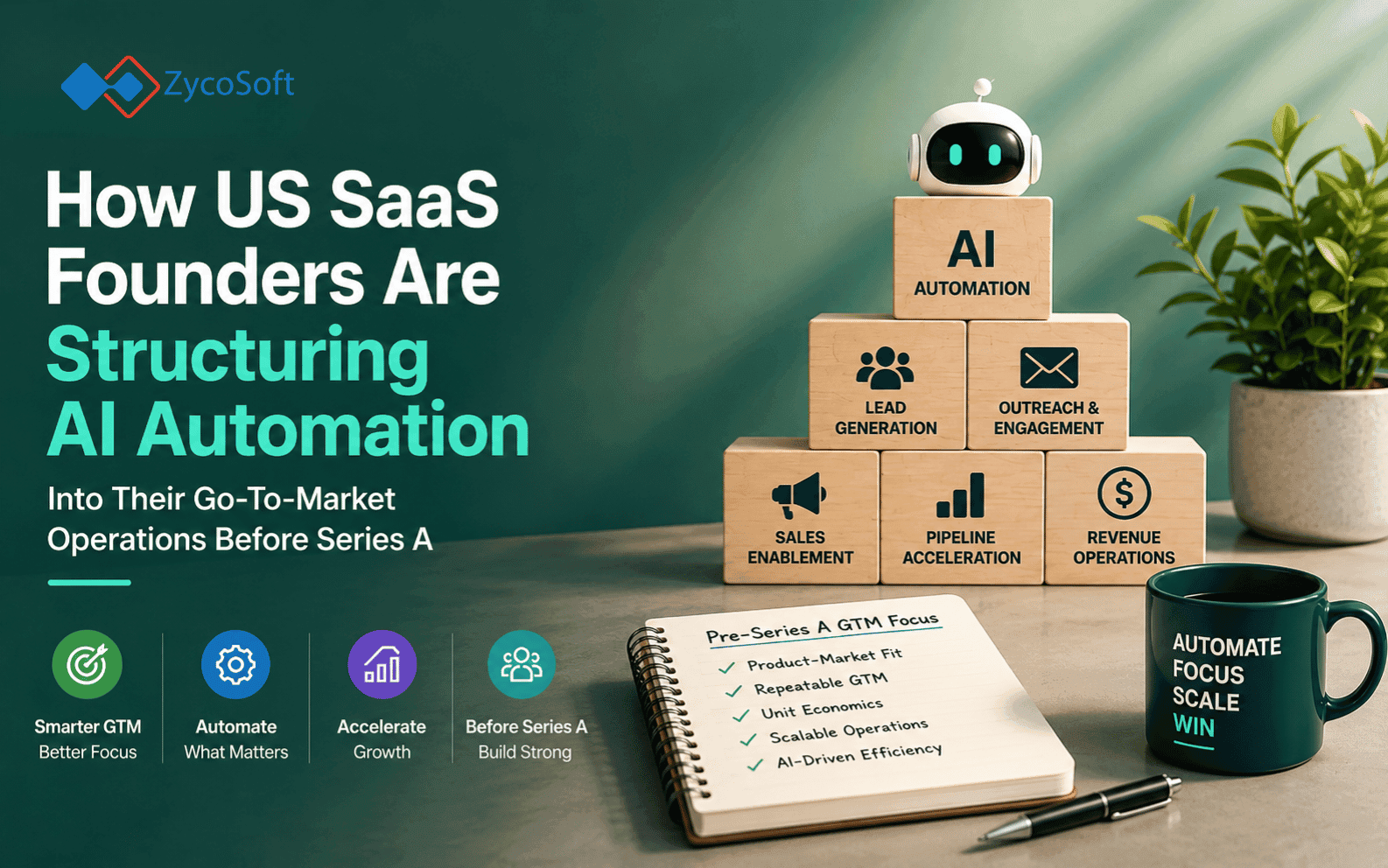
How US SaaS Founders Are Structuring AI Automation Into Their Go-To-Market Operations Before Series A .
Most conversations about AI automation for SaaS companies focus on internal efficiency: reducing back-office overhead, cutting finance admin, streamlining HR workflows. That is useful, but it is not the problem that is actually keeping pre-Series A founders awake. The real pressure is GTM velocity. You have a working product, early customers, and a fundraising window. You cannot afford to hire a six-person revenue team to fill it, and you cannot afford to let pipeline rot while your founders do manual CRM hygiene at midnight.
The founders who are entering Series A conversations with strong pipeline metrics and lean headcount have done something specific. They have embedded AI automation services for reducing manual back office tasks not just into their internal ops, but into the revenue-adjacent workflows that determine whether their GTM motion scales. This post breaks down exactly how they are structuring those pipelines.
Why GTM Automation Is a Different Problem From Back-Office Automation :
Back-office automation reduces cost. GTM automation compresses time-to-revenue. For a pre-Series A founder, those are not the same trade-off.
When an investor looks at your metrics, they are not impressed that you automated your invoice reconciliation. They want to see pipeline coverage, conversion rates, and onboarding-to-activation ratios. Those numbers are directly downstream of how efficiently your GTM motion operates. Every hour a founder or early sales rep spends manually qualifying leads, copying data between tools, or chasing stalled deals is an hour not spent closing or iterating on the product.
AI automation for revenue operations targets this gap specifically. The goal is not to replace salespeople. At this stage, you probably have one or two. The goal is to make them operate like a team of five by eliminating the manual overhead that sits between a signal and an action.
The Four GTM Workflows Worth Automating Before Series A :
Not every workflow is worth automating at this stage. The four areas below have the highest ratio of repetitive manual effort to revenue impact, which makes them the right starting point.
1. Lead Qualification Scoring :
Inbound leads from content, paid, and product-led channels arrive with almost no usable context. Founders spend hours triaging them manually or, worse, they do not triage at all and every lead gets the same follow-up sequence regardless of fit.
A custom AI qualification pipeline ingests lead data, pulls firmographic and behavioural signals from connected sources, applies a scoring model built around your actual ICP criteria, and writes a structured qualification summary directly into your CRM. The sales rep opens their CRM in the morning and sees a ranked list with context, not a raw queue.
2. CRM Enrichment :
CRM records decay fast. Job titles change, companies pivot, funding rounds close. Founders relying on static data make outreach decisions based on information that is weeks or months out of date.
An automated enrichment pipeline runs on a defined schedule, queries third-party data sources, and overwrites or flags stale CRM fields without any manual input. The result is a CRM that stays accurate without anyone maintaining it.
3. Pipeline Hygiene :
Stalled deals are the silent killer of pipeline credibility. A deal that has not had activity in 21 days is probably dead, but it still shows in your pipeline until someone manually removes it. Investors who ask to see your pipeline data will notice immediately.
An AI pipeline hygiene workflow monitors activity timestamps, identifies stalled or miscategorised deals, and either triggers a re-engagement sequence or flags the record for human review. Your pipeline stays clean without a weekly audit.
4. Onboarding Triggers :
Product-led SaaS companies lose most of their trial users in the first 72 hours, usually because nobody noticed the user had not completed the activation step. Monitoring that manually across dozens of active trials is not realistic for a small team.
An event-driven automation pipeline listens to your product analytics layer, identifies users who have stalled at a specific onboarding step, and fires a contextual message, either through email, in-app, or to a Slack channel for a founder to review personally. Activation rates improve without adding a customer success hire.
Why No-Code Tools Break at the Moment You Need Them Most :
The instinct for most early-stage founders is to reach for Zapier or Make. These tools are fast to configure and cheap to start. The problem is that they are designed for simple linear workflows, not for the conditional logic, multi-source enrichment, and LLM integration that effective GTM automation actually requires.
Three failure points that founders consistently encounter with consumer-grade automation tools:
- Webhook reliability degrades under volume, and failures are silent unless you build monitoring on top
- LLM integration is shallow, often limited to a single prompt step with no ability to structure or route the output
- Data handling limitations make it difficult to join signals from multiple sources before writing to the CRM
n8n, deployed on your own infrastructure, resolves all three. It supports custom code nodes, native LLM API connections, conditional branching, and self-hosting under your own data controls. For a SaaS founder with contractual data handling obligations to enterprise customers, self-hosting is not optional. It is a requirement.
The comparison between n8n, Zapier, and Make for production automation makes this trade-off clear. Consumer tools are fine for simple internal notifications. They are not the right foundation for pipelines that touch your revenue data.
What a Custom GTM Automation Stack Actually Looks Like :
The architecture varies by stack, but a typical pre-Series A GTM automation build covers the following components:
- Ingestion layer: Webhooks or API pulls from your CRM, product analytics platform, and any inbound lead sources
- Enrichment layer: Calls to third-party data APIs to append firmographic, technographic, or intent signals
- LLM reasoning layer: Structured prompts that apply qualification logic, generate summaries, or flag anomalies based on the enriched record
- Routing layer: Conditional logic that determines whether to write to the CRM, trigger a sequence, post to Slack, or flag for human review
- Monitoring layer: Failure alerts, volume tracking, and audit logs so you can prove the pipeline is working when investors ask
This is not a configuration you assemble in an afternoon with a no-code tool. It is an engineering build. Founders who try to build it themselves end up with fragile pipelines that require constant maintenance. The more efficient path is to commission the build from an engineering team that has done it before, then hand over a documented, maintainable system.
Using AI automation services for reducing manual back office tasks is only part of what this architecture delivers. The broader outcome is a GTM operation that generates better data, acts on signals faster, and presents a cleaner story to Series A investors without requiring you to hire ahead of that round.
How to Frame This Investment for a Series A Conversation :
Investors at the Series A stage are evaluating operational leverage. They want to know whether the business can scale pipeline without a proportional increase in headcount costs. A founder who can demonstrate that their GTM motion is partially automated, that qualification happens systematically, that their CRM is accurate, and that onboarding runs without manual intervention, is presenting a fundamentally more investable operation than one that depends entirely on founder time.
The spend on custom AI pipelines for SaaS GTM is also a strong signal in itself. It shows that the founder has thought structurally about operational leverage rather than just hiring to cover gaps. That framing matters when a partner is deciding whether this team can responsibly deploy a $4 million to $8 million round.
There is a timing consideration as well. Building these pipelines after you raise is more expensive and more disruptive than building them before. After Series A, you are scaling hiring, onboarding new team members, and accelerating product development simultaneously. Retrofitting automation into a GTM motion that is already moving fast is significantly harder than building the automation first and scaling into it.
Founders who treat AI workflow automation for revenue operations as a pre-fundraising infrastructure investment, rather than a post-funding luxury, consistently enter those conversations from a stronger position. The pipeline data is cleaner, the metrics are more defensible, and the operational story is more credible.
Building the Pipelines Without Adding Headcount :
The point of this entire approach is to add operational capability without adding permanent headcount. That means the build itself needs to follow the same logic. Commissioning a dedicated team extension to build, test, and document your GTM automation stack is a time-bounded engagement. You get the infrastructure without the ongoing salary obligation.
ZycoSoft builds custom AI automation pipelines for pre-Series A and Series A SaaS founders, covering lead qualification, CRM enrichment, pipeline hygiene, and onboarding trigger architecture. We deploy on n8n with full LLM integration, and we hand over documented, maintainable systems rather than black-box configurations. This is AI automation services for reducing manual back office tasks applied specifically to the revenue layer, not generic process automation.
If you are building toward a fundraise and your GTM motion still depends on manual effort to function, that is the problem worth solving first. Talk to us about scoping a custom GTM automation build.
Frequently Asked Questions
Pre-Series A SaaS startups can automate the revenue-adjacent workflows that typically consume founder or early sales rep time: lead qualification, CRM enrichment, pipeline hygiene, and onboarding triggers. Custom AI pipelines built on n8n and LLMs execute these tasks continuously without additional headcount, compressing the GTM cycle and making the operation more credible to investors.
Back-office AI automation reduces internal overhead such as invoice processing, HR admin, and reporting. GTM automation targets revenue-adjacent workflows: qualifying inbound leads, enriching CRM records, flagging stalled deals, and triggering onboarding sequences. For pre-Series A founders, GTM automation has a more direct impact on pipeline velocity and fundraising narrative than back-office efficiency alone.
The highest-impact workflows to automate first are lead qualification scoring, CRM field enrichment from third-party signals, pipeline hygiene checks for stalled or miscategorised deals, and product-usage-triggered onboarding sequences. These four areas consume disproportionate manual effort and directly affect the revenue metrics that Series A investors scrutinise most closely.
n8n supports self-hosting, which matters for SaaS founders handling customer data under contractual or regulatory obligations. It also allows custom code nodes and native LLM integrations that Zapier and Make cannot replicate at the same depth. For production AI pipelines that need to handle conditional logic, webhook ingestion, and multi-step enrichment, n8n is significantly more capable than consumer-grade automation tools.
A focused GTM automation build covering lead qualification, CRM enrichment, and onboarding triggers typically takes four to eight weeks with a dedicated engineering team. The timeline depends on the complexity of existing CRM integrations, the number of data sources involved, and whether the client needs a custom LLM prompt layer or can use a standard model via API.
Point solutions are fast to deploy but constrained by their own data models and pricing tiers. A custom AI pipeline integrates directly with your CRM, your product analytics, and your specific qualification criteria. It can apply proprietary scoring logic, route signals across multiple tools, and scale without per-seat or per-enrichment costs compounding as your pipeline grows.