
How to Build and Launch an MVP in 6 to 12 Weeks: A Founder's Execution Guide.
The product had been in development for five months. The founder, a former consultant who had raised a $400k pre-seed round in Austin, had a Figma prototype, a Notion doc full of features, and a development agency that kept asking for "just two more weeks." His runway was dropping. His pilot customers, three companies who had agreed to try the product, were growing impatient. The thing that was supposed to take eight weeks had become a moving target with no clear finish line.
When he finally brought in a second opinion, the diagnosis was immediate. The scope had never been locked. Every week, a new capability had been added to the backlog and quietly absorbed into the build. What started as a focused workflow tool had accumulated a permissions engine, a reporting module, and a half-built integration with Salesforce. None of those features were needed for week one. All of them were eating time and money that should have reached real users months earlier.
This situation is not unusual. It plays out across early-stage SaaS builds constantly, and it is almost always preventable. What follows is a concrete breakdown of how a 6-to-12-week MVP build actually runs in practice, based on the kind of structured process a serious MVP development company UK-based or otherwise uses when execution speed and capital efficiency are the brief.
Why Most MVPs Stall Before They Ship
The majority of failed MVP builds do not fail because of bad engineering. They fail because the scope was never agreed upon before development started. When a founder treats the product backlog as a live document that anyone can add to, the build has no fixed target. Engineers cannot sprint toward a finish line that keeps moving.
There are three patterns that reliably cause stalling:
- Features are added mid-sprint because a potential investor or pilot customer mentioned they would "love to see" something
- The MVP is scoped around an ideal product rather than the minimum set of capabilities needed to test a specific hypothesis
- The founder is not available for decisions, so engineers make assumptions that require expensive rework
A credible MVP development company will insist on a written scope document, signed off before sprint one starts. That document is not a bureaucratic formality. It is the mechanism that keeps the build moving and the runway intact. If a prospective engineering partner is willing to start coding without one, that is a warning sign worth taking seriously.
How to Lock Scope Before a Line of Code Is Written
Scope locking starts with a structured discovery phase, typically one to two weeks, during which the engineering team works with the founder to translate product vision into a defined, buildable specification. This is where knowing how to scope a software project before speaking to any developer gives founders a measurable advantage: the discovery phase moves faster and the output is more precise when the founder arrives with a clear problem statement and a prioritised list of user actions.
The discovery phase should produce four things:
- A primary user flow: the exact steps a first-time user takes from sign-up to completing the core action
- A feature list with clear tiers: must-have for launch, nice-to-have for version two, and explicitly out of scope
- Acceptance criteria for each must-have feature, written in plain language so both the founder and the engineering team agree on what "done" means
- An architecture decision: most early SaaS products benefit from starting with a monolithic architecture rather than microservices, because it is faster to build, easier to change, and appropriate for the traffic levels an MVP will actually see
The output of discovery is a scope document that both parties sign. From that point, new feature requests go into a version-two backlog, not the current sprint. That single rule is what separates a rapid MVP build from a build that never ships.
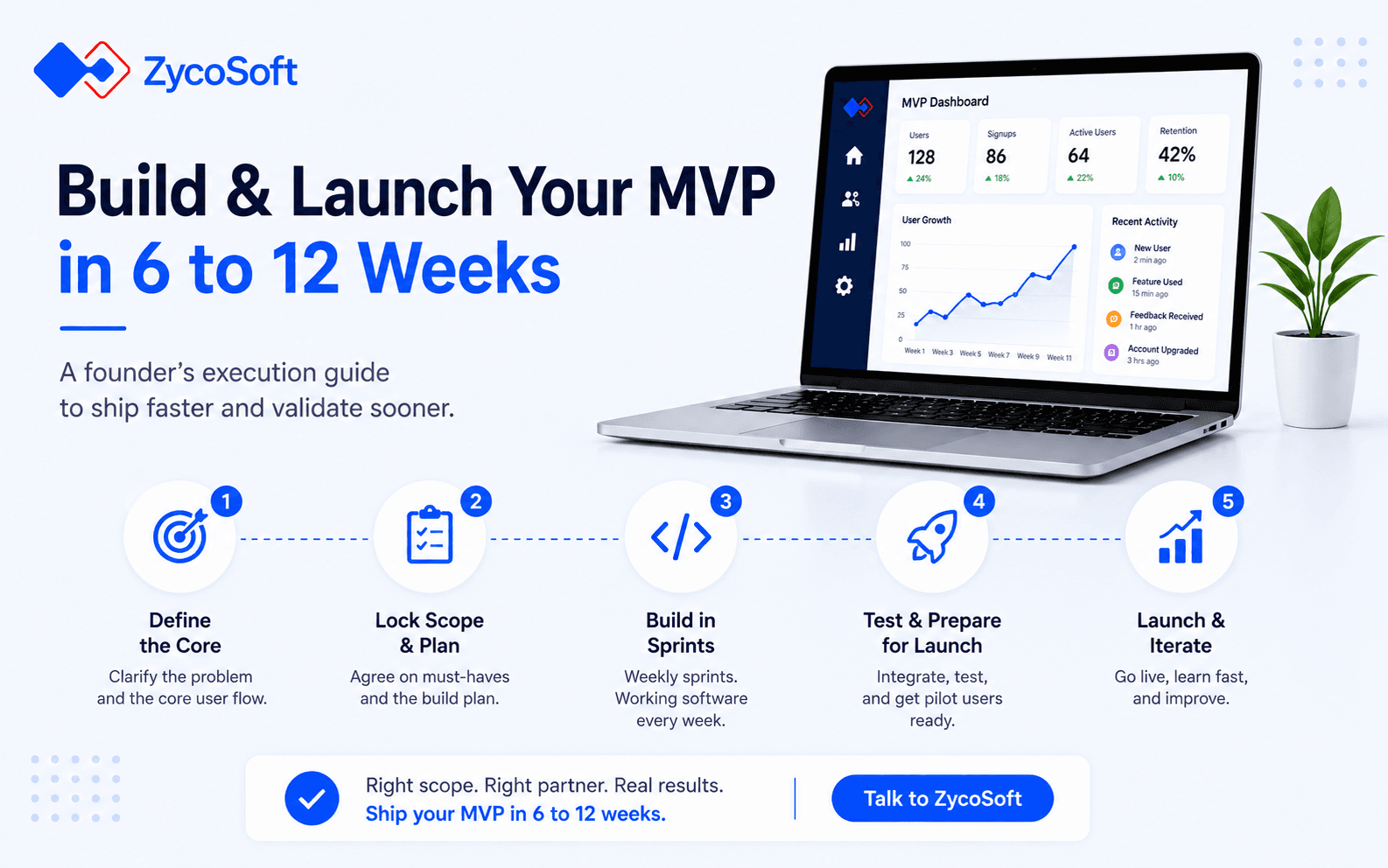
What a 6-to-12-Week Build Actually Looks Like Week by Week
A well-run MVP development engagement follows a predictable rhythm once discovery is complete. The exact timeline depends on scope complexity, but the structure holds across most SaaS builds.
Weeks 1 to 2: Discovery and Architecture
The team finalises the scope document, selects the technology stack, sets up the development environment and project management tooling, and establishes the communication cadence. Daily standups, weekly demos, and a shared Slack or Teams channel are standard practice. The founder should expect to spend four to six hours per week in this phase, not four to six minutes.
Weeks 3 to 7: Core Build Sprints
Engineering runs in one-week or two-week sprints. Each sprint delivers a testable increment of the product. The founder reviews working software at the end of every sprint, not mockups or status updates. This is the point where scope discipline matters most. If a sprint review surfaces a missing feature that was never in the original scope, it goes to the version-two backlog unless it genuinely blocks launch.
Weeks 8 to 10: Integration, QA, and Pilot Prep
Payment integration (using Stripe for most US-market SaaS products), third-party API connections, and security hardening happen here. QA runs in parallel with development rather than as a separate final phase. Pilot users, typically two to five companies or individuals who have agreed to test the product, receive access in a controlled environment before public launch.
Weeks 11 to 12: Launch and Stabilisation
The product goes live for real users. The engineering team remains on a reduced but active retainer to address issues surfaced by early usage. Launch is not the end of the engagement. It is the beginning of the feedback loop that informs version two.
How a Remote Engineering Partner Runs the Process
Working with a dedicated remote engineering partner rather than hiring in-house is a practical capital decision for most pre-Series A founders. A full-time senior engineer in San Francisco costs $180,000 to $230,000 per year in salary alone, before equity, benefits, and the three to four months it typically takes to hire. A custom SaaS development agency with an embedded team model can begin a structured discovery phase within days.
The embedded team model works when three conditions are met. The partner operates with Western work practices, meaning structured sprints, documented decisions, and direct communication without layers of account management. The founder maintains genuine availability for decisions. And the scope document is treated as a shared contract, not a suggestion.
US founders working with a UK-based MVP development company will find that East Coast time zones overlap comfortably with UK business hours in the mornings, and that contract and IP frameworks are familiar enough to avoid the friction that can complicate other international arrangements. Understanding what US founders typically get wrong before development starts is worth reviewing before the first scoping conversation, because the most expensive mistakes happen before a single engineer is engaged.
What Separates an MVP That Ships from One That Doesn't
The founder from the opening of this post eventually shipped. It took restarting the scope exercise from scratch, cutting the Salesforce integration, the permissions engine, and the reporting module, and committing to a fixed eight-week build with a partner who refused to accept new requirements mid-sprint. The product reached its three pilot customers six weeks after the restart. None of them asked about the features that had been cut.
The lesson is consistent across every fast-moving MVP build. Users do not evaluate an early product against a feature checklist. They evaluate it against whether it solves their problem. A focused, well-executed core workflow delivered in eight weeks is worth more than a sprawling, half-finished product that arrives in eight months, or never.
The factors that determine whether an MVP ships on time are:
- Scope locked before development starts, with a written document both parties have agreed to
- A disciplined version-two backlog that absorbs every new idea that emerges during the build
- An engineering partner with a documented sprint cadence and the confidence to push back on scope changes
- A founder who treats weekly sprint reviews as a core business commitment, not an optional update
- An architecture decision that prioritises build speed and changeability over theoretical scalability the product does not yet need
If your product is at the idea-to-build inflection point and you need an engineering partner who will hold scope, run structured sprints, and get working software in front of real users inside 12 weeks, speak to the ZycoSoft team. The discovery conversation is where the timeline gets real.
Frequently Asked Questions
A well-scoped MVP typically takes 6 to 12 weeks from discovery to first user access. The lower end is achievable when scope is locked before development starts, the core user flow is clearly defined, and a dedicated engineering team is available from day one. Scope creep, unclear requirements, or part-time involvement from the founder are the most common reasons timelines stretch beyond 12 weeks.
Include only the features that directly enable a user to complete the single most important action your product exists to support. For most SaaS MVPs, that means one core workflow, basic authentication, and a minimal dashboard or output. Billing, integrations, reporting, and admin tools almost always belong in version two unless your specific monetisation model requires payment at sign-up.
Start with user stories, not features. Write out the steps a target user takes from arriving at your product to achieving their goal. A structured discovery phase with your engineering partner will translate those stories into a prioritised feature list, effort estimates, and a scope document with defined acceptance criteria. This process typically takes one to two weeks and prevents costly mid-build changes.
Many US founders work successfully with a UK or EU-based MVP development company because the time zone overlap with US East Coast hours is workable, contract and IP law is familiar, and senior engineering talent is often more accessible than in saturated US hiring markets. The key is confirming the team operates with Western work practices, daily communication standards, and clear sprint accountability from the start.
The most common cause is scope that was never locked before development started. When a founder treats the MVP as an evolving wishlist rather than a fixed contract with the engineering team, features accumulate, timelines slip, and the product never reaches a shippable state. A disciplined discovery phase and a written scope document, agreed before sprint one begins, are the single most effective safeguard against this outcome.
A traditional agency typically assigns account managers and rotates engineers across projects. A dedicated remote engineering team embeds with your product from discovery through launch, maintains continuity across every sprint, and operates as an extension of your founding team rather than an external vendor. For MVP builds where context and speed matter, the embedded model produces faster, more coherent results.