
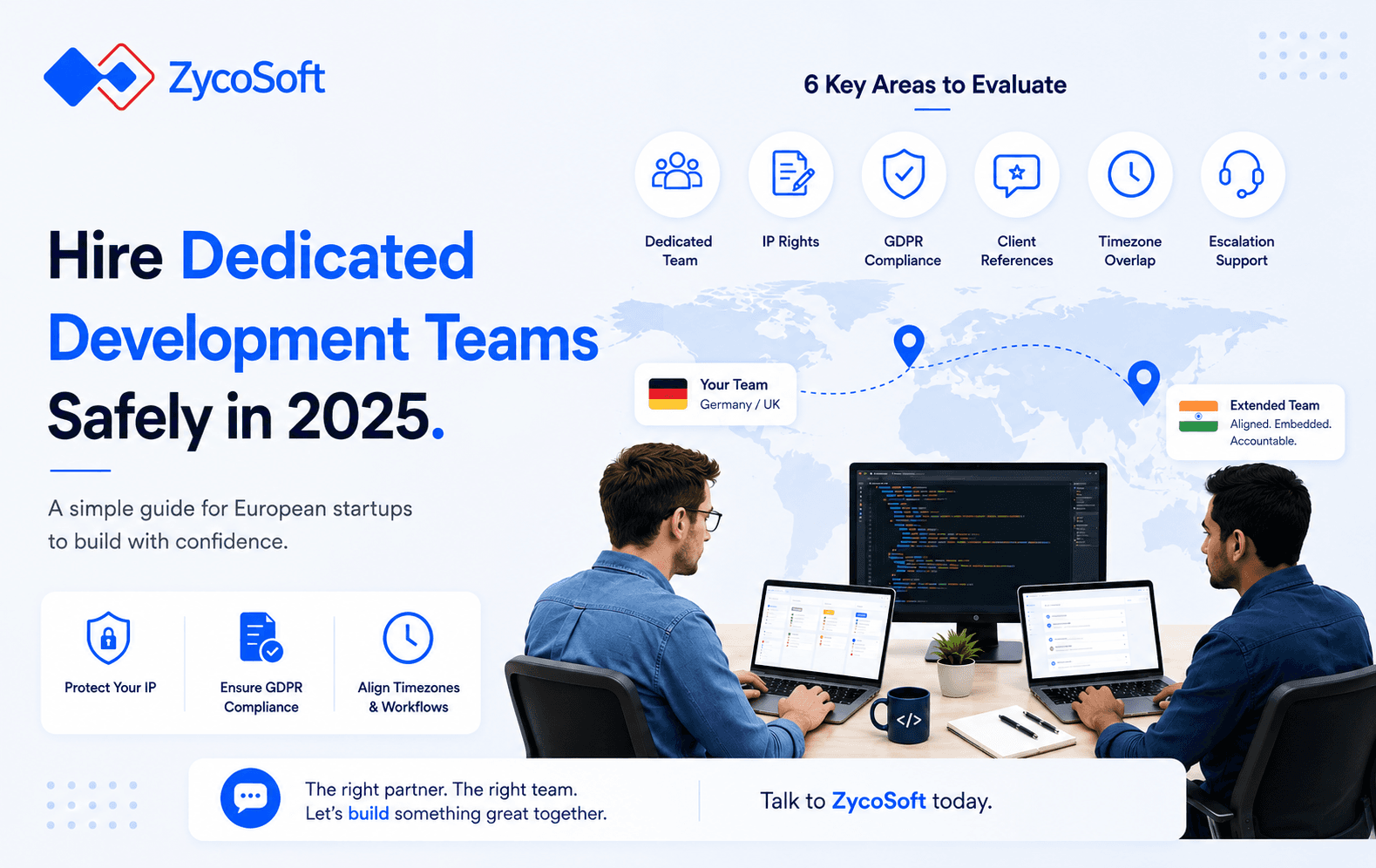
How European Start-ups Hire Dedicated Development Teams Safely in 2025.
Roughly 60 percent of European startups that engage a remote engineering partner for the first time report at least one serious contractual or compliance problem within twelve months. The problems are predictable: ambiguous IP ownership, no Data Processing Agreement in place before production data is shared, engineers rotated off the account without notice, and timezone gaps that compress the working day to a two-hour overlap. None of these are inevitable. They are the result of evaluating the wrong variables at the wrong stage of the decision. This guide is written for CTOs, technical co-founders, and product leads at German and UK startups who are approaching this decision seriously and want a structured framework for doing it without exposure.
Why the Standard Hiring Shortcut Fails European Founders
The default approach most founders take is to post on a talent marketplace, receive a volume of proposals, filter by rate and portfolio, and select the candidate or team that appears most credible at price. This works well enough for isolated tasks: a landing page, a data migration, a specific API integration. It fails systematically when the requirement is a sustained engineering capability across a multi-month product roadmap. The reason is structural. Marketplace platforms are optimised for transaction throughput, not for client outcomes. The incentives run against continuity, code quality, and accountability.
The structural alternative is a dedicated team extension: a named group of engineers embedded into your workflow, operating under your sprint cadence, accountable to your product lead, and contracted through a single professional entity that carries legal responsibility for the relationship. For founders evaluating offshore developers for German startups specifically, this distinction carries additional weight. German commercial law places significant obligations on companies around contractor classification, data handling, and third-party liability. A freelancer arrangement that functions adequately in a less regulated context can create genuine legal exposure under German law without either party intending it.
The model also matters for engineering coherence. A team that rotates individual contributors in and out of your codebase accumulates architectural debt faster than it delivers features. A stable embedded team, by contrast, develops institutional knowledge of your system that compounds over time. The choice between a remote engineering partner and traditional outsourcing models directly shapes your product roadmap capacity, and that effect becomes pronounced from the six-month mark onwards.
How to Vet a Remote Engineering Partner Before You Sign Anything
Vetting a remote engineering partner at the right level of rigour is not complicated, but it requires asking different questions from the ones most founders default to. Rate and portfolio are table stakes. The substantive criteria are these:
- Named team composition. You should know exactly which engineers will work on your product before the contract is signed. Any partner that cannot confirm this is operating a pooled model, which means your project competes for resource allocation with other clients.
- IP assignment policy, in writing. All work product must be assigned to your company at the point of creation. Assignment upon final payment is not acceptable. Verify the governing law clause and confirm it is enforceable in your jurisdiction.
- GDPR compliance posture. Ask specifically whether the partner has signed Data Processing Agreements with other European clients. Ask who their DPO is, or whether they engage one externally. If the answer is vague, the risk is real.
- References from product-stage clients. Ask for two or three references from companies at a similar stage, not from enterprise clients whose procurement process filters out the problems that affect startups.
- Timezone overlap and working practices. Confirm the actual working hours of the engineers you will work with, not the company's marketing position. A four-hour overlap with your core team is a workable minimum; less than that requires exceptional asynchronous discipline to compensate.
- Escalation and accountability structure. Understand who you call if something goes wrong at 11pm on a Thursday before a launch. If the answer involves a helpdesk ticket, that tells you something important.
Beyond these criteria, examine the partner's own product history. A remote engineering partner that has built and launched its own platforms, particularly under NDA for clients with sensitive requirements, demonstrates a different category of capability from one that delivers commodity development work. Scrutiny of their delivery methodology, code review practices, and how they handle technical disagreement with clients is also warranted at this stage.
IP Protection and Contract Structures for German and UK Founders
IP protection is the area where most engagements with offshore developers for German startups go wrong, and almost always because the issue was not addressed explicitly at contract stage. There are three clauses every European founder should treat as non-negotiable before a single line of code is written.
First, a work-for-hire or IP assignment clause that transfers all intellectual property, including source code, documentation, design files, and any derivative works, to your company at the moment of creation. In some jurisdictions, the default legal position is that the creator owns the IP unless explicitly assigned. Never assume the contract's silence means you are protected. Second, a non-disclosure agreement that covers both your product concept and your technical architecture, and that survives termination of the engagement. Third, a non-compete or non-solicitation clause that prevents the partner from deploying your proprietary solutions for competing clients. This is particularly important if you are building in a specialist vertical such as fintech, health tech, or communications intelligence.
For UK founders post-Brexit, the contracting framework is largely familiar, but cross-border data transfer provisions require specific attention. UK GDPR mirrors the EU regulation in most material respects, but the transfer mechanisms for sending personal data outside the UK now operate under UK-specific adequacy decisions and International Data Transfer Agreements rather than EU Standard Contractual Clauses. A remote engineering partner that has documented experience with both frameworks will save your legal team significant time and reduce the risk of an inadvertent breach.
GDPR Compliance When Your Development Team Handles User Data
GDPR compliance in a development context is not only about production data. It applies from the point at which your engineering team first accesses data that could be used to identify a living individual, including anonymised test datasets that can be re-identified when combined with other information. European founders routinely share this type of data with external teams without a signed Data Processing Agreement in place, which is a direct breach of Article 28 of the GDPR regardless of intent.
The Data Processing Agreement must specify what categories of data the development team will access, the purpose of processing, the technical and organisational security measures in place, the sub-processor chain (including cloud infrastructure providers), and the obligations of the processor in the event of a data breach. This is not a formality. Supervisory authorities in Germany, in particular the Landesbeauftragten für Datenschutz, have issued fines against companies that failed to execute DPAs with their technology vendors even where no actual breach occurred.
A remote engineering partner with genuine GDPR-compliant software development capability will not hesitate when you raise these requirements. They will have template DPA language ready, a clear understanding of their sub-processor obligations, and a documented incident response process. At ZycoSoft, GDPR compliance is embedded into our delivery model, not appended to it. Our work spans OSINT platforms and strategic communications tools where data protection is a core product requirement, not a compliance checkbox. That experience translates directly into the rigour we apply to every client engagement involving personal data.
What a Low-Risk Embedded Team Model Actually Looks Like in Practice
The gap between what founders expect from a dedicated remote development team and what they actually receive is most visible in the first eight weeks. A low-risk engagement structure establishes several things before code is written: a shared development environment with clear access controls, a defined sprint rhythm aligned to the client's planning cycle, a communication protocol that does not rely on the founder chasing updates, and a code review process that the client's CTO can participate in without becoming a bottleneck.
For founders building their first serious product, this structure is not bureaucracy. It is the mechanism by which engineering capacity becomes a reliable input to your business rather than a variable that introduces its own risk. Understanding what to put in place before your first sprint begins with a remote engineering partner significantly reduces friction across the full build cycle, and the founders who do this work upfront consistently report faster delivery from month three onwards.
ZycoSoft operates as a dedicated team extension with Western work practices, direct engineer access for clients, and a track record that includes multiple custom platform builds under NDA across strategic communications, OSINT, and SaaS. We work with German and UK founders who are at the stage where engineering quality and contractual clarity matter more than headline day rates. If you are evaluating your options and want a direct conversation about how a properly structured embedded team compares to what you have seen so far, contact us here and we will respond within one business day.
Frequently Asked Questions
A dedicated team extension provides a structured group of engineers who work exclusively on your product, operate under your processes, and are accountable through a formal contract. A freelancer marketplace connects you with individuals on a transactional basis, with no continuity guarantee, inconsistent IP assignment, and significant variance in GDPR awareness. For product-stage startups, the dedicated model reduces rework, attrition risk, and compliance exposure substantially.
German founders should ensure that any engagement includes a written IP assignment clause transferring all work product to the client company at the point of creation, not upon payment or project completion. The contract should be governed by German or EU law, include non-disclosure obligations, and explicitly prohibit the reuse of proprietary code in other client projects. Reviewing this with a German IP solicitor before signing is strongly advised.
If your development team accesses any personal data, including test data, user records, or production databases, you are required under GDPR Article 28 to execute a Data Processing Agreement with that vendor. You must also confirm the team operates from a country with adequate data protection under EU standards or has appropriate safeguards in place. Failing to do this exposes you to fines of up to 4 percent of global annual turnover.
Key criteria include: demonstrable experience with European clients, a clear IP assignment policy, willingness to sign a Data Processing Agreement, verifiable references from product-stage companies, transparent team composition with named engineers, alignment on working hours with your timezone, and a defined escalation process. Avoid any partner that cannot answer specific questions about their GDPR compliance posture or that bundles your work with other client projects.
Staff augmentation places individual contractors into your existing team on a short-term basis, with the vendor retaining employment control and no strategic accountability for outcomes. A dedicated team extension functions as an embedded unit aligned to your product roadmap, operating with shared goals, consistent processes, and a longer engagement horizon. For startups building complex products, the team extension model produces significantly better architectural coherence and lower onboarding overhead over time.
Yes, with the right contractual structure. The UK has its own data protection framework, the UK GDPR, which mirrors the EU regulation in most material respects. UK startups sharing personal data with teams outside the UK must apply transfer mechanisms equivalent to Standard Contractual Clauses. Choosing a remote engineering partner with documented GDPR and UK GDPR compliance experience significantly reduces regulatory exposure and simplifies your own data governance obligations.