
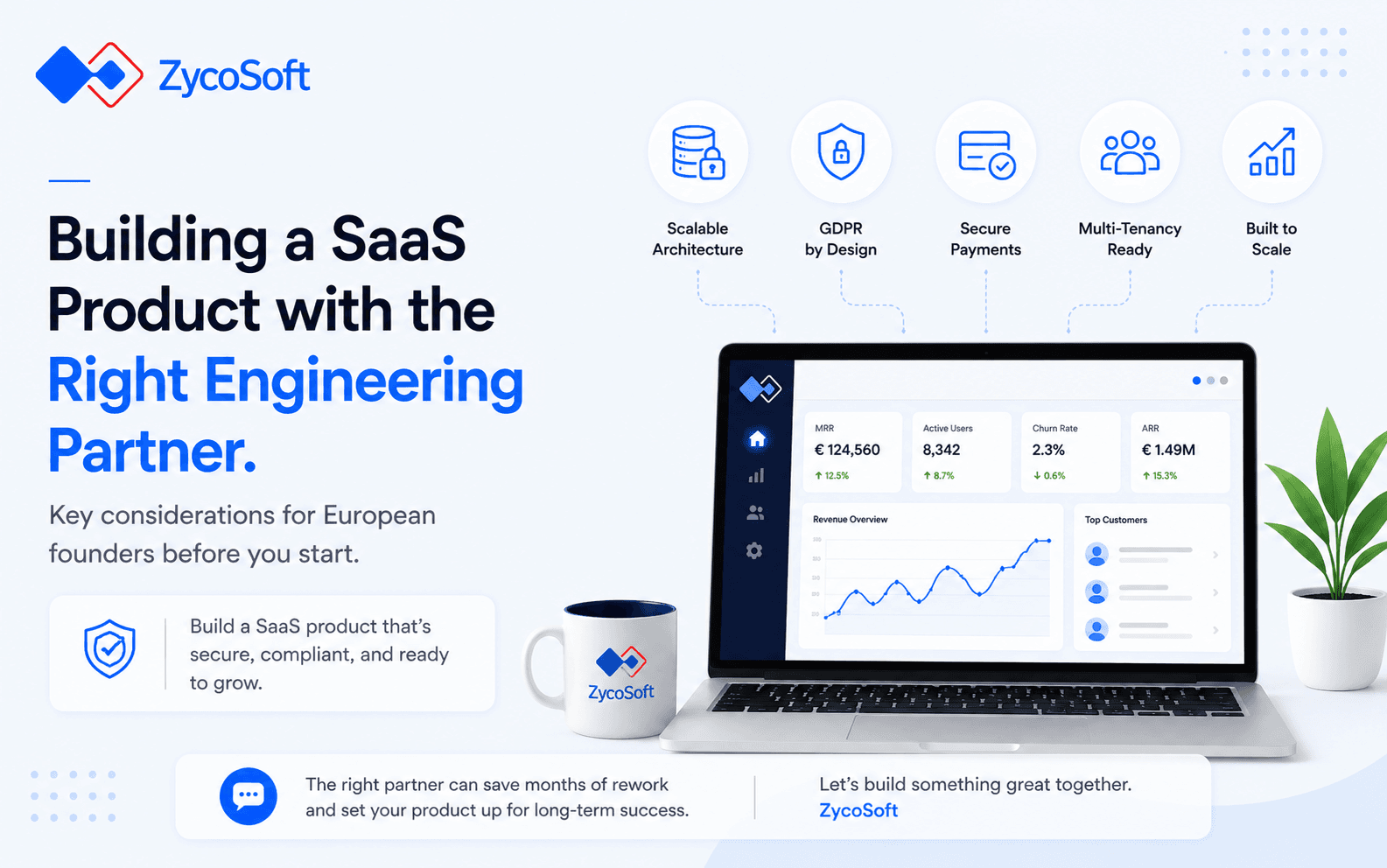
Building a SaaS Product with a Remote Engineering Partner: What European Founders Need to Know Before They Start:
Most SaaS products do not fail because the market was wrong. They fail because the founding team made four or five architecture decisions in the first two weeks that quietly accumulated into an unmaintainable codebase by month six. By the time the problem is visible, you are six figures into the build and facing a partial rewrite. Engaging a custom SaaS development agency UK or a dedicated remote engineering partner does not automatically prevent this. What prevents it is knowing which questions to ask before the first line of code is written, and choosing a partner equipped to answer them.
This guide is written for European and UK founders who are past the idea stage and are now making the practical decisions that will define whether their SaaS product scales or stalls. It covers the architecture decisions that bite hardest, GDPR-by-design requirements, payment integration strategy, multi-tenancy models, and how to structure the relationship with your engineering partner so that it produces a product rather than a backlog of tickets.
The Architecture Decisions That Cannot Be Undone
The three decisions that cause the most expensive rework in early SaaS products are the tenancy model, the authentication layer, and the data schema design. Founders consistently underestimate how permanent these choices feel once real customer data lives inside them. A custom SaaS development agency UK worth engaging will insist on resolving all three before any feature work begins, because retrofitting them later is not a sprint task. It is a project in itself, typically costing four to six weeks of engineering time at exactly the moment your roadmap is supposed to be accelerating.
Your tenancy model determines how customer data is stored and isolated. A database-per-tenant approach gives strong isolation and simplifies GDPR deletion requests, but scales poorly and increases infrastructure costs as customer numbers grow. A shared schema with tenant identifiers on every table is cheaper to operate but requires disciplined query patterns throughout the codebase to prevent data leakage. A hybrid model, with separate schemas per tenant inside a shared database instance, sits between the two. None of these is universally correct. The right choice depends on your pricing model, your expected customer volume at 12 and 24 months, and your compliance obligations. Any remote engineering partner that defaults to a single model without asking these questions is optimising for build speed, not for your long-term architecture.
Authentication is the other decision founders routinely defer. Building custom authentication in 2024 is almost never the right call for a SaaS MVP. Integrating an identity provider such as Auth0, Clerk, or AWS Cognito gives you MFA, social login, session management, and audit logging without building any of it from scratch. It also gives you a compliant audit trail, which matters significantly once GDPR enters the conversation. If you want a practical framework for scoping these decisions before any developer conversations begin, the pre-build scoping process is where this work belongs.
GDPR-by-Design Is Not a Legal Checkbox
European founders building SaaS products for EU or UK customers face a compliance requirement that their US counterparts do not. GDPR is not a policy document you bolt on before launch. It is an architectural constraint that shapes how you design your data layer, your logging infrastructure, your consent management system, and your tenant deletion workflows. Treating it as a legal checklist item for week fifteen of a twelve-week build is one of the most predictable and avoidable mistakes in European SaaS development.
GDPR-compliant SaaS development requires, at minimum, that you can identify every record associated with a specific data subject across all of your tables and third-party integrations, delete or anonymise that data on request within 30 days, export it in a portable format on request, and demonstrate a lawful basis for processing it in the first place. For a multi-tenant SaaS product, this means your schema design must support tenant-scoped deletion without cascading failures. Your logging infrastructure must not inadvertently store personal data in application logs. Your third-party integrations, including your payment processor, your email provider, and your analytics stack, must be covered by appropriate data processing agreements.
A genuinely capable custom SaaS development agency UK will raise all of this in the discovery phase, not in response to a legal query three months into the build. GDPR-compliant capability is rare in the agency market precisely because it requires engineering teams to understand the regulation at a schema and pipeline level, not just at the policy level. When evaluating any remote engineering partner, ask specifically how they handle data subject access requests in a multi-tenant architecture. The answer will tell you a great deal about whether they have actually built compliant SaaS products before.
Payment Integration Strategy for European SaaS Products
Subscription billing sounds straightforward until you are three weeks into the Stripe integration and realise that your pricing model includes usage-based components, volume discounts, and mid-cycle plan upgrades. Stripe's billing infrastructure is powerful, but it requires deliberate design to support anything beyond a simple flat-rate subscription. Founders who treat payment integration as a standard two-day task routinely find it consuming two to three weeks of engineering time once real pricing logic is applied to it.
For most European SaaS products, Stripe handles the majority of use cases across the UK, France, Germany, Spain, and the Nordic markets. If your target customers include businesses in the Netherlands, Belgium, or Germany who prefer local payment methods such as iDEAL or SEPA Direct Debit, Mollie provides stronger coverage for those workflows. The strategic decision is not which gateway to use, it is how to design your billing abstraction layer so that adding a second gateway later does not require rewriting your subscription logic. Build the abstraction first, then implement the gateway behind it.
Beyond gateway selection, your billing architecture needs to handle failed payment recovery, dunning sequences, proration on plan changes, tax calculation across multiple EU jurisdictions, and invoice generation that meets local legal requirements. Each of these is a discrete engineering problem. A remote engineering partner with payment integration experience across Stripe, Mollie, and Razorpay will scope these as separate workstreams in your MVP plan, not as a single line item. If your partner is not asking about your pricing model in the first discovery call, that is a signal worth paying attention to.
Structuring the Relationship with Your Engineering Partner
The difference between a SaaS product that ships on time and one that drifts six months past its launch window is usually not technical complexity. It is the quality of the working relationship between the founding team and the engineering partner. Founders who treat their remote engineering partner as a ticket-processing service get ticket-processing outcomes. Founders who embed their engineering partner into product thinking, give them context on commercial decisions, and include them in roadmap conversations get products that are architecturally aligned with where the business is going.
A dedicated team extension operating on Western work practices, with transparent sprint reporting, direct access to senior engineers, and genuine accountability for delivery quality, functions as an extension of your internal team rather than an external supplier. This distinction matters enormously for SaaS products, where the architecture must evolve as customer feedback arrives. The practical implications of this model versus fragmented supplier relationships are significant for founders managing product velocity alongside commercial milestones.
Before signing any engagement, establish the following with your engineering partner. First, confirm who holds technical ownership of architectural decisions and what the escalation path is when those decisions affect the roadmap. Second, agree on sprint cadence, demo frequency, and how feedback loops between product and engineering are managed. Third, understand the team's direct experience with the specific technology stack your product requires, particularly if your SaaS product involves AI automation components, OSINT data pipelines, or complex integration layers. A custom SaaS development agency UK that has delivered production AI automation deployments alongside SaaS products brings a different level of technical depth to these conversations than one operating purely within conventional web application frameworks.
From MVP to Scalable Product: Planning the Full SaaS Lifecycle
An MVP that cannot evolve into a scalable product is an expensive prototype. European founders, particularly those approaching seed or pre-Series A funding, need to demonstrate that their technical foundation can support the growth story in their investor deck. This means your MVP architecture must anticipate multi-region data residency requirements, horizontal scaling patterns, and the ability to onboard enterprise customers with SSO and role-based access controls, even if none of these features are built on day one.
Planning the full SaaS lifecycle from the outset does not mean building everything upfront. It means making architecture choices in the MVP phase that do not create expensive blockers at the growth phase. Use infrastructure-as-code from the start so that environment replication is a script rather than a manual process. Build your feature flag system into the application early so that staged rollouts and A/B testing are operational before you need them. Design your API layer with versioning in mind so that enterprise integrations do not break when you ship updates.
The founders who navigate this most effectively are those who treat their custom SaaS development agency UK as a long-term embedded partner rather than a project vendor. The partner that built your MVP understands your data model, your tenant architecture, your billing logic, and your compliance posture. That institutional knowledge is a genuine competitive asset at the growth stage. Rebuilding it with a new team because the original engagement was scoped as a fixed deliverable costs time and money that early-stage SaaS businesses cannot easily absorb. Use a structured partner evaluation checklist before any engagement to ensure the team you select is positioned to stay with you through the full product lifecycle, not just the first release.
Frequently Asked Questions
A remote engineering partner embeds into your product lifecycle, contributing to architecture decisions, sprint planning, and roadmap evolution. A traditional agency executes a fixed brief. For SaaS products, where requirements shift rapidly after first user feedback, the embedded model significantly reduces rework costs and protects launch timelines.
GDPR requires that data residency, consent management, data subject access requests, and deletion workflows are built into your system architecture, not retrofitted. For SaaS products serving EU users, this means designing your data layer, tenant isolation, and logging infrastructure with compliance in mind from the first sprint, not the week before launch.
Multi-tenancy means multiple customers share a single application instance while their data remains logically isolated. Choosing the wrong tenancy model early, such as a fully siloed database-per-tenant approach when your business model requires shared infrastructure, can force a costly architectural rebuild at Series A. This decision should be made before any database schema is finalised.
Stripe remains the most developer-friendly option for SaaS subscription billing across the UK and Europe. Mollie offers stronger coverage for Dutch, Belgian, and German local payment methods. Razorpay is relevant for products targeting South Asian markets. For most European SaaS products, Stripe with a Mollie fallback covers the majority of use cases at launch without over-engineering the payments layer.
Define the single workflow your product must execute better than any existing tool. Document your tenant model, user roles, and core data entities before any technical conversations. Identify your payment and billing logic, as subscription SaaS billing is rarely simple. A well-scoped brief reduces your MVP build time by 20 to 30 percent and gives any engineering partner a precise basis for estimation.
A well-scoped SaaS MVP with authentication, multi-tenancy, a core feature set, and Stripe billing typically takes 10 to 16 weeks with a competent embedded engineering team. Poorly scoped projects with undefined tenancy models or late GDPR requirements routinely add six to ten weeks. The quality of your pre-build decisions matters more than team size.