
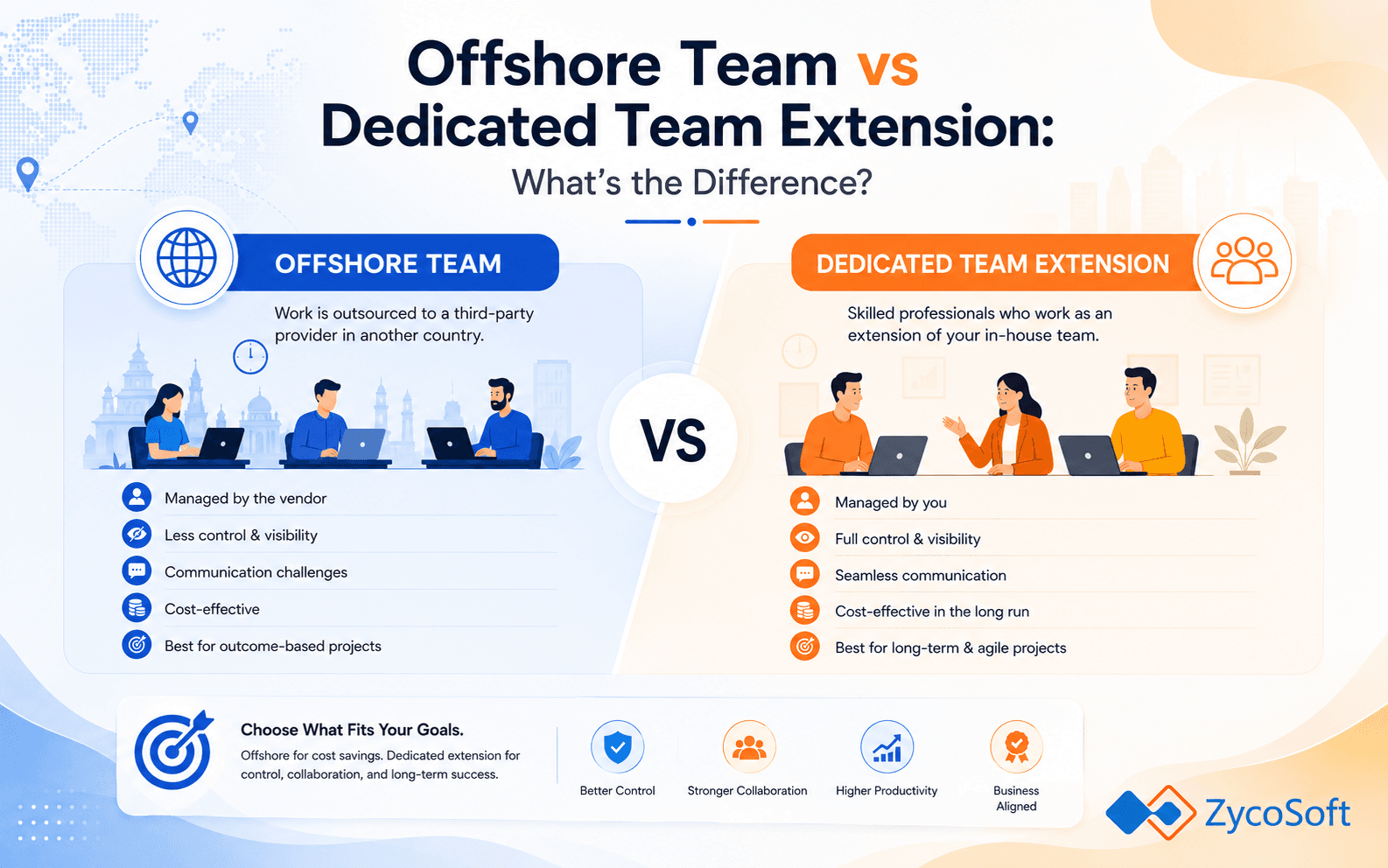
Most companies shopping for remote engineering help end up comparing two options: offshore outsourcing and a dedicated team extension. On the surface they look similar - both involve engineers working remotely, often from another country. In practice, they are structurally different, with different implications for control, quality, communication, and long-term outcomes.
If you are a startup founder, CTO, or engineering leader evaluating your options, this guide gives you a clear, honest breakdown of what each model actually means, when each one fits, and how to decide.
What Is Offshore Outsourcing?
Offshore outsourcing means handing a defined scope of work to an external vendor in another country. You describe what you need, they deliver it. The relationship is project-centric: there is usually a statement of work, fixed deliverables, and a defined timeline.
The vendor manages their own team internally. You rarely know who is working on your project day to day, and the developers typically work across multiple client projects simultaneously. Communication is often routed through a project manager rather than direct access to engineers.
When Offshore Outsourcing Makes Sense
Offshore outsourcing works best when the scope is clearly defined, requirements are stable, and the project is bounded. Fixed-scope builds - a landing page, a standalone integration, a one-time data migration - suit this model well. You do not need deep involvement with the team, and a clean handoff is acceptable at the end.
The risk increases significantly for complex, evolving, or long-term projects. When requirements change, or when quality requires close collaboration, the arm's-length nature of traditional outsourcing becomes a liability.
What Is a Dedicated Team Extension?
A dedicated team extension is a different model structurally. You are not handing work to a vendor - you are extending your own team with senior engineers who work exclusively on your product, embedded in your tools, sprints, and processes.
The engineers attend your standups, use your Jira or Linear board, communicate directly on your Slack, and take real technical ownership. They are accountable to your roadmap, not to a vendor's delivery quota. The relationship is long-term and collaborative by design.
At ZycoSoft, this is exactly how our Dedicated Development Teams service operates. We match vetted senior engineers to your stack and ways of working, arrange overlapping working hours, and integrate them as a genuine extension of your in-house team - not an external vendor at arm's length.
When a Dedicated Team Extension Makes Sense
This model fits product companies, startups, and SMBs that need to extend engineering capacity reliably without the time and cost of local hiring. If your roadmap is moving faster than your ability to hire, or if you need senior engineers with consistent focus on your product, a dedicated team extension is structurally better suited than project outsourcing.
It also works well for companies building complex or evolving products, where the cost of inconsistent quality or communication gaps is high.
Key Differences: Offshore Outsourcing vs Dedicated Team Extension
Control and Visibility
With offshore outsourcing, visibility into the team's day-to-day work is limited. Decisions are made inside the vendor's organization, and you typically see output rather than process.
With a dedicated team extension, you have direct access to engineers. They work within your processes, and you see progress in the same way you would with an in-house employee - through sprint boards, standups, and direct conversation.
Team Ownership
In an outsourced model, the vendor owns the team composition. Engineers may rotate between projects, and you have little say in who works on your product.
In a team extension model, the engineers are matched to your specific needs and focused on your product full-time. You are involved in the selection process, and the team is yours to direct.
Communication Structure
Offshore outsourcing often involves a project manager layer between you and the engineers. This introduces latency and information loss.
Dedicated team extension removes that layer. You communicate directly with engineers, the same way you would with any internal hire.
Fit for Long-Term Products
Offshore outsourcing is built for discrete, bounded engagements. It is not designed for products that evolve continuously.
A dedicated team extension is designed precisely for long-term product development. Engineers build context over time, understand your codebase deeply, and contribute more effectively the longer they are embedded.
Cost Structure
Offshore outsourcing often looks cheaper at the project level, but hidden costs accumulate: rework from misaligned requirements, communication overhead, and quality issues that surface post-handoff.
Dedicated team extension is priced on a time and capacity basis, which is transparent and predictable. Total cost of ownership is typically lower for ongoing work because quality is higher and rework is minimized.
Which Model Should You Choose?
Choose offshore outsourcing if your work is clearly scoped, requirements are stable, and a clean handoff is acceptable. Short integrations, one-time builds, and defined standalone features can work well in this model.
Choose a dedicated team extension if you are building or evolving a product, need senior engineers who take real ownership, and want your remote team to function like an extension of your in-house squad rather than a black box.
Most serious product companies find that as complexity and ambition increase, the outsourcing model becomes a bottleneck. A dedicated team extension scales with your product instead of constraining it.
How ZycoSoft Structures Dedicated Team Engagements
We assemble teams around your existing stack and conventions. After understanding your roadmap and technical requirements, we propose matched senior engineers, onboard them into your sprints and tools, and provide overlapping working hours so collaboration is close regardless of region.
Engagement models range from a single senior engineer or specialist to a cross-functional product squad and scalable multi-team delivery. Everything the team produces is your intellectual property, with clean documentation and handover at every stage.
If your roadmap is moving faster than your hiring - or if you've tried offshore outsourcing and found it falling short - a dedicated team extension is worth a direct conversation.
Frequently Asked Questions
Offshore outsourcing hands a defined project scope to an external vendor who manages their own team. A dedicated team extension integrates senior engineers directly into your workflows, tools, and sprints, so they operate as a true extension of your in-house team rather than an outside supplier.
The upfront rate may be comparable, but the total cost of ownership is typically lower for ongoing work. Dedicated team extensions minimize the rework, communication overhead, and quality issues that accumulate with traditional outsourcing.
At ZycoSoft, we typically propose matched engineers within days of scoping your needs and onboard them into your sprints shortly after — significantly faster than direct hiring.
You do. All intellectual property produced by the dedicated team belongs to the client, with clean documentation and handover at every stage.
Offshore outsourcing works well for clearly scoped, stable projects with defined deliverables and an acceptable clean handoff — such as standalone integrations, fixed-scope builds, or one-time data migrations.