
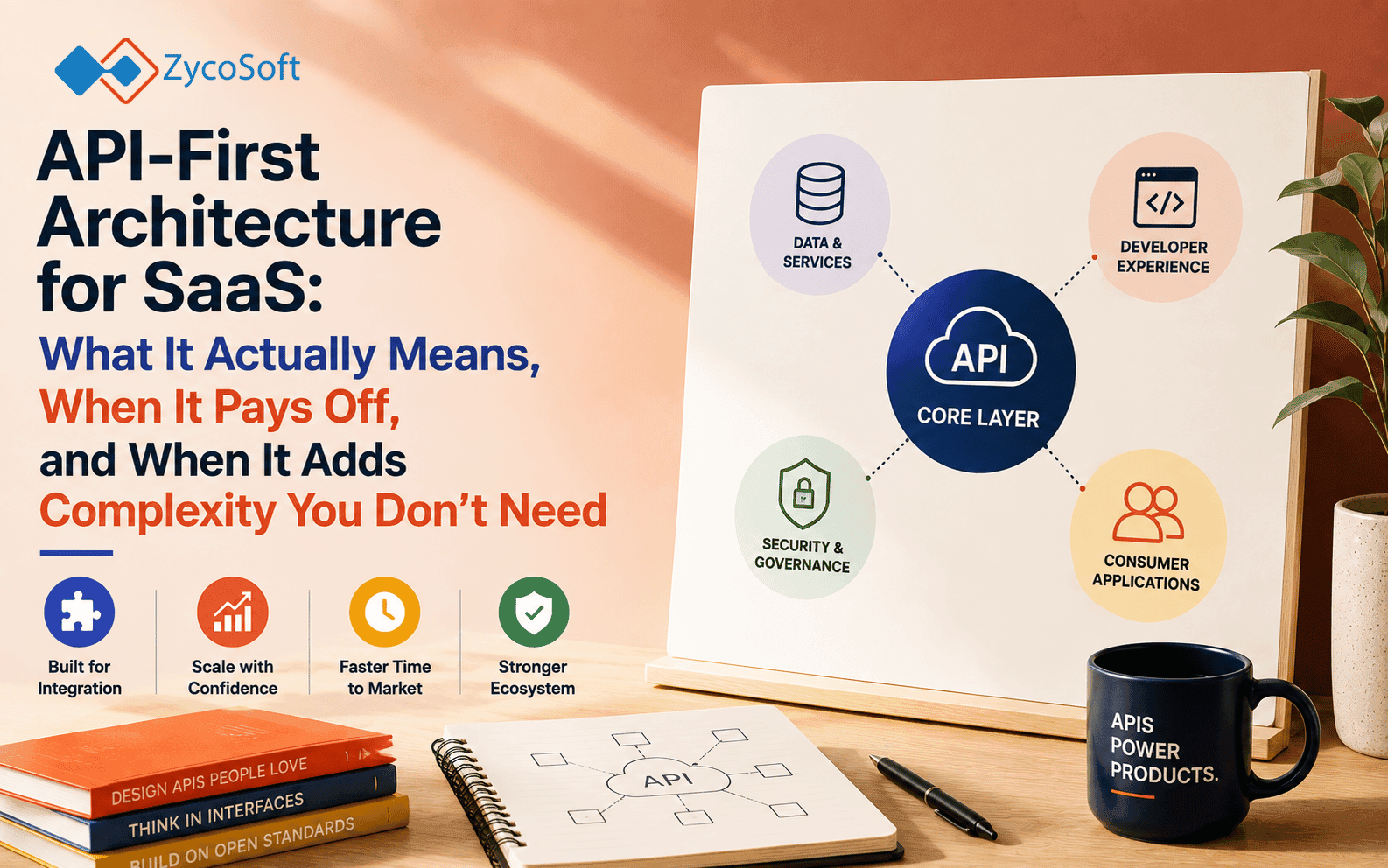
API-First Architecture for SaaS: What It Actually Means, When It Pays Off, and When It Adds Complexity You Don't Need.
The decision to commit to API-first architecture for SaaS is made too early, too often, by teams that conflate a good long-term architectural pattern with a good day-one architectural pattern. The result is an MVP that takes three times as long to ship, a backend encrusted with versioning logic, and a developer experience nobody asked for yet, because the product has one consumer, one team, and zero external integrations.
This post gives you a practitioner decision framework. It covers what API-first actually means at the engineering level, separates it from the adjacent but distinct practice of contract-first API design, and lays out a stage-gated model for when to introduce API-first patterns as your product and your consumer surface area grow. If you are a technical founder or engineering lead evaluating architecture for a new SaaS build, this is the trade-off analysis you need before committing.
What API-First Architecture Actually Means :
API-first architecture means the API is the product. The interface contract is designed and locked before any implementation begins, and every downstream consumer, whether a web frontend, mobile app, third-party integration, or internal microservice, is treated as an external client from the outset. Nothing consumes internal implementation details directly. Everything goes through the published interface.
In practice, this means three things that have real engineering consequences:
- Contract-first specification: You write an OpenAPI (or AsyncAPI for event-driven systems) specification before writing a single line of implementation code. The spec is the source of truth, not a generated artefact from your code.
- Interface stability as a first-class constraint: Once a contract is published, breaking changes require versioning. This is not optional overhead; it is the architectural commitment.
- Consumer-driven design: The API shape is driven by what consumers need, not by what is convenient for the backend implementation.
That last point is where most teams get tripped up. A backend developer designing an API around their data model is not doing API-first design. They are doing database-first design with an HTTP wrapper.
Contract-First API Design vs Full API-First Architecture :
These two terms are frequently used interchangeably, and they should not be. The distinction matters because one is almost always worth doing and the other depends entirely on your product stage.
Contract-first API design means writing your OpenAPI specification before implementation. A minimal example of what this looks like in practice is a YAML file that defines endpoints, request schemas, response schemas, and error models before any handler code exists. Tools like Stoplight, Swagger Editor, or even a raw YAML file in your repository enforce this discipline. The payoff is clear: your frontend team can mock against the spec on day one, your spec becomes your documentation, and you catch interface design mistakes before they are baked into implementation.
Full API-first architecture is the broader organisational and engineering commitment. It includes versioning strategies, a developer portal, SDK generation pipelines, deprecation policies, and governance processes for contract changes. This is appropriate when your API is a product surface used by multiple independent teams or external parties. It is not appropriate when you have one frontend team and one backend team working in the same repository on the same sprint cycle.
The practical guidance is this: do contract-first API design on almost every project. Commit to full API-first architecture only when the consumer surface justifies it.
The Most Common Mistake: Building API-First Before There Is a Second Consumer
The single most reliable indicator that full API-first architecture is premature is the absence of a second API consumer. If your product has one web frontend, controlled by your team, consuming one backend, also controlled by your team, full API-first architecture adds overhead with no compensating benefit.
The overhead is not trivial. Consider what API-first discipline requires when you need to change a response schema because the product model has shifted:
- Update the OpenAPI specification and get review sign-off.
- Decide whether the change is breaking or additive.
- If breaking, increment the API version (v1 to v2) and maintain both routes.
- Update any generated SDKs or client libraries.
- Update documentation and changelogs.
- Notify consumers and agree a deprecation timeline.
For a product with one internal consumer, steps 3 through 6 are pure overhead. You could simply update the frontend to match the new contract in the same pull request. Early-stage SaaS products need to iterate on their business logic at speed. Rigid interface contracts create friction at exactly the moment when product-market fit requires maximum flexibility. This is the same reasoning behind the deliberate monolith-first approach to SaaS architecture: start with the simplest structure that works, and introduce complexity only when the product justifies it.
When API-First Architecture for SaaS Actually Pays Off :
API-first architecture earns its overhead at the point where multiple independent consumers need to rely on your backend with a stability guarantee. The trigger conditions are specific and worth enumerating.
Commit to API-first architecture when one or more of the following are true at or before launch:
- You are shipping a web app and a mobile app simultaneously, consuming the same backend..
- Your product value proposition includes a public API that paying customers will build integrations against.
- You have partner integrations or webhook consumers that are external to your engineering team.
- Your backend serves multiple independently deployed frontend applications, for example a customer portal and an admin interface maintained by different teams.
- You are building a platform product where third-party developers are part of the go-to-market model.
A US-based B2B SaaS platform that ships with a native iOS app, a web dashboard, and a Zapier integration at launch has a legitimate multi-consumer API surface from day one. API-first architecture is appropriate. A UK-based SaaS product with a single web frontend targeting SMEs, planning to add a mobile app in version two, is not there yet. The architecture should be designed so that API-first patterns can be introduced incrementally, but it should not be imposed before the consumer surface exists to justify it.
The other scenario where API-first pays off early is when your team structure mirrors the architecture. If you have a dedicated frontend team and a dedicated backend team working in parallel on separate release cycles, a published API contract is the coordination mechanism that makes parallel development viable. Without it, you are coordinating informally, and that breaks under pressure.
A Stage-Gated Decision Framework for API-First Architecture :
Rather than a binary yes or no decision, treat API-first architecture as a spectrum with defined stage gates. The following framework gives engineering leads a concrete model for when to advance.
Stage 1: Single-team MVP (pre-product-market fit)
- Use contract-first API design with an OpenAPI spec checked into the repository
- Structure your backend with clean domain boundaries, but do not enforce external API versioning
- Keep your frontend and backend in the same deployment pipeline if team size allows
- Design your data model and domain logic so that extracting a proper API layer later is low-friction
Stage 2: Multiple consumers confirmed (post-PMF, pre-scale)
- Formalise the API contract: version it, publish it, and enforce backward-compatibility rules
- Introduce API gateway tooling if you do not already have it
- Separate frontend and backend release cycles explicitly
- Begin building the developer experience layer if external integrations are part of the product
Stage 3: Platform or partner surface (scale)
- Full API-first governance: versioning policies, deprecation schedules, SDK generation, developer portal.
- API as a first-class product surface with its own roadmap and stakeholders.
- Rate limiting, scoped authentication (OAuth 2.0 with granular scopes), and usage analytics baked in from the API layer.
Choosing the right tech stack from the start, including how you structure your backend to support this progression, has a direct bearing on how much rework Stage 2 and Stage 3 require. The decisions made at Stage 1 either create a clean upgrade path or a painful refactor. For a detailed treatment of making stack decisions that survive growth, the post on choosing a tech stack for a SaaS MVP that will not need a rewrite at scale covers the complementary decisions that sit alongside API structure choices.
How ZycoSoft Approaches API Architecture on Custom SaaS and MVP Builds :
The framing above reflects how we scope and architect SaaS products at ZycoSoft. On every Custom SaaS Development engagement, we make an explicit early decision about whether full API-first architecture is warranted at the current product stage or whether contract-first design within a structured monolith is the right starting point. We do not apply the same pattern to every product; we apply the pattern that matches the product's consumer surface and growth trajectory.
For MVP Development specifically, we consistently see over-engineering from teams that have read about API-first best practices and applied them without checking whether the second consumer exists yet. We scope projects to avoid this. The deliverable at MVP stage is a product that can be validated quickly, not an architecture that can support ten integration partners who do not exist yet.
What we do on every build, regardless of stage, is contract-first API design with OpenAPI specifications as living documents in the repository. This gives clients a clean upgrade path when the consumer surface grows, without the overhead of full API-first governance from week one. The architectural patterns we use are also designed to support GDPR-compliant data handling at the API layer, which matters for UK and EU clients where data exposure through API responses is a compliance consideration, not just an engineering one. If you are thinking through those data architecture obligations, the post on building GDPR-compliant software architecture from day one covers the engineering specifics.
The result is a codebase that reflects the product's actual stage, not an architecture astronaut's vision of where it might be in three years. When the product grows, the path to full API-first architecture is deliberate and low-friction rather than a structural debt problem.
If you are evaluating whether to commit to API-first architecture for a SaaS product you are building or scoping, talk to us before you lock in the design. The wrong decision at this stage costs months, not days. Get in touch with the ZycoSoft team to discuss your architecture.
Frequently Asked Questions
API-first means the API contract is designed and agreed before any implementation begins. The interface is treated as the primary product artefact, not a side effect of backend development. In practice, this means writing an OpenAPI or AsyncAPI specification first, getting stakeholder sign-off on that contract, and then building the implementation behind it. It enforces interface stability and enables parallel frontend and backend development.
Build API-first from day one when you have a confirmed second consumer of that API at launch, for example a mobile app and a web app consuming the same backend, a partner integration requirement, or a public API as part of the product value proposition. If your only consumer is a single web frontend you control, full API-first architecture adds overhead without proportionate return at the MVP stage.
Contract-first API design means writing the API specification, typically an OpenAPI YAML or JSON document, before writing any implementation code. API-first architecture is a broader commitment that includes organisational processes, governance, versioning strategies, and developer experience tooling. Contract-first is a subset of API-first and is worth doing on almost any project, regardless of whether you commit to the full API-first architectural pattern.
The primary risk is velocity loss. Early-stage SaaS products need to iterate on business logic quickly, and a rigid API contract creates friction every time the product model changes. You end up versioning APIs, writing migration guides, and managing backward compatibility for consumers that do not yet exist. This is the engineering equivalent of building a motorway before knowing whether the town needs a road at all.
Start by extracting well-defined domain boundaries into explicit HTTP interfaces, even inside a monolith. Write OpenAPI specifications for those interfaces, enforce them with a validation layer, and treat the spec as the source of truth. Over time, those internal contracts become the basis for external or service-level APIs. This incremental approach avoids a big-bang rewrite while building the contract discipline that API-first architecture depends on.
Yes. API-first architecture distributes data handling across explicitly defined interfaces, which makes it easier to enforce data access controls at the API layer and audit what personal data flows between consumers. Well-designed API contracts can include explicit response schema definitions that prevent accidental over-exposure of personal data fields. However, the compliance obligation sits in your implementation and data governance, not the architectural pattern itself.