
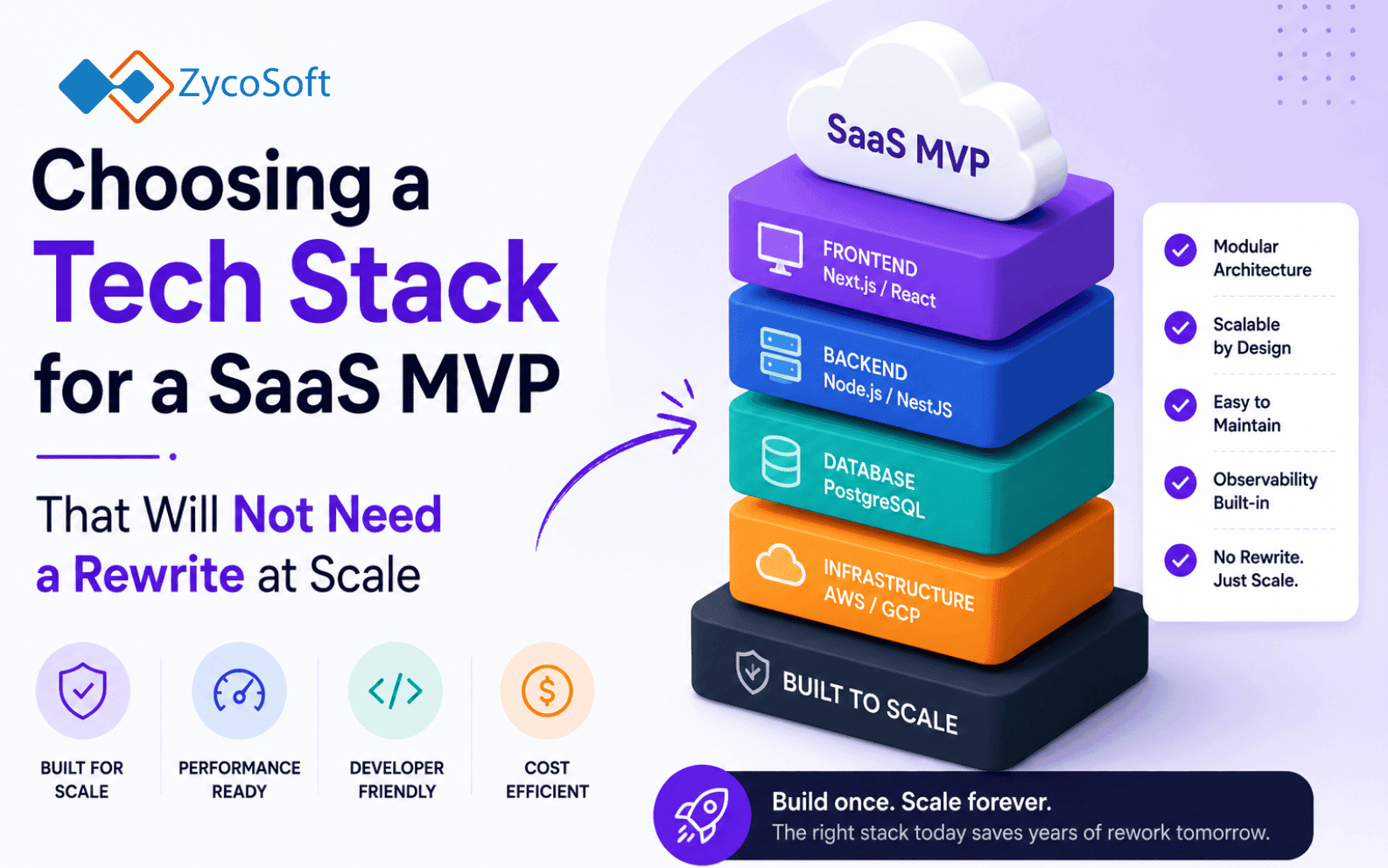
Choosing a Tech Stack for a SaaS MVP That Will Not Need a Rewrite at Scale :
The most expensive engineering decision you will make is not the one you labour over for three weeks. It is the one you make in forty-five minutes under pressure during the first sprint. Most SaaS rewrites trace directly to a stack choice that felt reasonable at week one and became a structural liability by month eighteen. The goal of this guide is not to hand you a single "correct" stack. It is to give you a decision framework for choosing a tech stack for a SaaS MVP that does not force a full rewrite when you cross 10,000 users, add a second product line, or onboard an enterprise client with strict data isolation requirements.
The Rewrite Root Causes You Are Actually Trying to Avoid
Before covering specific technology choices, it is worth naming the failure modes precisely. Most SaaS rewrites are not caused by the wrong programming language. They are caused by three specific architectural mistakes made at the MVP stage.
- Schema decisions that cannot be migrated cleanly. Choosing a document database for data that turns out to be deeply relational, then spending eighteen months working around the absence of joins and transactions.
- Premature service decomposition. Splitting into microservices before you understand your domain model, then discovering that your service boundaries cut across your actual business logic and every feature requires cross-service coordination.
- Business logic embedded in the HTTP layer. Controllers that contain validation, transformation, pricing rules, and persistence logic, making the codebase untestable and unmovable as requirements change.
The stack choices that follow are oriented around avoiding these three failure modes specifically. As covered in our guide on monolithic vs microservices architecture for SaaS, the decision to split services is almost always better made with production traffic data than with pre-launch assumptions.
Backend Language: Choose for Ecosystem Maturity and Team Fluency, Not Runtime Speed
For most SaaS MVPs, the backend language decision should be made on two criteria: what your team already writes fluently, and what ecosystem depth is available for the SaaS tooling you will need (authentication, billing, queuing, observability). Optimising for runtime performance at the MVP stage is almost always premature.
Node.js (TypeScript)
The strongest default for most teams in 2025. TypeScript across a shared monorepo means your backend and frontend share type definitions, which eliminates an entire class of API contract bugs. The ecosystem for SaaS primitives (Prisma for ORM, Stripe SDK, Bull for queuing, Passport or Auth.js for authentication) is mature and well-maintained. Node handles I/O-bound SaaS workloads well and scales horizontally without significant architectural changes.
Python (Fast API or Django)
The right call if your team has Python fluency or if your product has a data processing or ML component that benefits from the Python data science ecosystem. FastAPI is the better MVP choice over Django for most greenfield SaaS products: it is faster to iterate on, forces you to define schemas with Pydantic which improves API consistency, and has async support out of the box. Django is appropriate when you want the admin panel, ORM, and batteries-included defaults and your team knows it well enough to not fight the framework.
Go
Excellent for performance-critical services and genuinely low-latency requirements. Not the right choice for an MVP unless your team already writes Go. The smaller standard library means more decisions made from scratch, which slows early-stage iteration. Reserve Go for specific internal services where you have profiling data showing it is justified.
Database Selection: PostgreSQL Is the Correct Default
For the vast majority of SaaS MVPs, PostgreSQL is the right database. This is not a conservative or hedged recommendation. It is based on the actual failure distribution of database choices at scale.
PostgreSQL supports JSONB columns with indexing, which handles the "we need flexible schema" argument that most teams use to justify MongoDB. It enforces referential integrity, which matters enormously once you are operating multi-tenant data and need to guarantee that tenant records cannot leak across boundaries. Its migration tooling (Flyway, Liquibase, or framework-native tools like Prisma Migrate) is mature and battle-tested. And its query planner handles analytical queries that would require a separate read model in MongoDB.
The decision framework for database selection at MVP stage looks like this:
- Is your core data relational? (Users belong to tenants. Tenants have subscriptions. Subscriptions have invoices.) If yes, PostgreSQL.
- Do you need cross-document transactions? If yes, PostgreSQL.
- Is your data genuinely document-centric with highly variable structure per record and no need for joins? Only then consider MongoDB.
- Do you have time-series data as a primary workload? Consider TimescaleDB (a PostgreSQL extension) before reaching for InfluxDB.
Proper tenant data isolation in a multi-tenant SaaS product also has meaningful implications for your database schema design from day one. The decisions are interconnected and worth getting right early, as detailed in our breakdown of multi-tenant SaaS architecture and tenant isolation strategies.
Architecture Pattern: The Modular Monolith Is Not a Compromise
A well-structured modular monolith is not a fallback position for teams that cannot afford microservices. It is the correct architectural default for a SaaS MVP, and it is the pattern used by many products that now handle significant scale.
The critical discipline is not the deployment model. It is the internal structure. A monolith that will survive scale looks like this:
- Business logic lives in a dedicated service or domain layer, not in route handlers or controllers.
- Modules are separated by domain boundary (billing, tenancy, notifications, reporting) with explicit interfaces between them, not ad-hoc imports across module folders.
- Database access is mediated through a repository pattern or ORM layer, never inline SQL in controllers.
- Side effects (emails, webhooks, audit logs) are triggered via an internal event bus or queue, not called synchronously inside the core transaction.
A monolith structured this way can have its billing module extracted into a separate service with a three-day refactor when the business case appears. A monolith where billing logic is distributed across twelve route handlers requires a rewrite. The deployment model is less important than the module discipline.
A short illustrative example of the folder structure that enforces this separation looks like:
src/modules/billing/ (contains domain logic, repository, and event publishers for billing) | src/modules/tenancy/ (tenant creation, isolation enforcement) | src/modules/notifications/ (email and webhook dispatchers, triggered via internal events) | src/api/ (thin HTTP layer, only validation and delegation to module services) | src/shared/ (cross-cutting utilities: logger, config, base repository types)
Frontend and Hosting Defaults for 2025
For most SaaS MVPs, Next.js is the pragmatic frontend default. It handles server-side rendering and static generation, gives you a clean API routes layer for lightweight backend concerns, and has broad ecosystem support. If your product is heavily interactive with complex client-side state (think a collaborative editor or a real-time dashboard), a Vite-based React SPA with a clear API boundary is often cleaner.
On hosting, the right choice depends on where you are in the build cycle:
- Railway or Render for MVP and early production. Managed PostgreSQL, automatic deploys from Git, sensible defaults, minimal operational overhead. You can run a full SaaS stack on Railway for under £50 per month at early stage.
- AWS RDS + ECS or App Runner when you have predictable load, a need for VPC isolation (often a GDPR or enterprise client requirement), and a DevOps resource to manage the added configuration surface.
- Vercel for Next.js frontends when you want zero-config edge deployment. Pair it with a separate API service rather than relying solely on Vercel serverless functions for your core backend logic.
If your SaaS product serves EU customers, your hosting decision also has direct GDPR implications: specifically around data residency and processor agreements. Building GDPR compliance into your architecture from the first deployment is substantially cheaper than retrofitting it. Our engineering guide to GDPR-compliant software architecture covers the specific decisions that affect stack and hosting choices.
How ZycoSoft Approaches Stack Selection for MVP and Custom SaaS Builds :
The stack decisions above are the same ones we work through with technical founders and engineering leads at the start of every MVP Development and Custom SaaS Development engagement. The difference between a stack that holds up at Series A and one that requires a painful rewrite is almost never about picking the most advanced technology. It is about resisting the two common failure modes: over-engineering an MVP with premature service decomposition, and under-architecting a product by skipping the module discipline that enables clean extraction later.
Our team has delivered production SaaS products across the full lifecycle, from initial architecture through to scale, including deliberate monolith-first builds where the service extraction plan was designed in from the start rather than bolted on after the fact. We have worked across Node.js, Python, and Go backends, PostgreSQL and purpose-fit databases, and multi-tenant architectures with strict tenant isolation requirements for clients across the UK, EU, and US. We also bring production GDPR-compliant architecture experience that is genuinely rare in the agency market, which matters when your enterprise pipeline includes clients in regulated industries.
When you engage ZycoSoft as a remote engineering partner for an MVP or custom SaaS build, the stack decision comes with a documented rationale, a migration path mapped out from day one, and no incentive to recommend complexity that serves the build rather than the product. The stack recommendation is part of the scope process, not an afterthought in sprint one.
If you are about to make a stack decision for a SaaS product and want a second opinion grounded in production experience, talk to us. Get in touch with ZycoSoft here and we will give you a direct answer, not a framework that generates more questions.
Frequently Asked Questions
For most SaaS MVPs in 2025, a practical default is Node.js or Python (FastAPI or Django) on the backend, PostgreSQL as the database, and React or Next.js on the frontend, deployed on Railway, Render, or AWS. The right choice depends on team fluency, expected data model complexity, and whether you anticipate heavy async workloads. Avoid optimising for scale before you have real traffic data.
Start with a monolith. Microservices introduce distributed system complexity, independent deployment pipelines, and network latency before you have the engineering headcount or traffic to justify them. A well-structured monolith with clean internal module boundaries can be split into services later without a full rewrite. Most successful SaaS products, including Shopify and Basecamp, ran as monoliths well into their growth phases.
PostgreSQL is the correct default for the vast majority of SaaS MVPs. It supports JSONB columns for flexible schema needs, has mature tooling for migrations, and enforces relational integrity that prevents data consistency bugs at scale. MongoDB is a reasonable choice only when your core data is genuinely document-centric with highly variable structure and you have no need for cross-document transactions.
Choose based on team fluency first. Node.js is the best default if your team is JavaScript-heavy, since it shares a language with most frontend stacks and has a mature ecosystem for SaaS tooling. Python with FastAPI is a strong choice for teams with data or ML workloads. Go is excellent for performance-critical services but carries a steeper learning curve and smaller ecosystem that slows early-stage product iteration.
The two decisions that most often force rewrites are choosing a document database when a relational model was needed, and building microservices before module boundaries were understood. Use PostgreSQL, start with a modular monolith, keep your business logic decoupled from your HTTP layer, and define clean tenant isolation from day one. These four decisions cover the majority of rewrite root causes at the post-Series A stage.
Railway or Render are the best starting points for most SaaS MVPs: low operational overhead, sensible defaults for managed PostgreSQL, and straightforward promotion to production. Move to AWS or GCP managed services (RDS, Cloud Run, or EKS) when you have predictable load and a DevOps resource to manage the added complexity. Avoid Kubernetes at MVP stage unless you have a specific multi-region or compliance requirement that demands it.