
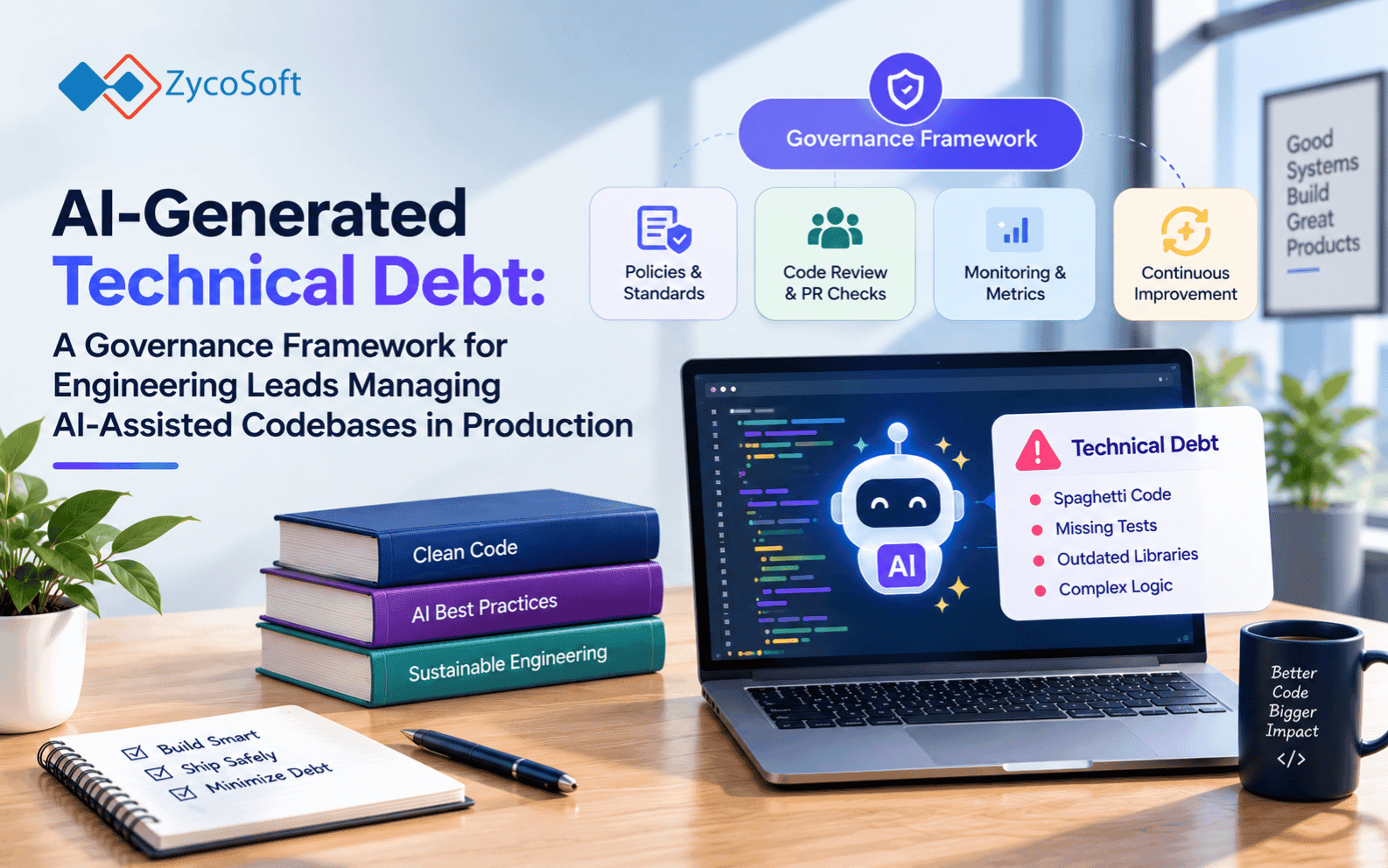
AI-Generated Technical Debt: A Governance Framework for Engineering Leads Managing AI-Assisted Codebases in Production.
The productivity case for AI coding assistants is real. The debt accumulation case is also real, and the two are not in conflict. They are happening simultaneously in your codebase right now. 41% of all new code is now AI-assisted, and LinearB's 2026 data shows those contributions carry 1.7x more issues per pull request than human-written equivalents. A March 2026 arXiv study found over 110,000 AI-introduced issues surviving into production codebases. Code Ninety's research puts defect injection up 50% and security flags up 61% in teams using AI assistants without enforced quality gates.
The problem for engineering leads is structural. Your velocity metrics are almost certainly masking it. PR merge rate, story points shipped, and deployment frequency all trend upward when you adopt AI coding tools. What those metrics do not capture is the quality decay accumulating underneath, the kind that compounds quietly until a scaling event or a security incident makes it impossible to ignore.
This framework gives you the classification model, the pipeline gates, and the review checkpoints to govern AI-assisted development without sacrificing the productivity gains that justified adopting the tools in the first place.
The Four Types of AI-Generated Technical Debt You Need to Classify Separately :
Treating all AI-generated technical debt as a single category is the first governance mistake. Each type has a different detection mechanism, a different remediation cost, and a different risk profile. Classifying them separately before you design any quality gate strategy is essential.
Structural Debt
Structural debt occurs when AI-generated code violates your intended architecture. The most common patterns are god objects produced by code completion that does not understand your bounded context design, direct cross-boundary calls that bypass domain interfaces, and persistence logic leaking into application or presentation layers.
AI assistants interpolate patterns from training data. If your codebase has architectural inconsistencies (and most production codebases do), the assistant will replicate and amplify them. A US SaaS team using Copilot without architecture-aware linting will find that within three to four sprint cycles, the AI has reproduced the same boundary violations they were actively trying to refactor away.
Comprehension Debt :
Comprehension debt is the most insidious type because it is invisible to automated tooling. It is the gap between code that executes correctly and code that a human engineer can safely reason about, modify, and extend. AI assistants optimise for syntactic correctness and pattern completion. They do not optimise for intent legibility.
The practical consequence is that AI-generated functions often do the right thing the first time and the wrong thing when a downstream engineer modifies them without fully understanding the original logic. This is where velocity metrics actively mislead: the code shipped, the tests passed, the PR merged. The comprehension debt only materialises as a regression three sprints later when someone touches the same file.
Security Debt :
Security debt from AI coding assistants has three main sources: hallucinated API usage that defaults to insecure configurations, pattern completion that reproduces historical security anti-patterns from training data, and insufficient input validation in generated data-handling code. Code Ninety's 61% increase in security flags is not surprising to any team that has audited Copilot or Cursor output against OWASP Top 10 criteria without enforced gates.
Authentication and authorisation logic are the highest-risk areas. AI assistants will generate JWT handling, role checks, and session management code that looks plausible, passes linting, and contains subtle privilege escalation paths or token validation gaps. This is one of several areas where automated scanning is necessary but not sufficient.
Churn Debt :
Churn debt is the inflation of codebase size through AI-generated duplication. When developers use code generation to accelerate feature work across multiple areas simultaneously, the assistant produces functionally similar code blocks that are subtly different in ways that prevent deduplication. The result is a codebase that is significantly larger than its functional scope warrants, with a correspondingly higher maintenance surface and test burden.
CI/CD Quality Gates That Catch AI-Generated Debt Before Merge :
The right place to intercept AI-generated technical debt is at the pull request boundary, not post-deployment. Retrofitting quality controls after merge means the debt has already entered your main branch and started compounding. The following gates are sequenced by detection cost: cheapest to compute first, most expensive last.
- Cyclomatic complexity threshold. Flag any function with a complexity score above 10. AI assistants frequently generate deeply nested conditional logic that a human engineer would refactor instinctively. A complexity gate at the PR level catches this before it merges. Set the gate to fail the build, not just warn.
- Static analysis with architecture rules. Tools such as ArchUnit (JVM), Deptrac (PHP), or Dependency Cruiser (Node) let you encode your bounded context rules as executable constraints. A PR that crosses a domain boundary without going through the correct interface fails the build automatically. This is the primary defence against structural debt.
- Security scanning on every PR. Semgrep with your own rule set, or SonarQube Security Hotspots, should run on every AI-assisted PR without exception. Triage fatigue from too many warnings is a real problem; configure your rule set to a manageable signal-to-noise ratio and enforce zero high-severity findings as a merge prerequisite.
- Coverage delta gate. Reject any PR that reduces test coverage below your current baseline. AI-generated code frequently arrives without adequate test coverage, or with tests that assert the AI's own output rather than the intended behaviour. A delta gate prevents coverage regression even when absolute coverage is already low.
- Dependency audit. AI assistants hallucinate package names and versions. A dependency audit step that validates all new imports against your approved dependency list, and flags packages not present in the current lockfile, catches hallucinated dependencies before they reach your build.
- Human architecture review checkpoint. For PRs touching domain boundaries, authentication flows, or data access layers, automated gates are not sufficient. Route these PRs to a senior engineer with explicit authority to reject on architectural grounds, not just on failing tests.
A practical configuration note: these gates should run as required status checks in your GitHub or GitLab branch protection rules. A configuration snippet for a GitHub Actions workflow might look like this in plain terms: define a job called "ai-quality-gate", run it on pull-request events targeting your main branch, execute complexity analysis, then architecture validation, then security scan in sequence, and block the PR merge until all three pass with exit code 0. The key detail is that all three jobs are required checks, not advisory ones.
Setting Measurable Thresholds That Your Team Will Actually Enforce :
Quality gates without agreed numeric thresholds become negotiable under deadline pressure. Set specific numbers, document the rationale, and make the thresholds part of your engineering standards document rather than living only in pipeline configuration.
A defensible starting set of thresholds for a SaaS team adopting AI coding assistants looks like this:
- Maximum cyclomatic complexity per function: 10 (fail), 8 (warn)
- Maximum cognitive complexity per function: 15
- Test coverage delta: no PR may reduce coverage by more than 0% (absolute floor), target 80% coverage on new AI-generated modules
- Security hotspots: zero high-severity findings permitted to merge
- Duplication: no file may have more than 5% duplicated code blocks introduced by a single PR
- Dependency audit: 100% of new dependencies must be on the approved list or require explicit sign-off
These are not arbitrary numbers. Cyclomatic complexity above 10 correlates statistically with defect injection rate in multiple empirical studies predating the AI coding assistant era. The correlation is stronger, not weaker, for AI-generated code because the assistant has no instinctive preference for simplicity.
Calibrate your thresholds to your current codebase baseline first. If your existing codebase averages a complexity of 12 per function, setting the gate at 10 immediately will fail every PR. Set it at 13 initially, enforce it, then ratchet down by one point per quarter. This is the same ratchet-down approach used for coverage floors and it works for the same reason: it makes the standard directionally correct without creating an enforcement crisis on day one.
Where Human Review Is Non-Negotiable and Automation Cannot Substitute :
Automated gates handle the measurable surface of AI-generated technical debt. Human review handles the judgement layer that tooling cannot reach. Being specific about where human review is non-negotiable prevents it from being treated as optional when sprint pressure increases.
Human review is non-negotiable for the following change categories:
- Any modification to authentication or authorisation logic, including token validation, session management, role assignment, and permission checks.
- Any change to data access or persistence layer code, including ORM query construction, transaction boundaries, and schema migrations.
- Any PR that crosses a bounded context or service boundary, even if the architecture gate passes.
- Infrastructure-as-code changes affecting security groups, network policy, secret management, or IAM configuration.
- Any code that handles personally identifiable information, payment data, or health data, where GDPR, PCI-DSS, or HIPAA obligations apply.
This is not a comprehensive list of review triggers, but it covers the areas where AI hallucination and pattern interpolation have caused the highest-severity production incidents in documented case studies. For UK and EU teams, the GDPR dimension of the last point deserves particular attention: an AI assistant that generates data handling code with inadequate consent scope or retention logic creates a compliance exposure that no automated scanner will reliably catch.
If you are building or scaling agentic systems on top of your AI-assisted codebase, the governance surface expands further. Understanding how AI agents fail in production is a necessary complement to this framework, because the debt classification model changes when the AI is not just writing code but executing it.
Clean Architecture as the Durable Structural Defence Against AI-Generated Debt :
Quality gates slow the accumulation of AI-generated technical debt. Clean architecture is what makes it manageable long-term. The two are complementary, not alternatives.
When your codebase has enforced separation between domain logic, application services, and infrastructure adapters, AI assistants have less opportunity to introduce structural debt because the boundaries constrain their output. The assistant generating a repository implementation cannot easily reach into the domain layer when the domain interfaces are explicit and the dependency direction is enforced by your architecture rules gate. This is why the monolith-first architectural discipline that enforces modularity internally pays off disproportionately in AI-assisted development contexts: the seams are already defined, and the AI's output has less surface to contaminate.
The engineering leads who are managing AI-assisted codebases most effectively in 2026 are not the ones who adopted the most sophisticated AI tooling. They are the ones who established clean architectural foundations before scaling AI assistance across their teams. Without those foundations, AI coding assistants amplify existing architectural inconsistencies at the same pace they amplify velocity.
How ZycoSoft Helps Engineering Teams Build Clean Foundations That Resist AI Debt Accumulation :
The governance framework above is actionable for any engineering lead. The harder problem is implementing it in a team that is already carrying architectural debt, already under delivery pressure, and already adopting AI coding tools faster than its review processes can keep pace. That is the scenario where the choice of engineering partner matters.
ZycoSoft's custom SaaS development practice is built around clean architecture from the first commit, not as a refactoring ambition. Every engagement begins with explicit bounded context definition, enforced dependency direction, and CI/CD pipelines that include the quality gates described in this post as standard, not optional add-ons. When teams integrate AI coding assistants into a ZycoSoft-built codebase, the structural constraints are already in place: the architecture rules gate has something to enforce, the domain boundaries are explicit, and the human review checkpoints are built into the PR workflow rather than left to team convention.
The dedicated remote engineering team model ZycoSoft operates on means your embedded engineers maintain architectural context across the full product lifecycle, from initial scope through to production scale. That continuity is directly relevant to comprehension debt: engineers who understand the intent behind every domain boundary cannot be replaced by generated code that pattern-matches the surface without understanding the design rationale underneath. For SaaS teams in the US, UK, and EU building on AI-assisted workflows, the combination of clean-architecture discipline, Western engineering standards, and GDPR-aware data handling is the durable counter to the debt accumulation patterns the empirical data is now clearly showing.
If your team is adopting AI coding assistants and you want to build or audit the architectural foundations before the debt compounds further, talk to ZycoSoft about how we structure the engagement.
Frequently Asked Questions
AI-generated technical debt refers to structural, security, comprehension, and churn-related code quality problems introduced specifically by AI coding assistants such as GitHub Copilot or Cursor. It differs from traditional debt because it accumulates at a velocity that human review cycles were not designed to handle, and because the code often looks syntactically correct while hiding logic errors, hallucinated APIs, or architectural violations that only surface under production load.
According to LinearB's 2026 data, AI-assisted pull requests contain 1.7x more issues per PR than human-written equivalents. A March 2026 arXiv study of production codebases identified over 110,000 surviving AI-introduced issues. Code Ninety's findings show defect injection rates up 50% and security flag rates up 61% in teams using AI coding assistants without enforced quality gates.
The four types are: structural debt (architectural violations such as bypassing domain boundaries or introducing god objects), comprehension debt (code that is syntactically valid but lacks the intent clarity needed for safe future modification), security debt (hallucinated or misconfigured authentication, input validation gaps, and insecure defaults), and churn debt (high-frequency regeneration of functionally equivalent code blocks that inflates codebase size without adding capability).
The most effective gates are: static analysis with cyclomatic complexity thresholds (flag functions exceeding complexity 10), SonarQube or Semgrep security scanning on every PR, test coverage delta checks (reject PRs that reduce coverage below your baseline), dependency audit for AI-hallucinated or outdated packages, and a mandatory human architecture review for any PR touching domain boundaries, authentication flows, or data access layers.
Comprehension debt is the gap between code that executes correctly and code that a human engineer can safely reason about, modify, and extend. AI assistants optimise for syntactic correctness, not for intent clarity. Velocity metrics such as PR merge rate or lines of code shipped reward throughput, not readability or architectural coherence. Comprehension debt only surfaces when a subsequent engineer modifies the code and introduces a regression because the original intent was not legible.
Human review is non-negotiable at four points: changes to authentication and authorisation logic, modifications to data access or persistence layers, any code crossing bounded context or service boundaries, and infrastructure-as-code changes affecting security groups, network policy, or secret management. These are the areas where AI hallucination and pattern interpolation cause the highest-severity production incidents and where automated gates alone cannot substitute for engineering judgement.