
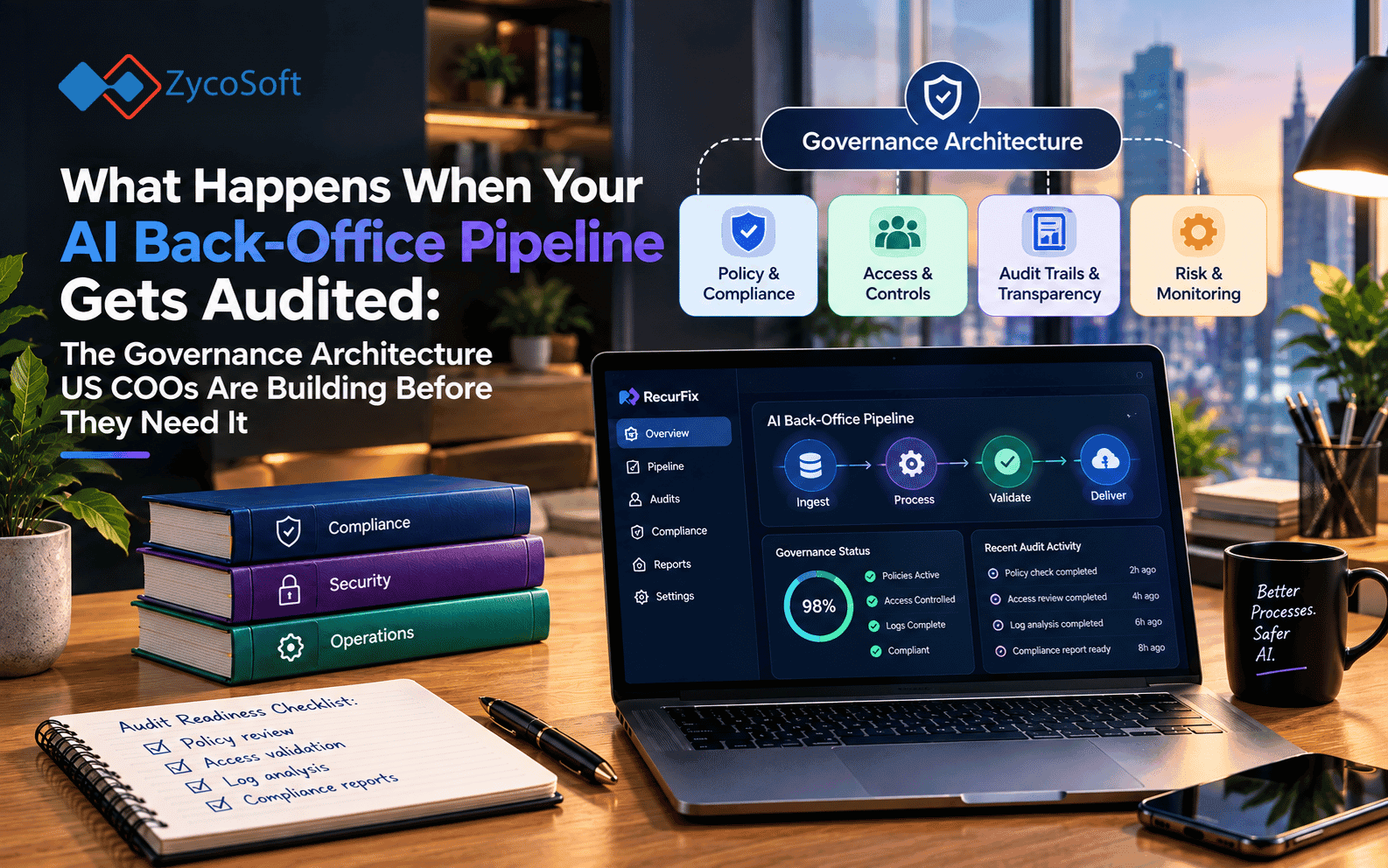
What Happens When Your AI Back-Office Pipeline Gets Audited: The Governance Architecture US COOs Are Building Before They Need It.
The call came on a Tuesday afternoon. The VP of Operations at a mid-market logistics technology company had just wrapped a quarterly board meeting when the audit committee chair pulled her aside. Internal audit had flagged something in the back-office review: over the prior six months, the company's automated vendor onboarding and invoice-routing pipeline had processed roughly 4,200 transactions. The auditor's question was straightforward. For any disputed transaction, could the team show what information the AI agent had when it made the routing decision, who or what had authorised it to act, and whether the output was consistent. with the company's documented approval policy at the time?
The answer, after two days of engineering investigation, was no. Not because the pipeline had failed. It had worked exactly as designed. It had been designed for speed, not scrutiny. Logs existed, but they captured execution status, not decision context. There were no human-in-the-loop checkpoints on transactions below a certain dollar threshold. The agent's scope had never been formally bounded. None of this had mattered until it did.
That company is not unusual. Gartner's Q1 2026 data shows 80% of enterprises now have at least one production AI agent. Deloitte's 2026 State of AI report found only 21% have a mature governance model. The gap between those two numbers is where audit liability lives, and in September 2026, with FINRA formally classifying AI agents as a distinct supervisory risk category and the EU AI Act's enforcement provisions now active, the scrutiny is no longer theoretical.
Why AI Back-Office Pipelines Were Not Built to Be Audited :
Most AI automation governance for back-office operations did not start as a governance project. It started as an efficiency project. The original brief was to eliminate manual data entry, accelerate approvals, and reduce the headcount cost of repetitive processing. Speed and throughput were the success metrics. Auditability was not on the requirements list.
That is a rational product of how these deployments happened. Teams scoped a pilot, showed a compelling reduction in processing time, and extended the automation to cover more workflow surface. The pipeline grew organically. Each extension felt incremental. But collectively, those increments added up to an agent ecosystem that was touching consequential decisions, modifying records, and initiating actions, all without the documentation layer that audit, legal, or a board risk committee would need to review.
The problem is structural, not negligent. AI agents behave differently from traditional workflow automation because they make context-sensitive decisions rather than following fixed conditional logic. That flexibility is precisely what makes them powerful. It is also what makes them hard to audit after the fact, because the reasoning that produced a given output may never have been stored anywhere.
What Auditors, Boards, and Regulators Are Actually Asking :
Understanding the audit moment requires understanding the specific questions being asked. These are not abstract compliance questions. They are operational ones, and they arrive with a deadline.
- Authorisation: What rule, policy, or human decision authorised this agent to take this specific action? Was that authorisation documented before the action occurred?
- Context: What information did the agent have at the point of decision? If that information was incomplete or incorrect, what safeguard would have caught it?
- Consistency: Was the agent's output consistent with the company's documented policy at the time of execution? Can you demonstrate that consistency across a sample of transactions?
- Escalation: Under what conditions was the agent required to escalate to a human rather than act autonomously? Were those conditions enforced in code or only in policy?
- Scope: What was this agent permitted to do? Where were the hard limits on its actions, and how were those limits enforced?
Most n8n pipelines and LLM-driven automation stacks deployed in the past two years cannot answer all five of these questions from their existing logs. That is the governance gap. And as the failure modes of production AI agents demonstrate, the gap tends to surface at the worst possible moment.
The Four Architectural Layers of an Audit-Ready AI Pipeline :
Effective AI automation governance for back-office operations is not a single control. It is a layered architecture, and each layer needs to be in place before the pipeline goes live, not added later under pressure.
Layer 1: Immutable Audit Trails
Every agent action must generate a structured log entry that captures four things: a unique trace ID for the workflow run, a snapshot of the input context the agent received (including any retrieved documents, API responses, or prior conversation turns), the specific tools or APIs called and with what parameters, and the final output alongside any confidence score or uncertainty flag the model returned.
These logs must be written to an append-only store. A standard database table that can be updated or deleted does not satisfy audit requirements. Purpose-built audit tables with write-once constraints, or dedicated logging services, provide the tamper-evident record that an auditor can rely on. n8n supports custom logging middleware that can feed this structured audit layer at each execution node.
Layer 2: Human-in-the-Loop Checkpoints
Human-in-the-loop design means defining, before deployment, which categories of decision require human review before the agent acts. The threshold is not arbitrary. It should be calibrated to the cost of a wrong decision: the financial value at risk, the reversibility of the action, and the regulatory sensitivity of the data involved.
A vendor payment below $500 with a matched purchase order may be appropriate for fully autonomous processing. A vendor payment above $10,000, a new vendor not previously in the system, or any action touching a contract clause should trigger a human approval step. Those thresholds should be enforced in the workflow logic, not left to the agent's judgement. FINRA's 2026 supervisory risk guidance effectively requires this for any AI agent operating in a financial decision context.
Layer 3: Scope Boundary Enforcement
Every agent needs a documented and technically enforced action ceiling. This covers the maximum transaction value it can commit, the record types it is permitted to modify, the external systems it can write to, and the conditions under which it must escalate rather than proceed. Scope boundaries should never rely on the LLM to self-limit. They should be enforced through permission scopes on API keys, parameter validation at the integration layer, and hard-coded escalation triggers in the workflow.
This is the layer that most pipelines are missing entirely. The agent was given broad API access because it was convenient during development. That access was never formally bounded. When an auditor asks what this agent was permitted to do, the honest answer is often "everything the API allowed," which is not a defensible governance position.
Layer 4: Policy Versioning and Effective Dates
Audit consistency questions require knowing not just what the agent did, but what policy was in force when it did it. That means storing a versioned reference to the prompt configuration, the decision rules, and any policy documents used to ground the agent's behaviour, alongside each audit log entry. If the prompt or policy changes, the version change must be logged with an effective timestamp. This allows an auditor to reconstruct the policy context that applied to any historical transaction.
Why Retrofitting Governance Costs More Than Building It In :
The case for building AI automation governance for back-office operations from sprint one is not primarily philosophical. It is financial. Retrofitting governance into a live pipeline requires re-engineering the logging layer without breaking the production workflow, restructuring agent prompts to surface decision context that was never captured, inserting human checkpoints into live processes that downstream systems may depend on operating without interruption, and conducting a retrospective audit of every action the pipeline has already taken.
Deloitte's 2026 data found that organisations retrofitting governance spend an average of 3.4 times more than those who designed it in from the start. That multiple does not include the cost of a qualified audit finding, a regulatory inquiry, or the reputational risk of a board-level accountability question that cannot be answered cleanly.
The operational disruption is also significant. Re-instrumenting a pipeline that runs hundreds of transactions per day means running governance work alongside live operations. Every change carries a regression risk. The engineering effort that should have been spent on expanding capability is spent on justifying what has already been built. For US operations teams already managing growth pressure, that diversion is a real cost.
How to Build Audit-Ready AI Automation from Sprint One :
The practical question for a COO scoping an AI back-office deployment today is not whether to include governance. It is how to sequence it so it does not slow the initial build. The answer is that governance architecture and automation architecture are not in tension when they are designed together. The logging layer is built alongside the workflow. The scope boundaries are set at the same time as the API integrations. The human-in-the-loop checkpoints are mapped during requirements, not added during a post-deployment review.
The checklist for an audit-ready pipeline at launch looks like this:
- Append-only audit log capturing trace ID, input context, tool calls, and output for every agent execution.
- Versioned policy and prompt storage with effective-date tagging on every configuration change
- Human approval checkpoints defined by transaction type, value, and regulatory sensitivity, enforced in workflow logic.
- Scope boundaries enforced at the API and integration layer, not reliant on LLM self-limitation
- Escalation triggers with documented thresholds and a clear handoff protocol to named human reviewers.
- Periodic sample-review process owned by operations or compliance, not just engineering.
None of these elements requires a separate governance project. They require governance to be on the requirements list from day one, alongside throughput, latency, and cost. The processes US COOs automate first are typically the highest-volume, most repetitive ones. Those are also the processes where an audit finding would expose the largest number of unreviewed transactions. The intersection of volume and risk is exactly where governance architecture earns its cost.
The VP of Operations Got Her Answer Eventually :
The logistics technology company from the opening of this post did resolve its audit finding. It took eleven weeks of engineering work, a retrospective review of six months of transaction logs reconstructed from partial data, and the insertion of human-in-the-loop checkpoints that temporarily slowed the pipeline's throughput by 30% while the new approval flow was stabilised. The finding was ultimately classified as a control gap rather than a material weakness. That distinction mattered enormously for the board conversation that followed.
The VP of Operations later noted that the governance architecture they retrofitted was not technically complex. It was architecturally straightforward. What made it expensive was doing it after the fact, under audit pressure, while the pipeline was still processing live transactions. Building it in from sprint one would have taken a fraction of the time and none of the risk.
If your team is scoping, extending, or reviewing an AI back-office pipeline and governance is not yet on the requirements list, the right moment to add it is now, not after the audit committee chair asks for a Tuesday afternoon conversation.
ZycoSoft builds AI automation pipelines that are production-ready and audit-ready from the first sprint. If you want to scope a governance-first back-office automation build, speak to our team.
Frequently Asked Questions
It means every automated action in your back-office pipeline, whether an agent classifies an invoice, routes an approval, or updates a vendor record, is tied to a documented authorisation chain, a captured decision context, and a tamper-evident log. Governance is not a policy document. It is an architectural property of the pipeline itself, built into how agents execute, escalate, and record their actions.
Auditors typically ask three categories of question: who or what authorised this action, what information did the agent have when it made the decision, and was the output consistent with documented policy at the time. Pipelines built purely for speed rarely store enough context to answer any of these. The audit trail gap is what turns a routine review into a material finding.
An agentic audit trail requires four components: a unique trace ID per workflow run, a snapshot of the input context the agent received, a record of which tools or APIs were called and with what parameters, and the final output alongside any human review decision. Logs must be written to an append-only store. n8n supports custom logging middleware that can feed a structured audit database at each execution step.
Human-in-the-loop design means inserting a mandatory human review or approval step before an AI agent takes a consequential action, such as releasing a payment, modifying a vendor record, or triggering a contract clause. It is required wherever the cost of an error exceeds the cost of the review delay. FINRA's 2026 supervisory risk guidance effectively requires it for any AI agent touching financial decisions in regulated environments.
Retrofitting governance requires re-engineering the logging layer, restructuring agent prompts to capture decision context, inserting human checkpoints into live workflows without breaking dependent processes, and re-auditing every historical action the pipeline has already taken. Deloitte's 2026 State of AI report found that organisations retrofitting governance spend an average of 3.4 times more than those who designed it in from the start.
Every agent should have a documented action ceiling: the maximum financial value it can commit, the record types it can modify, the external systems it can write to, and the conditions under which it must escalate rather than act. Scope boundaries should be enforced in code, not just in policy, using parameter validation, permission scopes on API keys, and hard-coded escalation triggers rather than relying on the LLM to self-limit.
n8n supports governance architecture through execution logging, webhook-triggered human approval steps, custom error handling nodes, and the ability to write structured metadata to external databases at each workflow stage. When combined with an append-only audit store and a scope-enforcement layer on outbound API calls, n8n pipelines can meet the documentation requirements that internal audit and legal teams now routinely request for AI-driven back-office processes.