
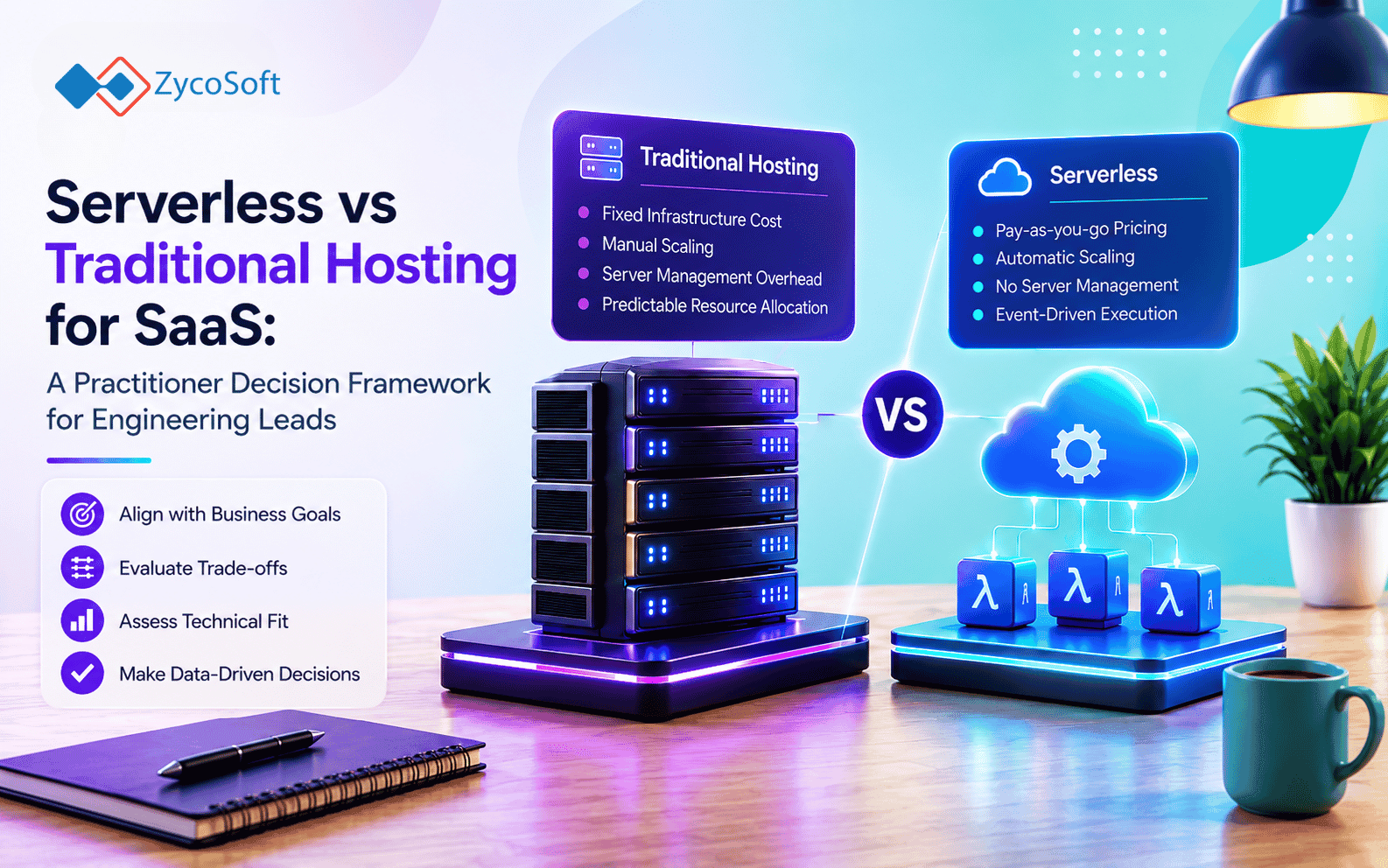
Serverless vs Traditional Hosting for SaaS: A Practitioner Decision Framework for Engineering Leads.
The question is not which model is better. It is which model fits your traffic pattern, your cost structure, and the operational maturity of your team right now. Serverless vs traditional hosting for SaaS is a trade-off decision, not a technology preference, and engineering leads who treat it as the latter end up with either an overprovisioned VPS they are paying for at 3am when nobody is using the product, or an invocation bill that doubles unexpectedly the month they hit a growth milestone.
This framework covers the specific technical criteria that should drive the decision at each growth stage, including cold start behaviour, cost model crossover points, stateful workload handling, and vendor lock-in exposure. It is written for engineering leads who are past the conceptual overview and need concrete decision criteria.
How the Two Cost Models Actually Work at Scale:
Serverless and traditional hosting use fundamentally different billing models, and understanding the crossover point is the single most important financial decision in this comparison.
Serverless invocation pricing (AWS Lambda, Google Cloud Functions, Vercel Functions) charges you per request and per GB-second of compute time. At low or unpredictable traffic, this is genuinely economical. A function invoked 500,000 times per month at 128MB and 200ms average duration costs almost nothing under AWS Lambda's free tier and pricing structure. The problem arrives when traffic becomes sustained and predictable.
Consider a SaaS API endpoint handling 50 requests per second continuously throughout business hours. At that volume, invocation billing accumulates quickly compared to a $50 to $150 per month container on Railway, Render, or a reserved EC2 instance. The crossover point varies by function duration and memory allocation, but most teams encounter it somewhere between 5 and 20 million monthly invocations. That is well within reach of a SaaS product with a few hundred active users hitting your API regularly.
Reserved capacity pricing on containers or VMs costs the same whether you are processing 1 request per minute or 1,000. This is wasteful at MVP stage with unpredictable traffic, but becomes the cheaper and more predictable model once your usage pattern stabilises. Series A companies are regularly surprised by serverless bills precisely because their growth made serverless uneconomical without any architectural warning sign triggering beforehand.
Cold Starts: When They Matter and When They Do Not
Cold start latency on serverless is a genuine production concern, not a theoretical footnote. AWS Lambda cold starts typically add between 200ms and 2 seconds of additional latency depending on runtime, memory allocation, and whether the function is inside a VPC. Node.js functions cold start faster than JVM-based runtimes. A Python function in a VPC with a 128MB allocation can take over a second on first invocation.
The cold start problem matters in these specific scenarios:
- Synchronous user-facing API endpoints where latency directly affects perceived performance
- Authentication flows where a cold-started token validation adds visible delay to login
- Real-time data queries where sub-100ms response times are part of the product contract
- Scheduled jobs that must complete within a narrow execution window
Cold starts are broadly acceptable in these scenarios:
- Asynchronous webhook handlers (the calling service does not wait for your response)
- Background processing triggered by queue events (SQS, Pub/Sub)
- Nightly batch jobs with no user-facing latency dependency
- Image or document processing triggered by storage events:
Provisioned concurrency on AWS Lambda can eliminate cold starts for critical paths, but it removes most of the cost benefit of serverless by effectively reserving compute capacity, which is the same model as traditional hosting at higher cost. If you need provisioned concurrency on your core API functions to make latency acceptable, that is a signal to evaluate containerised hosting directly.
Stateful Workloads: The Architecture Where Serverless Consistently Fails
Serverless functions are stateless by design. Each invocation is isolated, with no guaranteed in-memory state between calls. This is not a limitation you can engineer around with clever patterns; it is a fundamental property of the execution model. For SaaS products with specific stateful requirements, this creates real architectural problems.
Workloads where serverless creates compounding complexity include:
- WebSocket connections requiring persistent server-side state (chat, live dashboards, collaborative editing)
- Long-running background jobs exceeding 15 minutes (AWS Lambda's hard limit)
- In-memory caching layers where cache warming on every cold start is too expensive
- Database connection pooling, since each Lambda invocation opens a new connection, which exhausts PostgreSQL connection limits at scale
- Streaming data pipelines requiring stateful aggregation across event windows:
The database connection problem is particularly common and worth illustrating. A Lambda function connecting directly to PostgreSQL can open hundreds of concurrent connections under moderate load. PostgreSQL's default connection limit (typically 100 to 200) is exhausted well before your Lambda concurrency limit. The fix, using RDS Proxy or PgBouncer, adds operational complexity and cost that partially negates the simplicity argument for serverless in the first place.
If your SaaS product includes any of the workload types above, plan a hybrid architecture from the start rather than retrofitting containerised services later. This is the same reasoning behind preferring a deliberate monolith-first approach for new SaaS products, as discussed in our post on monolithic vs microservices architecture for SaaS: the right boundary decisions made early prevent expensive re-architecture at scale.
Vendor Lock-In: What You Are Actually Committing To
Serverless lock-in is not about the function syntax. Moving from AWS Lambda to Google Cloud Functions is relatively straightforward if your handler code is thin. The real lock-in is in the trigger and integration layer surrounding your functions.
A Lambda architecture wired to the following services is highly AWS-specific and not portable without significant rework:
- API Gateway for HTTP routing
- SQS or SNS as event triggers
- DynamoDB Streams for change data capture
- Cognito for authentication
- IAM roles and resource policies governing execution permissions
The mitigation is an architectural discipline, not a platform switch. Keep business logic in plain modules that handler functions call, rather than embedding it in handler code. A function handler should be a thin adapter that extracts input, calls a domain function, and formats output. This pattern means the handler is disposable and portable; the business logic is not coupled to the serverless runtime.
Container-based deployments (Docker on ECS, Kubernetes, or a managed platform like Fly.io or Railway) are meaningfully more portable. Your container runs identically in local development, CI pipelines, and production. Migrating between cloud providers is a configuration change, not a code rewrite. For SaaS products with long-term ambitions or investor expectations around infrastructure optionality, this portability has real strategic value.
The Decision Framework: When Each Approach Wins
Use this criteria set when evaluating your infrastructure choice. It is ordered by the factors that most commonly determine the correct answer in practice.
Choose serverless when
- Traffic is genuinely unpredictable and low-volume at launch, with no committed baseline load
- The workload is event-driven and asynchronous (webhooks, queue consumers, storage triggers)
- The engineering team is small and needs to eliminate server management overhead entirely
- Functions are short-lived (under 5 minutes), stateless, and triggered by discrete events
- The product is a true MVP where time-to-market outweighs infrastructure optimisation
Choose containerised or VM-based hosting when:
- Your API has a predictable baseline load above a few hundred requests per minute continuously
- Any workload requires persistent connections (WebSockets, long-polling, stateful streaming)
- Functions regularly exceed 5 minutes of execution time
- Your data layer uses PostgreSQL or MySQL and connection pooling at the database level is impractical
- Cost predictability matters more than theoretical cost efficiency at low load
- The team has entered growth or Series A stage and infrastructure bills are under board-level scrutiny
Use a hybrid model when:
Your core application runtime runs on containers (handling HTTP APIs, WebSockets, or persistent connections), while genuinely event-driven auxiliary tasks (email sending, PDF generation, payment webhook processing) run as serverless functions. This is the most pragmatic architecture for SaaS products between seed and Series A, and it avoids applying a single infrastructure model to workloads with fundamentally different compute and state requirements.
A plain-text illustration of this split: your core API runs as a Docker container on ECS or Railway (always-on, predictable cost, persistent DB connections via PgBouncer), an SQS queue receives payment webhook events from Stripe, a Lambda function processes each event and writes to your database, and a scheduled Lambda handles nightly reporting jobs. The container handles latency-sensitive user traffic; serverless handles discrete, asynchronous events.
How ZycoSoft Approaches This Decision in Custom SaaS and MVP Engagements:
When we scope a custom SaaS product or MVP, the infrastructure model is not a default configuration. It is a decision driven by your traffic profile, team capacity, and the specific workloads your product needs to support from day one.
For early-stage MVPs where launch speed matters and traffic is unpredictable, we typically start with a containerised monolith on a managed platform, not a serverless-first architecture. This avoids the cold start, connection pooling, and cost model surprises that tend to surface six months after launch when the team is focused on retention and growth, not infrastructure refactoring. The choice of tech stack for a SaaS MVP and the infrastructure model are decisions we make together at scoping, with explicit criteria for when the architecture should evolve.
Where serverless functions genuinely belong in the architecture, we scope them as thin, portable handlers with business logic kept in testable modules. Where they create operational debt, particularly around stateful workloads and database connections, we say so at the design stage rather than retrofitting a different model after the product has users depending on it.
Our embedded teams bring direct experience with GDPR-compliant architecture across UK, EU, and US deployments, Stripe, Mollie, and Razorpay payment integration, and production AI automation pipelines. Infrastructure decisions are made in the context of the full product lifecycle, not as isolated technical preferences. The goal is an architecture that does not need emergency rework at your Series A because the infrastructure model was chosen for the wrong stage.
If you are making an infrastructure decision for a SaaS product right now and want a direct technical conversation about which model fits your specific workload and growth stage, get in touch with the ZycoSoft team.
Frequently Asked Questions
Serverless charges per invocation and per GB-second of compute, which is cost-effective at low or spiky traffic. Traditional hosting (containers or VMs) uses reserved capacity pricing, which becomes cheaper per request at sustained high throughput. The crossover point varies by workload, but most SaaS products hit it somewhere between 5 and 20 million monthly invocations depending on function duration.
Cold starts are a genuine production concern, not a theoretical one. AWS Lambda cold starts typically add 200ms to 2 seconds of latency depending on runtime and memory allocation. For synchronous user-facing API endpoints, this is noticeable. For background jobs, event processing, or webhook handlers, it is usually acceptable. The problem compounds when you use serverless for latency-sensitive flows like authentication or real-time data queries.
Serverless is a sensible MVP choice when traffic is unpredictable, the team is small, and operational overhead needs to stay minimal. It removes the need to provision or manage servers early on. The risk is building habits and abstractions around serverless that become expensive or architecturally painful to unwind once the product reaches sustained traffic or requires stateful processing.
Vendor lock-in on serverless is real because trigger systems, IAM integrations, VPC configuration, and cold start behaviour are all provider-specific. AWS Lambda functions wired to SQS, DynamoDB Streams, and API Gateway are not portable. Managing this means keeping business logic in plain modules that serverless handlers call, rather than embedding logic in handler code directly. This allows you to re-host without rewriting core application behaviour.
Container-based hosting (ECS, Kubernetes, or plain Docker on a VPS) typically becomes the better economic and operational choice when your SaaS passes approximately 10,000 daily active users with consistent usage patterns, or when any single workload runs longer than 15 minutes regularly. At Series A, sustained traffic profiles and cost predictability usually tip the balance firmly toward reserved capacity over invocation-based billing.
Yes, and this is usually the most pragmatic approach at growth stage. Run your core application runtime on containers or a managed platform like Railway, Render, or ECS, and use serverless functions for genuinely event-driven tasks such as webhook processing, scheduled jobs, image resizing, or notification dispatch. This hybrid model avoids applying a single infrastructure model to workloads with fundamentally different compute characteristics.