
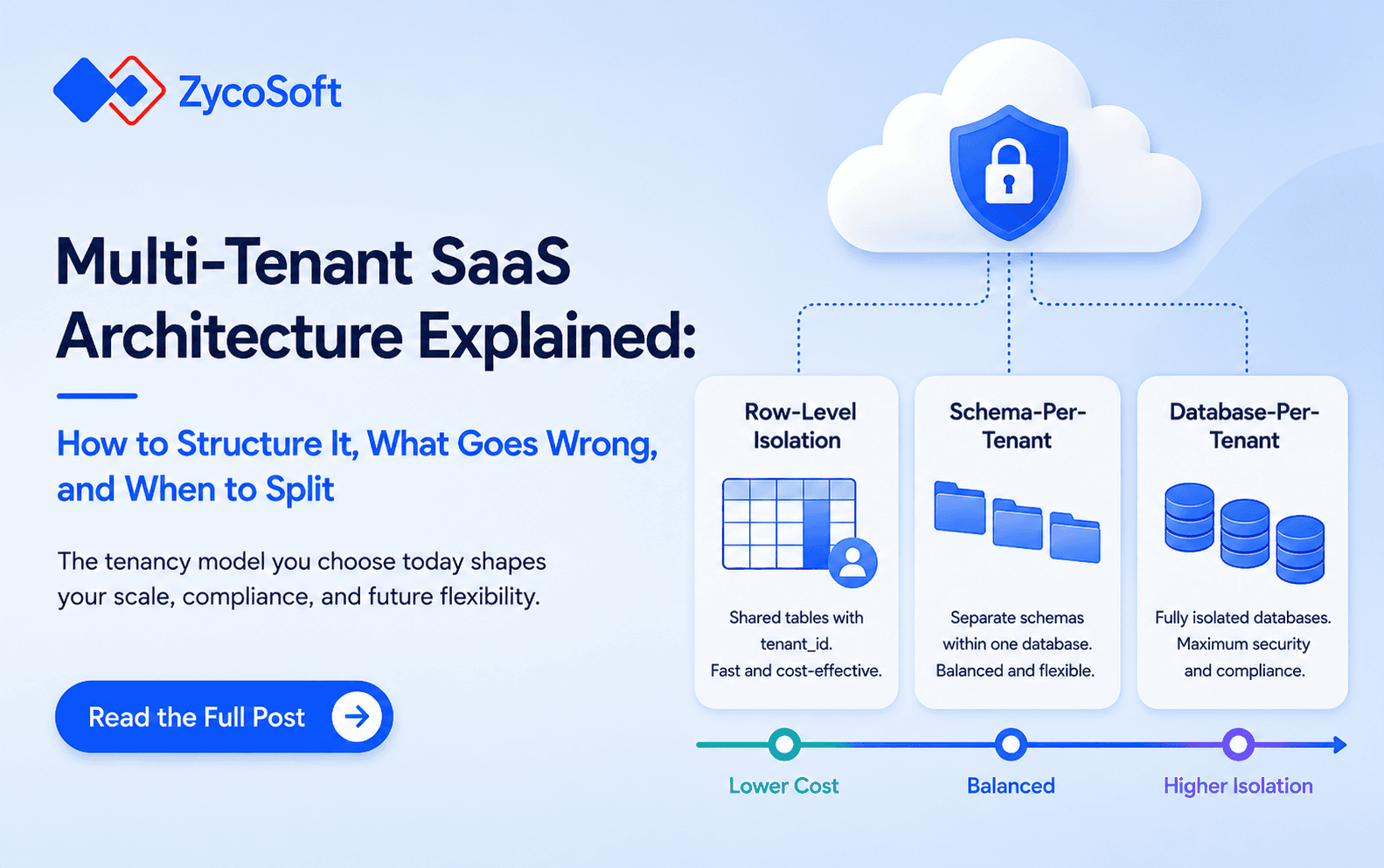
Multi-Tenant SaaS Architecture Explained: How to Structure It, What Goes Wrong, and When to Split:
The tenancy model you choose in week two of your SaaS build will still be constraining your engineering decisions in year three. Most teams underestimate this. They pick row-level isolation because it is the fastest to implement, and then spend significant time two years later untangling it when an enterprise client demands a data processing agreement that their shared-table architecture cannot satisfy. Multi-tenant SaaS architecture is not a detail you tune later. It is a foundational decision with downstream consequences for cost, compliance, and your ability to close certain customer segments.
This post gives you a direct comparison of the three main isolation strategies, the conditions under which each one breaks, and a decision framework for choosing the right model at the right stage.
The Three Core Multi-Tenancy Models:
The right isolation strategy depends on tenant count, data sensitivity, regulatory exposure, and projected growth. There are three architecturally distinct approaches, each with a different position on the cost-versus-isolation spectrum.
Row-Level Isolation :
Every tenant's data lives in shared tables, distinguished by a tenant_id column. Application code (or a database-level policy) filters every query by that identifier. This is the cheapest model to start with: one database, one schema, minimal infrastructure overhead.
PostgreSQL's row-level security (RLS) makes this safer than relying purely on application-layer WHERE clauses. You define a policy once and the database engine enforces it at query time.
A simplified example looks like this:
ALTER TABLE orders ENABLE ROW LEVEL SECURITY; CREATE POLICY tenant_isolation ON orders USING (tenant_id = current_setting('app.current_tenant')::uuid);
You set the session variable on connection, and every subsequent query on that table is automatically scoped. The risk of a developer accidentally exposing cross-tenant data from a missing WHERE clause drops substantially, though it does not disappear entirely. RLS adds a small query planning overhead and requires consistent session management across your connection pool.
Schema-Per-Tenant
Each tenant gets their own PostgreSQL schema within a shared database cluster. Tables are identical in structure across schemas, but data is physically separated by namespace. There is no risk of a missing WHERE clause leaking cross-tenant data, because the schema boundary is enforced at the database level rather than the application level.
This model works well for SaaS products where tenants need light customisation (different column defaults, tenant-specific views) without the cost of separate infrastructure. The operational complexity sits in your migration tooling: when you update the schema, you need to apply that migration to every tenant schema individually. At 50 tenants, that is manageable. At 800 tenants, a poorly designed migration pipeline becomes a significant deployment risk.
Database-Per-Tenant
Each tenant gets a fully separate database, often on separate infrastructure. This is the highest-cost model and the most operationally complex, but it provides the strongest isolation guarantees. It is the architecture of choice when enterprise contracts require it, when data residency regulations mandate that specific tenants' data cannot leave a particular geography, or when a single tenant's query load is large enough to affect others.
The infrastructure cost scales linearly with tenant count. At 10 enterprise tenants, database-per-tenant is entirely reasonable. At 10,000 SMB tenants, it is economically untenable without significant automation of provisioning, monitoring, and backup at the per-database level.
GDPR Implications of Each Isolation Strategy
GDPR's right to erasure and right to data portability are straightforward to implement correctly only if you designed for them from the start. Multi-tenant SaaS architecture decisions affect how easily you can satisfy both obligations.
With row-level isolation, deleting a tenant's personal data means issuing DELETE statements across every table filtered by tenant_id. This is scriptable, but you must be confident your data model has no orphaned references and that your audit logs can demonstrate the deletion was complete. Regulators asking for proof of erasure expect more than "we ran a DELETE query."
Schema-per-tenant makes right-to-erasure cleaner. Deleting a schema (DROP SCHEMA tenant_xyz CASCADE) removes all associated data in a single, auditable operation. Data portability is similarly straightforward: dump the schema and export it in a structured format. This makes schema-per-tenant the pragmatic middle ground for UK and EU SaaS products handling personal data at scale.
Database-per-tenant is the easiest model to demonstrate to a regulator. The data boundary is physical and unambiguous. For SaaS products serving regulated industries such as healthcare, legal, or financial services, this may not be optional. Data residency requirements for specific EU member states, or requirements under UK GDPR following Brexit, may mandate that certain tenants' databases sit on infrastructure within a specific jurisdiction. This is an architecture constraint, not a nice-to-have.
When Each Model Breaks Down
Every isolation strategy has a failure condition. Understanding where the model breaks helps you plan the migration before you are forced into it under operational pressure.
Row-level isolation breaks when:
- A single tenant's data volume grows to the point where their queries degrade performance for all other tenants on the same table (the "noisy neighbour" problem)
- An enterprise prospect's legal team requires contractual evidence of data separation that a shared-table model cannot provide
- You need per-tenant schema customisation, because structural changes to shared tables affect every tenant simultaneously
- A developer omits a tenant_id filter and, even briefly, exposes cross-tenant records before it is caught
Schema-per-tenant breaks when:
- Tenant count exceeds roughly 500 to 800 schemas on a single cluster, at which point migration tooling, connection pooling, and backup management become serious operational burdens
- Schema migrations start taking longer than your deployment window allows, particularly for large column additions on busy tables
- A high-volume tenant's activity creates lock contention that affects other schemas on the same database instance
Database-per-tenant breaks when:
- Tenant count grows faster than your infrastructure automation can provision new databases reliably
- Per-tenant monitoring, alerting, and backup processes are not fully automated, and operational overhead grows linearly with tenant count
- Cross-tenant analytics (aggregated reporting, platform-wide metrics) become structurally difficult because data is spread across hundreds of separate databases
A Decision Framework: Choosing the Right Model for Your Stage
The right answer to "which tenancy model should we use?" is almost always "it depends on where you are and where you are going." Here is a practical decision framework based on stage and risk profile.
- Early-stage, many small tenants, low per-tenant data volume: Start with row-level isolation using PostgreSQL RLS. Move fast, keep infrastructure costs low, and instrument your query patterns from day one so you can detect noisy-neighbour behaviour early.
- Mid-market SaaS, 50 to 500 tenants, moderate data sensitivity: Schema-per-tenant is the appropriate default. Invest in migration tooling early (Flyway or Liquibase with a per-schema runner). Build your GDPR erasure script around DROP SCHEMA so it is tested before you need it.
- Enterprise-facing SaaS, regulated industries, or data residency requirements: Database-per-tenant for your largest or most sensitive accounts, with a tiered model for smaller tenants. Automate provisioning from day one using infrastructure-as-code so the operational overhead does not scale with headcount.
- Mixed tenant base (SMB plus enterprise): Hybrid models are legitimate. Many mature SaaS products use row-level or schema isolation for the long tail of smaller accounts and database-per-tenant for enterprise contracts. Build the routing layer to be model-agnostic so individual tenants can be migrated without application-level changes.
If you are at the stage where this decision is live, the post on monolithic vs microservices architecture for SaaS covers a closely related sequencing question: whether to split services before you have validated the product, or after. The same principle applies to tenancy models. Avoid the architecture that matches your year-three ambition when your year-one data does not yet justify it.
Migration Between Models: What It Actually Costs
Migrating from row-level isolation to schema-per-tenant is not a rebuild, but it is a significant engineering project. The steps involved are sequential and each carries risk.
- Create a new schema for each existing tenant
- Migrate rows from shared tables into tenant-specific tables, maintaining referential integrity
- Recreate indexes, sequences, and foreign keys per schema
- Update application connection logic to resolve the correct schema per request
- Run both models in parallel during a cutover window to validate data parity
- Decommission the shared tables once per-schema parity is confirmed
For a product with 100 tenants and a reasonably normalised schema, this is a two-to-four week engineering effort. For 1,000 tenants with complex data models, plan for longer and expect that migration scripting and validation will consume most of the time. The lesson is not that row-level isolation is wrong to start with. It is that you should document the migration path before you need it, so the decision to change models is a planned project rather than an emergency.
How ZycoSoft Approaches Multi-Tenancy in Custom SaaS Builds :
The tenancy decision is one of the first conversations we have when scoping a Custom SaaS Development engagement. Getting it wrong in either direction is costly: over-engineering a database-per-tenant model for a product with 30 pilot users wastes infrastructure budget and engineering time, while under-architecting a shared-table model for a product heading into regulated enterprise markets creates a compliance liability that is painful to unwind.
Our default starting position is a deliberate monolith with row-level isolation using PostgreSQL RLS, with schema-per-tenant as the designed-for migration target. We instrument the data layer from the start so that noisy-neighbour queries surface early, and we build the GDPR erasure and export endpoints as first-class features rather than afterthoughts. For clients operating in the UK, EU, or regulated US markets, GDPR-compliant architecture is not a checkbox. It is part of the schema design, the audit log model, and the deployment topology.
Where enterprise contracts or regulated-industry clients are part of the go-to-market from the start, we scope a hybrid model: a shared cluster for the SMB tier and isolated databases for named enterprise accounts, with a routing layer that makes the distinction invisible to the application. This is the same pattern used by a number of mature UK and US SaaS businesses, and it avoids the forced migration that typically happens when a product built for one market tries to sell upmarket without the architecture to support it. If you are currently making this decision, the guidance in our post on what US founders get wrong before SaaS development starts covers a number of the upstream scoping mistakes that make tenancy choices harder than they need to be.
If you are building or scaling a multi-tenant SaaS product and want a direct conversation about which isolation model fits your current stage and target market, get in touch with the ZycoSoft team. We will give you a straight answer based on what the architecture actually requires, not what is easiest to sell.
Frequently Asked Questions
There is no single best strategy. Row-level isolation is cheapest and simplest for early-stage products with many small tenants. Schema-per-tenant balances isolation and cost for mid-market SaaS. Database-per-tenant is best when enterprise contracts, GDPR data residency, or regulatory requirements demand full physical separation. The right model depends on tenant count, data sensitivity, and your compliance obligations.
GDPR requires you to be able to identify, export, and delete a specific tenant's personal data on request. Row-level isolation makes this straightforward if your tenant_id filtering is consistent. Schema-per-tenant makes deletion cleaner. Database-per-tenant makes data residency and right-to-erasure the simplest to demonstrate to a regulator. Any shared-infrastructure model requires careful audit logging to prove data boundaries were maintained.
Row-level isolation breaks down when a single tenant's data volume starts affecting query performance for other tenants, when enterprise clients demand contractual proof of data separation, or when you need per-tenant schema customisation. It also becomes a liability if a developer accidentally omits a WHERE tenant_id filter, which in a shared table exposes all tenant data rather than just one account's records.
Yes, but it is a significant engineering effort. You need to write a migration script that reads each tenant's rows, creates a new schema, and inserts the data while maintaining referential integrity. Foreign keys, sequences, and indexes all need to be recreated per schema. The process is manageable for up to a few hundred tenants but becomes a multi-week project beyond that without purpose-built tooling.
PostgreSQL row-level security (RLS) lets you attach a security policy directly to a table so the database engine enforces tenant filtering at the query level, rather than relying on application-layer WHERE clauses. You set a session variable for the current tenant, and the policy uses it to filter rows automatically. This reduces the risk of data leakage from a missing WHERE clause, but it requires careful policy design and adds a small query planning overhead.
PostgreSQL handles schema-per-tenant well up to roughly 500 to 1,000 schemas on a single cluster before operational complexity becomes significant. Beyond that, schema migrations using tools like Flyway or Liquibase slow considerably because every schema needs to be updated individually. Connection pooling also becomes harder to manage. Past this threshold, most teams either shard across multiple database clusters or migrate high-value tenants to dedicated databases.