
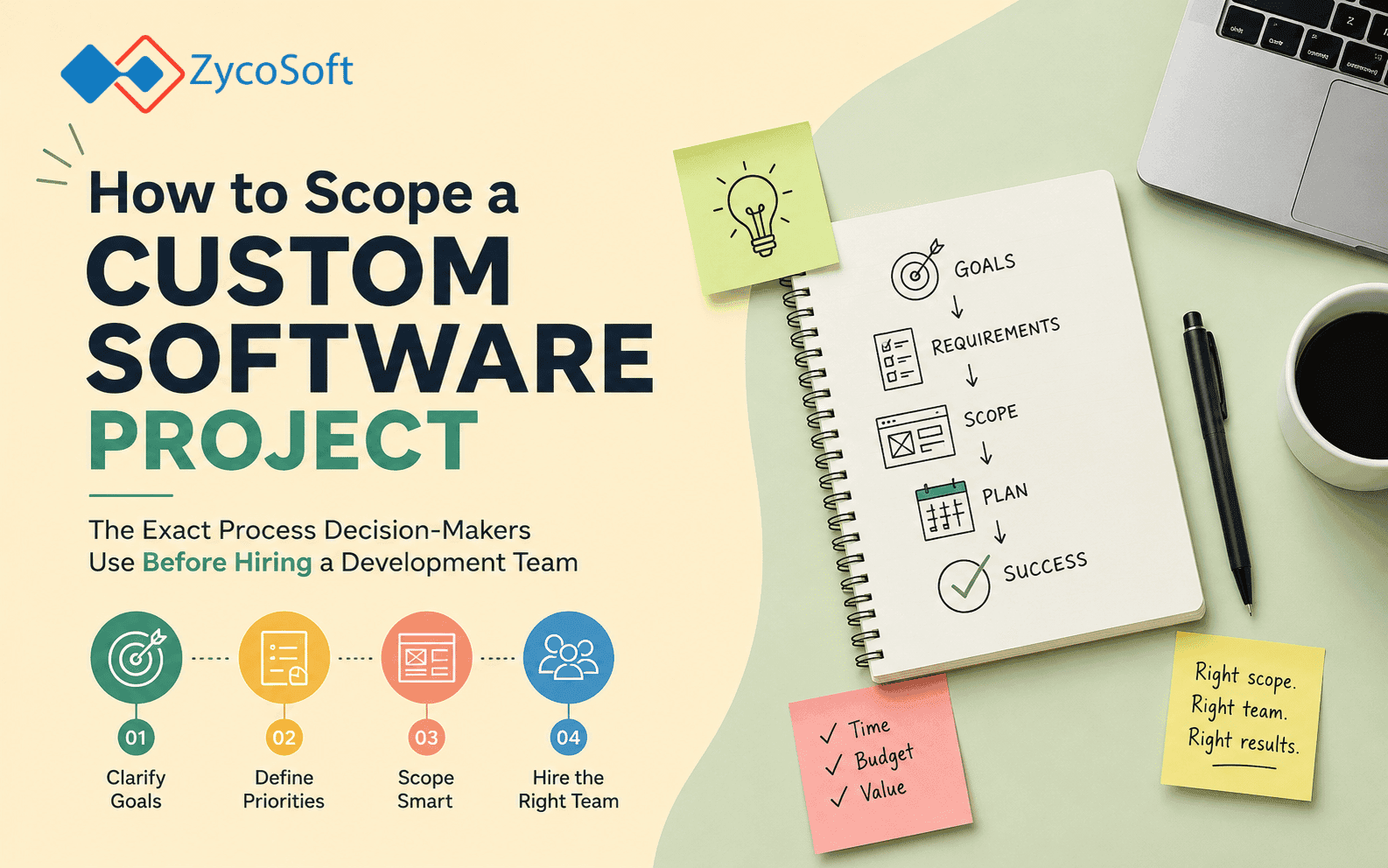
How to Scope a Custom Software Project: The Exact Process Decision-Makers Use Before Hiring a Development Team
Most custom software projects fail before a single line of code is written. The failure happens in the brief: a vague collection of feature requests, a rough budget figure, and a timeline pulled from optimism rather than analysis. Development teams then quote against incomplete information, assumptions compound on both sides, and by month three the project is over budget, behind schedule, and missing the point it was supposed to solve.
Knowing how to scope a software project properly is the single highest-leverage thing a CTO, product lead, or operations director can do before any developer conversation begins. This guide walks through the exact process: defining outcomes before features, separating must-haves from noise, mapping integration dependencies, and producing a scope document that gets accurate quotes and holds the build accountable.
Start With Outcomes, Not Features
The first question in any software scoping exercise is not "what should the system do?" It is "what does success look like in measurable terms?" Features are the means. Outcomes are the point. Confusing the two is how you end up with a fully built platform that does not actually solve the problem it was commissioned for.
A US SaaS operations director commissioning a workflow automation tool should not open the scoping process with a feature list. They should open it with a statement such as: "Today, our team spends 14 hours per week on manual data reconciliation. The system must reduce that to under two hours, with zero manual intervention for standard cases." That outcome statement immediately shapes what the software must do, what it does not need to do, and what a successful build looks like at handover.
For each outcome, write down the metric that will confirm it has been achieved. If you cannot define a metric, the outcome is not yet specific enough to scope against. This discipline also protects the project from scope creep, because every proposed addition during the build can be tested against the question: does this help achieve a stated outcome?
How to Separate Must-Have Requirements From Nice-to-Haves
Every stakeholder in a software project believes their requirements are essential. The scoping process must impose a formal prioritisation decision before development begins, not after. The most reliable method is a two-column test applied to every proposed feature.
The Must-Have Test
For each feature, ask: if this product launches without this capability, does it fail to solve the core problem for the primary user? If the answer is yes, it is a must-have. If the product still delivers its core value without it, it is a nice-to-have, regardless of how much any stakeholder wants it.
Apply this test in a structured workshop with all relevant stakeholders present. Disagreements about prioritisation that surface in a workshop take an hour to resolve. The same disagreements surfacing in week six of a build can cost tens of thousands of dollars in rework and delay.
Deferral Is Not Deletion
Nice-to-haves should be documented in a separate backlog with the reason for deferral noted. This serves two purposes: it prevents the features from re-entering scope mid-build through informal requests, and it gives the development team a roadmap for future phases. A well-structured nice-to-have backlog is also a signal to your engineering partner that the project is being run with discipline, which typically results in sharper, more accurate quotes.
Map Every Integration Dependency Before Writing a Line of Spec
Integration complexity is the single most common source of cost overruns in custom software builds. A product that connects to five external systems is not five times more complex than a standalone product. In many cases it is twenty times more complex, because integrations introduce data format mismatches, authentication layers, rate limits, versioning risk, and failure states that must each be designed for.
Before finalising your software development scope, produce an integration map. List every external system the product must connect to, then for each one answer the following:
- Does a documented, stable API exist, and what version is it?
- What data flows in each direction, and in what format?
- What are the authentication requirements (OAuth, API key, SAML)?
- Are there rate limits or data volume constraints?
- Who owns the integration from the third-party side, and how quickly do they respond to technical queries?
- What happens to the system if the integration is unavailable?
Payment integrations deserve particular attention. A product requiring Stripe, Mollie, or Razorpay each has different webhook structures, refund flows, and reconciliation requirements. Treating these as equivalent during scoping is a common and expensive mistake. The integration map forces these differences into the specification before development starts, so the quote reflects actual complexity rather than an optimistic assumption.
If your project involves AI automation components, the same logic applies to LLM API dependencies, data pipeline connections, and any n8n workflow integrations. Understanding the architectural difference between AI agents and traditional workflow automation is worth doing before you scope those components, because the integration requirements are materially different.
How to Write a Software Scope Document That Gets Accurate Quotes
A scope document is not a wish list. It is a technical and functional contract between your organisation and the team that will build the product. It must be specific enough that two different development teams, reading it independently, would produce comparable cost estimates. If their quotes differ by more than 30%, the scope document is not specific enough.
A complete scope of work for software development should contain the following sections, in this order:
- Problem statement and measurable outcomes: one paragraph, no feature references.
- User roles: every distinct type of user and what they need to accomplish.
- Functional requirements (must-have): written as user stories or capability statements, not as UI descriptions.
- Functional requirements (deferred): the nice-to-have backlog with deferral rationale.
- Integration map: every third-party dependency with API details and data flow direction.
- Non-functional requirements: performance benchmarks, security requirements, compliance obligations (GDPR, SOC 2, HIPAA as applicable), and uptime expectations.
- Data model or flow diagram: even a rough entity diagram prevents architecture misalignment later.
- Explicit exclusions: a written list of what is out of scope. This is as important as the inclusions.
- Constraints: budget range, technology preferences or restrictions, and timeline.
The explicit exclusions section is where most scope documents fail by omission. If your internal teams assume that admin reporting is included and the development team has excluded it from their quote, that gap will surface as a change order during the build. Writing exclusions down removes the assumption from the relationship entirely.
If your project involves a SaaS platform build, planning the full custom software project before hiring developers is a step that rewards early attention to architecture decisions around data isolation and multi-tenancy, both of which affect cost significantly if they are retrofitted rather than designed in from the start.
How ZycoSoft's Scoping-First Model Protects Your Budget
The professional alternative to arriving at a development conversation with a vague brief is a structured discovery engagement before any build commitment is made. ZycoSoft runs a dedicated scoping phase with every new project, during which we work directly with your product lead or CTO to produce a complete scope document before any development resource is allocated.
This model exists because we have seen what happens when it is skipped. A US SaaS company commissions a platform extension with a two-page brief and a six-month timeline. By month two, undocumented integration requirements have added eight weeks to the build. By month four, a stakeholder surfaces a requirement that conflicts with an architecture decision already embedded in the codebase. The scope document would have resolved both before development began.
Our embedded team model operates with Western work practices, synchronous communication during US business hours, and a scoping-first engagement structure that means the development quote you receive is based on a fully documented scope, not an assumption. For projects involving payment integration, AI automation pipelines, or custom OSINT and strategic communication platforms, the scoping phase is where the real intellectual work happens, and where the most money is either saved or wasted.
If you are preparing to commission a custom software build and want to start with a scoping conversation rather than a sales call, speak to ZycoSoft directly. Bring your problem statement. We will help you build the rest.
Frequently Asked Questions
Scoping a software project means defining what the system must do, who it serves, what integrations it requires, and what success looks like, before development begins. A proper scope document captures functional requirements, technical constraints, data flows, and prioritisation decisions. It gives developers enough information to produce accurate time and cost estimates, and gives your team a baseline to manage change against during the build.
For a focused custom software build, scoping typically takes two to four weeks when done properly. This includes stakeholder interviews, outcome definition, integration mapping, and document drafting. Rushing this phase to save time almost always costs more in change orders and rework than the scoping exercise itself would have taken. Some teams run a paid discovery sprint with their engineering partner to produce the scope document collaboratively.
A complete scope document for software development should include: the problem being solved and the measurable outcomes expected, a prioritised list of functional requirements separated into must-have and nice-to-have, user roles and permissions, integration dependencies with named third-party systems, data models or flow diagrams, non-functional requirements such as performance and security, and explicit exclusions. Exclusions are as important as inclusions because they prevent assumption drift during development.
Apply a single test to every proposed feature: if the product launches without this, does it fail to solve the core problem? If yes, it is a must-have. If the product still works without it, it is a nice-to-have regardless of how useful it might be. A useful exercise is to list every proposed feature, then write the user outcome it enables. Features whose outcomes duplicate another must-have are candidates for deferral to a later release.
Most budget overruns trace back to three causes: undefined requirements that get added mid-build, integration complexity that was not identified upfront, and disagreement between stakeholders that surfaces after development has started. A rigorous scoping process forces these issues into the open before any code is written. When a developer receives a complete scope document, their estimate reflects actual complexity rather than optimistic assumptions, which makes the final cost far more predictable.
The build-versus-hire decision depends on whether your internal team has the specific skills the project requires and whether those skills are needed long-term or just for this build. If the project requires specialised architecture, integrations your team has not built before, or a faster timeline than internal capacity allows, an embedded team extension is usually faster and more cost-effective than hiring full-time staff for a time-limited project.