
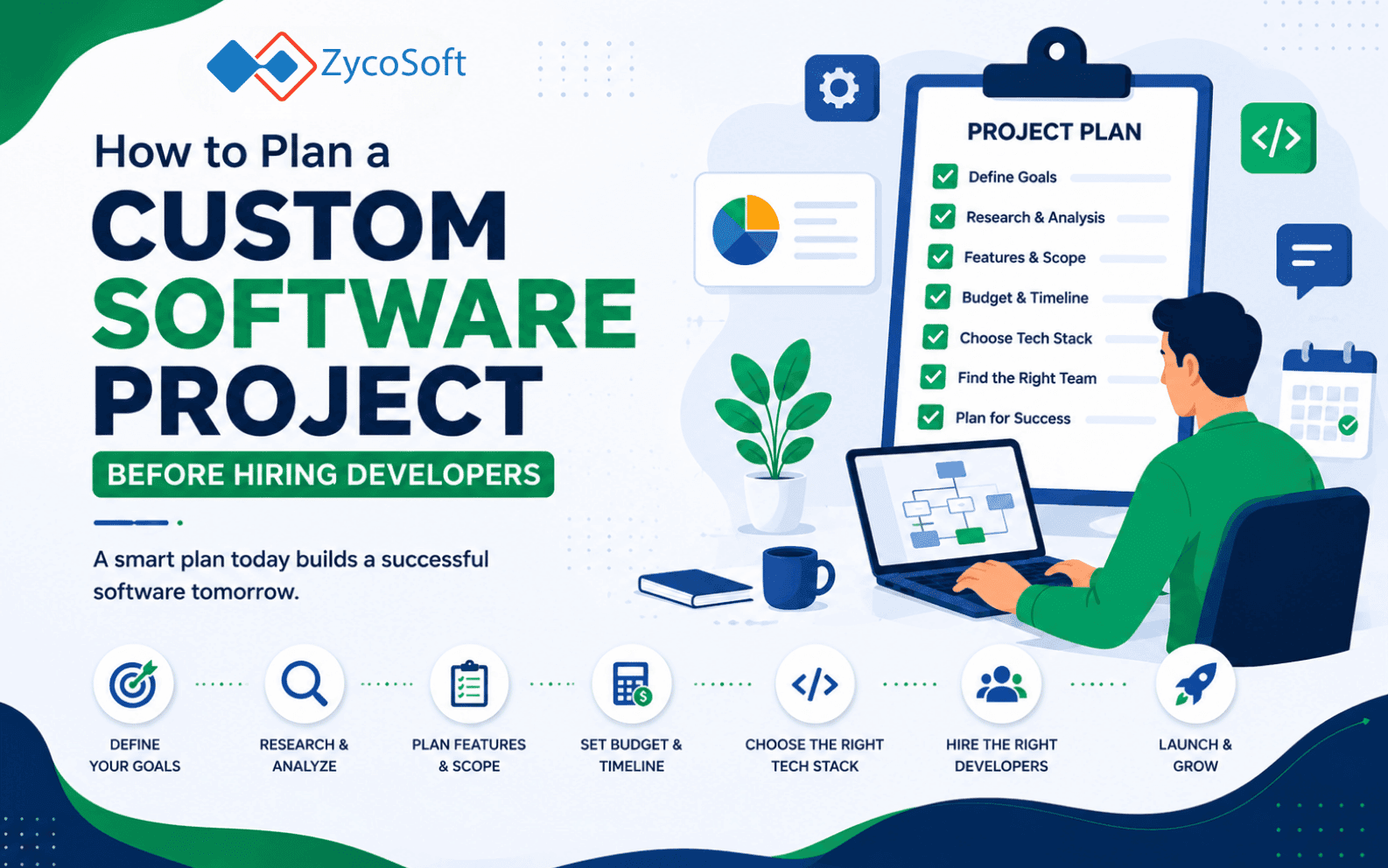
Hiring developers before you've nailed down what you actually need is one of the most expensive mistakes a business can make. Vague requirements lead to scope creep, missed deadlines, and budgets that balloon far past the original estimate. A little planning up front saves you months of rework later. Here's how to do it right.
1. Define the Problem, Not the Solution
Before you think about features, get crystal clear on the problem you're solving. Are you trying to automate a manual process? Replace a clunky legacy system? Serve a customer need no off-the-shelf tool covers?
Write this down in one or two sentences. If you can't explain the core problem simply, you're not ready to talk to developers yet you're still in the discovery phase, and that's fine. It's better to spend an extra week here than to build the wrong thing quickly.
2. Identify Your Core Users
Every custom software project serves someone. Get specific:
- Who will use this daily?
- What's their technical skill level?
- What are they trying to accomplish, and what currently frustrates them?
If you have multiple user types (say, admins and customers), map out what each group needs. This becomes the backbone of your feature list later.
3. List Must-Have Features vs. Nice-to-Haves
This is where most projects go wrong. Founders often want to build the "perfect" version on day one, which drives up cost and timeline dramatically.
Instead, separate your feature list into three tiers:
- Must-have (MVP): The absolute minimum needed to solve the core problem and launch.
- Should-have: Valuable additions you'll build in a fast-follow release.
- Nice-to-have: Ideas worth revisiting once you have real user feedback.
A lean MVP gets you to market faster, costs less, and gives you real data to guide what to build next instead of guessing.
4. Sketch a Basic Workflow or User Journey
You don't need professional wireframes at this stage. A simple flow even hand-drawn or built in a free tool like Figma or Whimsical showing how a user moves through your product helps you (and later, your developers) spot gaps early.
For example: Sign up → Set up profile → Create first project → Invite team → Get first result.
Walking through this flow often reveals missing steps you hadn't considered.
5. Decide on Your Tech Constraints (If Any)
You don't need to know the tech stack in detail, but you should think through:
- Does this need to integrate with existing tools (CRM, payment processor, internal systems)?
- Will it be web-based, mobile, or both?
- Do you have data or compliance requirements (HIPAA, GDPR, SOC 2)?
- Roughly how many users do you expect at launch, and in a year?
These answers shape which developers or agencies are even a good fit for the job.
6. Set a Realistic Budget Range
Custom software costs vary wildly based on complexity, but going in with zero budget framing makes it impossible to have a productive conversation with developers. Even a rough range (e.g., "$30k–$60k" or "$150–200/hour, 3 months") helps developers tell you quickly whether your expectations are realistic or need adjusting.
If you don't know where to start, ask a few development agencies for ballpark estimates based on your feature list most will give you a range for free during a discovery call.
7. Write a Simple Project Brief
Pull everything together into a one-to-two-page brief. It doesn't need to be fancy. Include:
- The problem you're solving
- Target users
- Must-have features for launch
- Any technical constraints
- Budget range and timeline
- Success metrics (how you'll know it worked)
This document becomes the single source of truth you'll share with every developer or agency you talk to and it's the first sign to them that you're a serious, organized client worth prioritizing.
8. Decide: Freelancer, Agency, or In-House?
Each option has tradeoffs:
- Freelancers are cost-effective for smaller, well-defined projects but require more hands-on management from you.
- Agencies offer more structure, project management, and a full team (design, dev, QA) but cost more.
- In-house hires make sense for long-term products needing ongoing development, but come with recruiting time and overhead.
Your project brief will help you figure out which option fits your timeline, budget, and complexity level.
9. Prepare Your Questions for Developer Interviews
Once you're ready to talk to developers, come prepared with questions like:
- Have you built something similar before? Can I see examples?
- How do you handle scope changes mid-project?
- What does your communication and reporting process look like?
- Who owns the code and intellectual property after launch?
- What happens after launch do you offer maintenance and support?
Their answers will tell you as much about how they work as their portfolio does.
Final Thoughts
The planning work you do before hiring developers is what separates smooth projects from painful ones. Spend real time defining your problem, your users, and your must-have features before a single line of code gets written. It's the cheapest, highest-leverage step in the entire process and it's the difference between building software that fits your business and building something you'll need to rebuild in a year.
Why Choose Zycosoft for Custom Software Development?
A successful software project starts with careful planning, clear requirements, and the right development partner. By investing time in defining your goals, understanding your users, and prioritizing essential features, you can reduce development risks, stay within budget, and build software that delivers lasting business value.
At Zycosoft, we help businesses transform ideas into scalable digital products through expert custom software development. As a trusted software development company, we specialize in custom web applications, mobile apps, enterprise software, and AI automation solutions designed to solve real business challenges and support long-term growth.
Want to learn more about how we can help? Explore our Custom Software Development Services to see our capabilities, or Contact Zycosoft to discuss your project with our team and receive a free consultation. Whether you're starting from an idea or refining an existing project, we're here to help you build software with confidence.