
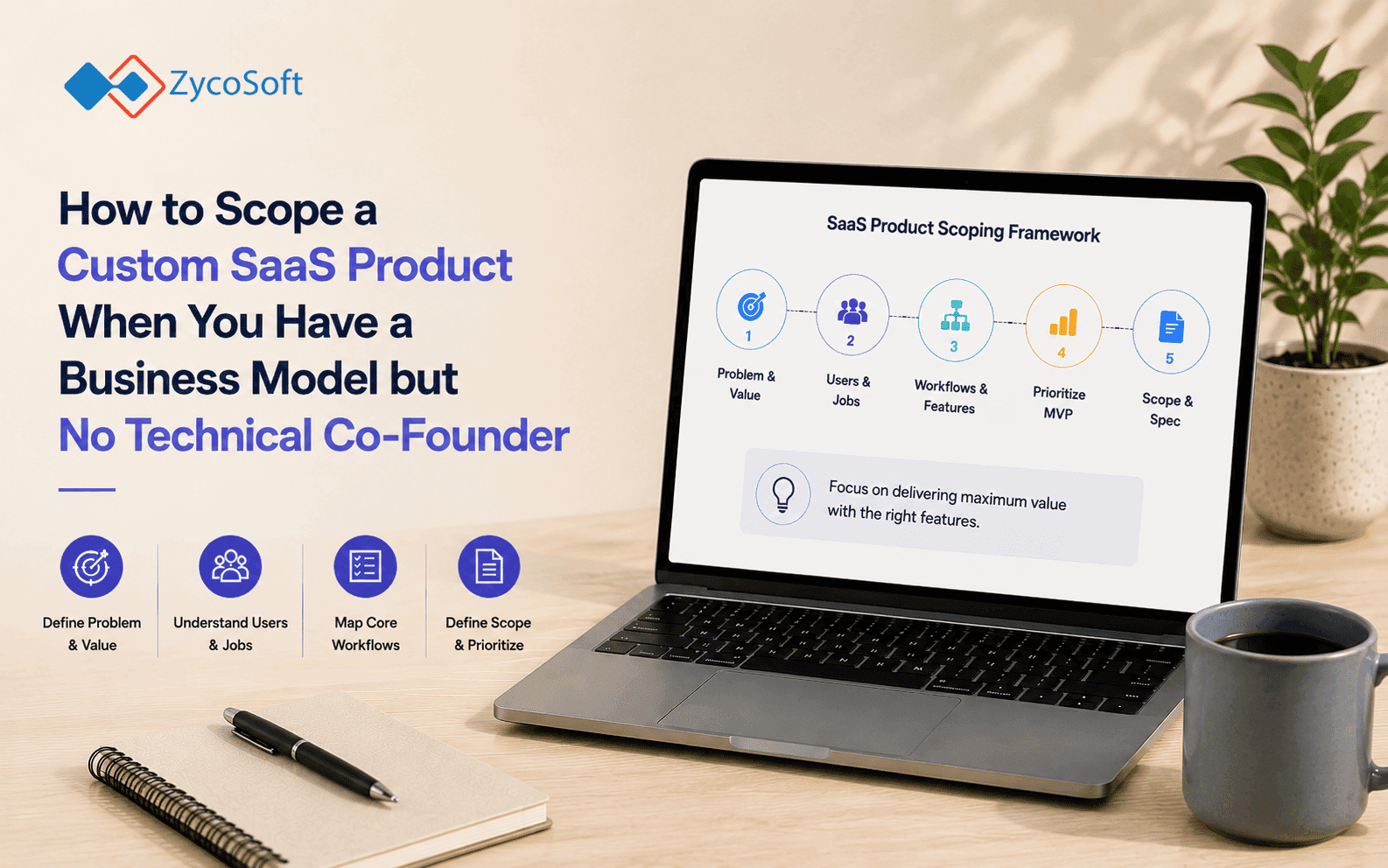
How to Scope a Custom SaaS Product When You Have a Business Model but No Technical Co-Founder
You have paying customers, a repeatable sales motion, and a clear picture of what the software needs to do. What you do not have is a CTO, a VP of Engineering, or any internal engineering leadership to translate your product vision into a buildable scope. That gap kills more SaaS projects than bad code does.
Custom SaaS development for non-technical founders is not inherently harder than any other build. But it requires a different preparation process. Without a technical translator in-house, the founder has to do the structural thinking that a CTO would normally handle before the first development conversation ever happens. This post gives you the framework to do exactly that.
Why Standard SaaS Scoping Advice Does Not Apply to You :
Most scoping guides open with advice like "work with your CTO to define the architecture" or "ask your engineering lead to review the third-party integrations." That assumes internal technical leadership exists. For the majority of early-stage US SaaS founders, it does not.
The absence of a technical co-founder changes the scoping process in three specific ways. First, no one inside the business can validate whether a feature is technically trivial or genuinely complex. Second, there is no one to catch scope creep before it reaches a development partner. Third, cost estimates received from external teams are harder to interrogate without a technical frame of reference.
None of these problems are insurmountable. But they do mean you need a structured approach to scoping that does not rely on internal engineering instinct.
Start With the Minimum Viable Workflow, Not the Full Product Vision :
The most effective first step in custom SaaS development for non-technical founders is to stop thinking about features and start thinking about workflows. A feature list is not a scope. A workflow description is.
A workflow describes the sequence of actions a specific user takes to achieve a specific outcome. For example: a recruiter logs in, uploads a candidate file, the system scores the candidate against an open role, and the recruiter receives a ranked shortlist. That is one workflow. It is also a complete, scopeable unit of work.
How to Identify Your Core Workflow :
Ask yourself one question: what is the single thing my product must do for a first-time user to consider it worth paying for? The answer defines your MVP scope. Everything else is phase two.
Write it out as a numbered sequence of steps. Include:
- Who initiates the workflow (the user type)?
- What input they provide (data, file, form entry, API trigger)?
- What the system does with that input?
- What output the user receives?
- What success looks like from the user's perspective?
This single document will do more to focus your development conversations than any wireframe or feature list. It also forces you to confront the real complexity of your product before a developer is billing you to figure it out.
How to Pressure-Test Scope Without a Technical Translator :
Once you have your core workflow documented, you need to pressure-test it before taking it to any remote engineering partner. The goal is to identify hidden complexity, unclear requirements, and assumptions that will create problems mid-build.
The most reliable method is to write user stories in plain English, then try to break them. A user story follows the format: "As a [user type], I want to [action], so that [outcome]." Write one for each step in your core workflow. Then ask yourself what happens when something goes wrong at each step. What if the file format is wrong? What if the user skips a step? What if the third-party API is unavailable?
The Three Scoping Traps That Burn Budget Before Launch :
Non-technical founders consistently fall into three specific traps during scoping. Recognising them early is the fastest way to protect your budget.
- Trap 1: Scoping to the vision, not the outcome. Founders describe the full product they eventually want to build rather than the minimum version that delivers value. Development partners estimate accordingly, and the runway evaporates before the first user onboards.
- Trap 2: Leaving integration complexity undefined. "It needs to connect to Salesforce" is not a scope item. The direction of data flow, the frequency of sync, the authentication method, and the error-handling logic are all scope items. Undefined integrations are one of the most common sources of cost overruns on SaaS builds.
- Trap 3: Confusing UI complexity with product complexity. A polished interface takes significant engineering time. Many founders spend weeks debating UI design before the data model underneath it is defined. Scope the data behaviour first. The interface follows from that, not the other way around.
If you want a deeper look at the decisions that determine how fast a product actually ships, this breakdown of the decisions that determine MVP speed covers the sequencing issues that trip up even well-prepared founders.
What to Define Before You Talk to a Remote Engineering Partner :
Engaging a remote engineering partner without a defined scope is expensive. You are effectively paying for discovery that you could have done yourself. The following preparation turns a vague first conversation into a productive scoping session.
Before the first call, have the following documented in writing:
- A one-paragraph problem statement describing what your product solves and for whom.
- Your core workflow, written as a numbered sequence of steps.
- A list of user types (roles) who will interact with the product.
- A list of any third-party tools or APIs the product must connect to, with notes on what data moves in which direction.
- A clear definition of what "done" looks like for the MVP: what can a user do on day one that they could not do before?
- Any regulatory or compliance requirements, particularly around data storage or user privacy.
This preparation also changes the quality of estimates you receive. A well-scoped brief produces a reliable cost estimate. A vague brief produces a number that will grow by 40 to 60 percent before the build is finished.
What to Ask a Development Partner Before Signing Anything
Without internal engineering leadership, the questions you ask a prospective development partner become your technical due diligence. Do not skip this step.
Ask these questions directly, and pay close attention to how the answers are structured:
- How do you separate MVP scope from post-launch phases during the scoping process?
- Do you provide a written technical specification before development begins?
- What is your process when a client requests a change to scope mid-build?
- How do you approach data architecture for a multi-tenant product?
- How do you communicate technical decisions and progress to non-technical stakeholders?
A partner who answers these questions with specific process descriptions is worth engaging further. A partner who deflects into portfolio links and hourly rates is not ready to work without a CTO on the client side.
For context on how architecture decisions interact with long-term scalability, this guide to choosing a tech stack that does not require a rewrite at scale is worth reading before your first technical conversation.
The Build vs Buy Decision You Need to Make Before Scoping Starts
Custom SaaS development for non-technical founders only makes sense when no existing product can deliver your core workflow. Before scoping a custom build, run a direct comparison against the tools already on the market.
Build custom when:
- Your core workflow is genuinely proprietary and no off-the-shelf tool replicates it without significant compromise
- Your business model depends on owning the product layer, for example, white-labelling to other businesses
- Existing tools require you to adapt your process to fit the software rather than the reverse
- Data portability or compliance requirements make vendor lock-in a material risk
Buy or configure when:
- An existing tool covers 80 percent or more of your core workflow at a fraction of the build cost.
- Speed to market is more important than product differentiation at this stage.
- Your competitive advantage sits in distribution or relationships, not in the software itself.
This decision is worth making explicitly and in writing before you invest time in scoping. This build vs buy framework for custom SaaS covers the criteria in more detail and is directly applicable regardless of whether you are building for a US or international market.
If the answer is build, you now have a methodology to scope it without internal engineering leadership. Document the workflow, pressure-test the user stories, define the integrations, and arrive at the first development conversation with a written brief rather than a vision deck.
Start the Scoping Process Before You Start the Search for a Development Partner
The single most effective thing a non-technical founder can do is complete the scoping groundwork before any external team is involved. This protects your budget, produces better estimates, and filters out development partners who are not equipped to work with a client-side product owner rather than a CTO.
At ZycoSoft, we work with US founders at exactly this stage: business model validated, demand confirmed, and no internal engineering leadership. Our scoping process produces a written technical specification, a phased delivery plan, and a clear separation between MVP scope and future capabilities before a single line of code is written.
If you are ready to scope a custom SaaS product and want a structured first conversation, get in touch with the ZycoSoft team directly.
Frequently Asked Questions
Start by mapping the single workflow your product must complete to deliver value for your first paying customer. Document it in plain English as user stories, identify what data moves between steps, and define what success looks like. A qualified remote engineering partner can then translate that into a technical scope. You do not need internal engineering leadership to run a productive scoping process.
Scoping to the full product vision instead of the minimum viable workflow. Founders with validated demand often arrive at the first development conversation with a list of 40 features rather than a defined core outcome. The result is a bloated estimate, a longer runway burn, and a product that ships 6 months late. Define what your first paying customer actually needs to get value, then scope everything else as phase two.
Prepare a written problem statement, a user story for your primary user type, a data flow description covering what inputs the product needs and what outputs it produces, and a list of any third-party tools it must connect to. You should also have a clear definition of what done looks like for your MVP. This preparation alone will save significant time and improve the quality of any estimate you receive.
A focused scoping process typically takes two to four weeks when the founder has done preparatory work. That includes one or two structured discovery sessions with the engineering partner, a written scope document with feature prioritisation, and a rough architecture recommendation. Founders who arrive unprepared can extend this to six to eight weeks and still end up with a vague brief that produces unreliable cost estimates.
Ask how they separate MVP scope from future phases, what their process is for handling scope changes mid-build, whether they provide a written technical specification before development starts, what their approach is to data architecture and multi-tenancy, and how they communicate progress to non-technical stakeholders. Their answers will tell you far more about fit than any portfolio case study will.
If an existing tool covers 80 percent of your core workflow and your business model does not depend on proprietary data handling or a differentiated user experience, buying is almost always faster and cheaper in the short term. Build custom when your workflow is genuinely unique, when off-the-shelf tools force you to adapt your business model to the software, or when your competitive advantage depends on owning the product layer.