
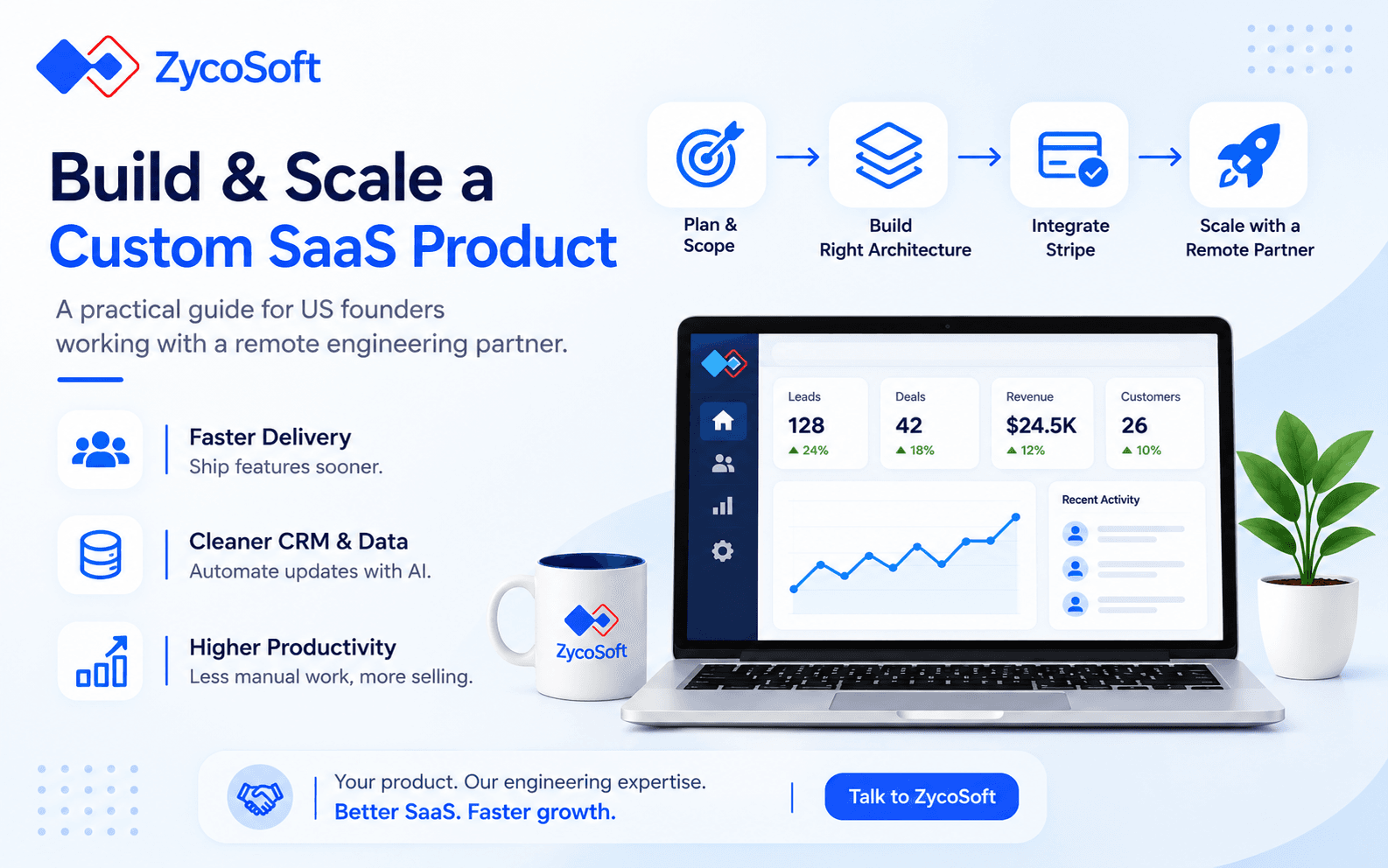
How to Build and Scale a Custom SaaS Product : A Practical Guide for US Founders Working with a Remote Engineering Partner
The founder had a working demo, a term sheet in progress, and a codebase that was quietly falling apart. Eighteen months earlier, he had hired three freelancers from different platforms to build his B2B SaaS product fast and keep burn low. Each one had delivered their piece. The problem was that nobody owned the whole. Authentication logic was scattered across two services. The database schema treated every customer as a single-tenant instance, meaning the infrastructure cost scaled linearly with each new account added. Stripe subscriptions had been wired directly into the application controllers with no abstraction layer. It worked, until it didn't.
By the time a mid-market prospect asked for custom pricing tiers and a dedicated environment, the answer was a six-week rewrite estimate. The investor meeting was in four. This is not an unusual story. It is, in various forms, the most common conversation we have with US founders who come to us twelve to eighteen months into a build that should have been further along.
The decisions that created that situation were not made out of negligence. They were made under pressure, with limited information, and without a senior engineering voice in the room. What follows is a practical walkthrough of how to avoid that trajectory, from scoping decisions and architecture choices through to Stripe integration and maintaining product velocity with a dedicated remote engineering partner rather than a fragmented freelance arrangement.
Why Product Scoping Determines Architecture, Not the Other Way Around
Most founders approach scoping as a feature list. It is not. Scoping for a SaaS product is an architectural decision-making process that happens before a single line of code is written. Get it wrong at this stage and every technical choice downstream inherits the mistake.
The questions that matter most at scoping are not "what does the product do" but rather how customers will be segmented, how data will be isolated between accounts, whether pricing will be flat, seat-based, or usage-driven, and which third-party systems the product must integrate with on day one versus day ninety. The most expensive mistakes US founders make before development starts are almost always rooted in skipping this stage or treating it as a formality.
A well-structured scope document for a SaaS MVP should cover at minimum:
- Tenant model: shared database, schema-per-tenant, or database-per-tenant
- User role hierarchy and permission boundaries
- Core feature set for version one, with explicit out-of-scope items listed
- Payment integration requirements, including billing model and plan structure
- Authentication approach: in-house, Auth0, Clerk, or similar
- Infrastructure and deployment targets: AWS, GCP, or Azure
- Data residency requirements for any enterprise or regulated customers
Producing this document in partnership with your engineering team before development begins is not overhead. It is the single highest-return activity in the entire product lifecycle.
Multi-Tenant Architecture: The Decision That Follows You to Series
A Multi-tenant architecture is the correct default for most SaaS products. It keeps infrastructure costs manageable as customer count grows and simplifies maintenance because you are running one application, not dozens of isolated instances. The question is not whether to go multi-tenant but which tenancy model to implement.
- Shared database, shared schema: All customers share the same tables, distinguished by a tenant ID column. Lowest infrastructure cost, fastest to build, but harder to isolate data for compliance-sensitive customers and harder to migrate a single tenant out later.
- Shared database, separate schemas: One database, but each tenant gets their own schema namespace. A reasonable middle ground that makes tenant-level migrations and backups more manageable without multiplying database instances.
- Separate database per tenant: Maximum isolation, easiest compliance story for enterprise and regulated customers, but infrastructure costs scale with customer count. Usually reserved for enterprise tiers or specific regulated verticals.
The founder in the opening scenario had effectively built option three by accident, because each freelancer had provisioned resources independently. He was paying enterprise-grade infrastructure costs for a startup-grade customer base. Choosing the right architecture model for SaaS requires this conversation to happen explicitly, at the scoping stage, with an engineer who understands the commercial implications, not just the technical ones.
Stripe Integration Done Right: Billing as Infrastructure, Not an Afterthought
Stripe is the dominant payment infrastructure choice for US SaaS products, and it is genuinely excellent. The problem is not Stripe. The problem is how founders instruct developers to integrate it.
Hardcoding Stripe logic directly into application controllers is the most common mistake. It works for a single pricing plan. The moment you introduce annual billing, seat-based upgrades, promotional discounts, or enterprise contracts, the tightly coupled integration becomes a refactoring project measured in weeks. The right approach is to build a billing abstraction layer from day one, a service or module that owns all communication with Stripe and exposes clean internal methods to the rest of the application.
A well-structured Stripe integration for a SaaS product should handle:
- Subscription creation, modification, and cancellation through the abstraction layer, never directly from feature code
- Webhook handling with idempotency keys to prevent duplicate event processing
- Failed payment recovery flows and dunning logic
- Metered billing hooks if usage-based pricing is on the roadmap
- Tax calculation integration, particularly important for US SaaS products selling across state lines
A dedicated remote engineering partner with SaaS delivery experience will raise these requirements during scoping. A pool of rotating freelancers will implement what they are asked for and move on. That difference in posture compounds over every sprint.
Maintaining Product Velocity Without an In-House Engineering Team
The most common objection to working with a remote engineering partner rather than building in-house is control. Founders worry about communication lag, misaligned priorities, and losing the ability to react quickly. These are legitimate concerns about the wrong model, not about remote engineering in general.
The freelance patchwork model genuinely does create all of those problems. An embedded team operating with consistent engineers, shared product context, and structured sprint cycles does not. The practical difference is that your remote partner participates in product planning and architecture decisions rather than simply executing tickets. They carry context between sprints. They push back on scope decisions that will create technical debt. They behave, in every operationally meaningful sense, like an in-house team without the fixed overhead of one.
Maintaining velocity with a dedicated team extension depends on three operating conditions:
- Bi-weekly or weekly sprint reviews with a consistent lead engineer present, not a rotating account manager
- A shared product backlog maintained in a tool both sides can access and update in real time
- Agreed definition-of-done standards so "complete" means the same thing on both sides of the relationship
US founders working with a remote engineering partner that operates on Western work practices and overlapping time zones find that the communication overhead is far lower than anticipated. The timezone gap between US East Coast and UK or Central European hours, for instance, typically provides a productive morning handoff window without requiring anyone to work unusual hours.
From MVP to Scale: What Changes and What Should Not
An MVP built on sound architectural foundations scales without being rewritten. That sounds obvious, but the distinction between a scalable MVP and a prototype dressed as a product is not always visible until the load arrives. The founder from the opening scenario had the latter, and discovered it at precisely the worst moment.
The elements that should remain stable from MVP through to a Series A-ready product include the tenant model, the billing abstraction, the authentication architecture, and the core data model. These are not features. They are structural decisions that become progressively more expensive to change as customer data accumulates on top of them. Extending your product team with a remote engineering partner is most effective when that partner is involved in setting these foundations, not inherited after a first build has already locked them in.
What does change as you scale is infrastructure configuration, feature depth, integration surface area, and team structure. A well-chosen dedicated remote engineering partner grows with these changes rather than requiring you to re-onboard a new vendor at each stage. Continuity of engineering context is not a soft benefit. It translates directly into faster delivery and fewer regression incidents as the product matures.
The founder eventually did rebuild. It took ten weeks with a properly scoped engagement, a consistent embedded team, and architecture decisions made before the first sprint rather than discovered during it. He shipped the enterprise tier in time. But the ten weeks and the associated cost were entirely avoidable. If you are at the stage where those decisions are still ahead of you, the right time to make them correctly is now.
If you are scoping a SaaS product or reassessing a build that has accumulated the wrong kind of complexity, talk to the ZycoSoft team. We work with US founders from architecture through to production, and we will tell you plainly what needs to be fixed and what does not.
Frequently Asked Questions
A dedicated remote engineering partner operates as an embedded extension of your product team, with consistent engineers, shared context, and accountability for architecture decisions across the full SaaS lifecycle. A freelance patchwork delivers disconnected contributions with no shared ownership, which compounds into technical debt and rewrite costs as the product scales.
Multi-tenant architecture is the right default for most SaaS products because it reduces infrastructure cost per customer and simplifies maintenance at scale. Single-tenant deployment makes sense only when enterprise customers contractually require data isolation or when compliance obligations, such as HIPAA or FedRAMP, mandate it. Choosing the wrong model early typically forces a costly rewrite before Series A funding.
Stripe integration affects scalability through how you model subscriptions, usage-based billing, and plan upgrades in your database and application logic. Building a billing abstraction layer from the start means your pricing model can evolve without rewiring core infrastructure. Founders who hardcode Stripe logic directly into application controllers face significant refactoring costs when they introduce annual plans, seat-based pricing, or enterprise tiers.
Product velocity without an in-house team depends on structured sprint cycles, shared documentation, and a remote engineering partner who participates in product planning rather than just executing tickets. Western-aligned work practices, clear SLAs, and a defined escalation path matter more than raw headcount. Founders who treat their remote partner as a strategic collaborator consistently ship faster than those who manage a pool of rotating freelancers.
A production-ready SaaS scope should define the tenant model, user role hierarchy, core feature set for the MVP, third-party integrations including payment processing, authentication approach, and infrastructure requirements. It should also specify what is explicitly out of scope for version one. Founders who skip formal scoping routinely spend the first two sprints renegotiating what was agreed, burning both time and budget before a single feature ships.