
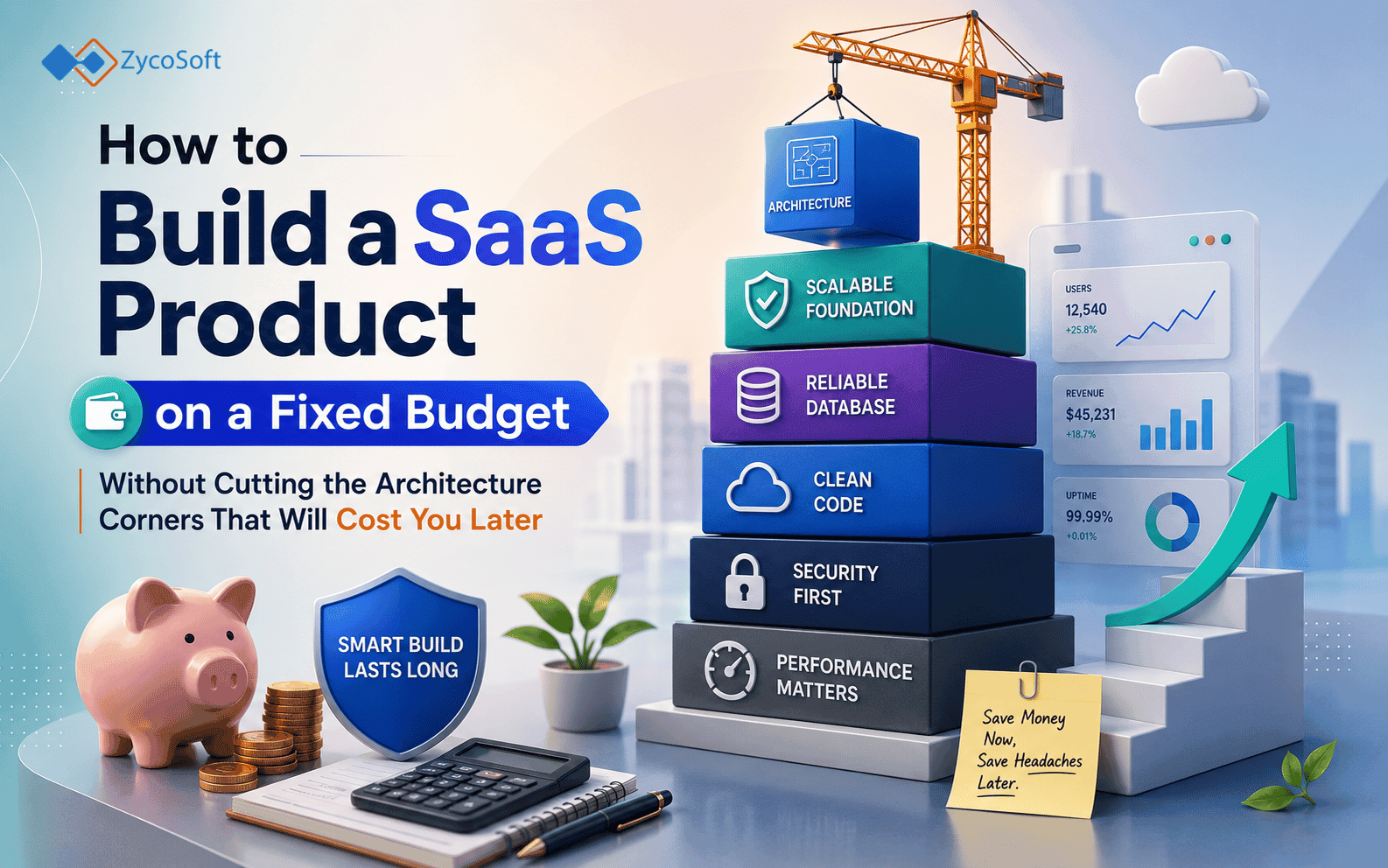
How to Build a SaaS Product on a Fixed Budget Without Cutting the Architecture Corners That Will Cost You Later.
Most SaaS rewrites are not caused by bad code. They are caused by deferred architectural decisions made under budget pressure during the MVP phase. A founder agrees to cut scope, the remote engineering partner starts building, and twelve months later the product cannot support multi-tenancy, the data model is wrong, and every new feature costs three times what it should. The full rewrite bill is usually 60 to 120 percent of the original build cost. This guide is about preventing that outcome without increasing your initial spend.
The Real Budget Problem Is Not What You Think:
When US SaaS founders approach a custom SaaS development agency US side with a fixed budget, the instinct is to cut features. That is the correct instinct. What goes wrong is cutting the wrong things. Founders compress spend on infrastructure decisions and over-invest in visible features that look good in a demo but do not affect whether the architecture will survive twelve months of real usage.
The distinction that matters is this: some decisions are reversible and some are not
Reversible decisions include UI design, colour schemes, onboarding copy, admin dashboard polish, and non-core integrations. Irreversible decisions, or at least very expensive ones to reverse, include your multi-tenancy model, your authentication architecture, your core data schema, and the boundary between your application logic and your API layer.
A fixed budget forces prioritisation. The framework is straightforward: compress spend on reversible decisions, protect spend on irreversible ones. The problem is that reversible decisions are visible and irreversible ones are not, which makes it easy to make the wrong trade-off under pressure.
Which Architectural Decisions Cannot Be Deferred at MVP Stage:
Four decisions made at MVP stage consistently cause rewrites when they are wrong. Getting these right is not a luxury for well-funded teams. It is the minimum viable architecture, separate from the minimum viable product.
Multi-Tenancy Structure:
How your application separates customer data is a foundational decision that affects your database schema, your query patterns, your security posture, and your compliance obligations. The three common models are shared schema with row-level isolation, separate schemas per tenant, and separate databases per tenant. Each has a different cost profile and a different scaling behaviour.
Choosing the wrong model at MVP stage and then growing to 50 customers before correcting it is not a refactor. It is a rebuild of the most critical layer of your application. Multi-tenant SaaS architecture requires a deliberate decision before a single table is created, and that decision must be documented and reviewed before development starts.
Authentication and Authorisation Model:
Authentication is the most commonly under-scoped component in a fixed-budget SaaS build. Founders accept a basic username and password implementation to save time, then discover six months after launch that a key enterprise customer requires SSO, a different customer needs role-based access control, and neither can be bolted on without restructuring the entire auth layer.
The right decision at MVP stage is not to build every auth feature. It is to choose an authentication architecture that can extend to support SSO, granular roles, and audit logging without a rewrite. Libraries like Auth0 or purpose-built auth services add modest cost and eliminate the rebuild risk entirely.
Core Data Schema:
Your data model is the skeleton of your application. Features come and go, but the relationships between your core entities, users, organisations, subscriptions, resources, persist across every version of the product. A schema designed around the MVP feature set rather than the underlying business model will fracture as the product grows.
The most common mistake is modelling data around the UI rather than around the domain. A good remote engineering partner for SaaS founders will push back on this and produce a data model review before sprint one. If they do not, ask for one explicitly. The choice of database technology matters here too, but schema design within whichever database you choose is the more consequential decision.
API Boundary Design:
If your application will ever have a mobile client, a third-party integration, or a public API, the boundary between your application logic and your API layer needs to be designed correctly from the start. Tightly coupled front-end and back-end code that works fine for a single web client becomes a major constraint the moment a second client or integration surface is needed. API-first architecture is not always necessary, but the decision to adopt it or not must be made deliberately, not by default.
Where to Compress Spend Intelligently:
Once the non-negotiable architectural decisions are protected, there is real room to compress spend without creating future liability. The following areas are safe to defer or simplify at MVP stage:
- Admin dashboard and internal tooling. Use a simple tool like Retool or a basic custom admin panel for your internal team. A polished internal dashboard can wait until post-launch.
- Advanced reporting and analytics. Ship with basic metrics. A full analytics suite is a post-validation feature.
- Non-core third-party integrations. Build the one or two integrations your first cohort of users will actually need. Everything else is scope for version two.
- UI polish and design system depth. A functional, consistent UI is necessary. A fully tokenised design system with comprehensive component coverage is not an MVP requirement.
- Billing complexity. Start with a simple subscription model using a payment provider that handles the heavy lifting. Add usage-based billing, dunning logic, and complex plan structures once you have validated pricing.
The pattern here is consistent: defer features that add visible richness but do not affect the integrity of the underlying architecture. Do not defer decisions that are embedded in the structure of the application itself.
How to Structure the Engagement So the MVP Does Not Become a Rewrite:
The engagement structure between a US SaaS founder and a dedicated remote development team is as important as the technical decisions themselves. A poorly structured engagement, one where the team starts building immediately without a shared understanding of the architecture, is the most common cause of the rewrite problem.
Start with a Paid Discovery Phase:
Before sprint one, run a two to three week discovery phase with a defined output. That output should include an architecture decision record covering the four decisions above, a data model diagram, a scoped feature list with explicit cut lines, and a prioritised backlog that distinguishes MVP features from post-launch features. This phase typically costs between three and eight percent of the total project budget and prevents the majority of structural problems.
Define Architectural Guardrails Before the First Sprint:
An embedded engineering team working without architectural guardrails will make locally reasonable decisions that create globally incoherent structure. Before the first sprint, agree on:
- The multi-tenancy model and how it is enforced at the query layer
- The authentication library and the extensibility requirements it must support
- The core entities in the data model and their relationships
- The API boundary convention and whether the project is API-first
- The deployment target and the infrastructure primitives in scope for MVP
These guardrails do not slow the team down. They accelerate the team by eliminating the need for repeated architectural discussions mid-sprint.
Build in a Post-MVP Architecture Review:
Before you move from MVP to the growth phase, commission a formal architecture review. This does not need to be expensive. Two to three days of senior engineering time reviewing the codebase against the original decision record will surface any drift, any shortcuts taken under time pressure, and any structural debt that should be addressed before the product scales. Catching these issues at 50 users costs a fraction of catching them at 5,000.
What to Look for in a Custom SaaS Development Agency US Founders Should Trust with This Work:
Not every custom SaaS development agency US founders evaluate will approach a fixed-budget build with this level of rigour. The ones that will are identifiable before you sign anything.
Ask the agency or embedded team three questions before engaging:
- What does your discovery process produce, and can you show me an example architecture decision record from a previous project?
- How do you handle scope trade-offs when a fixed budget forces a cut between an architectural decision and a feature?
- What does your post-MVP handoff process look like, and how do you document decisions for the next phase of the team?
A team that cannot answer the first question clearly is building without sufficient upfront rigour. A team that answers the second by always cutting the architectural decision is optimising for short-term velocity at long-term expense. The right remote engineering partner will push back on feature scope to protect structural decisions, and will be able to explain precisely why.
For US founders evaluating a custom SaaS development agency, the difference between a team that delivers a scalable product and one that delivers a rewrite candidate is rarely visible in the portfolio. It is visible in how they approach the first two weeks of an engagement.
If you are scoping a SaaS build and want to understand how to structure the engagement, protect the right architectural decisions, and compress spend intelligently without creating a liability, speak to the ZycoSoft team directly. The conversation starts with your problem, not a sales process.
Frequently Asked Questions
Multi-tenancy structure, authentication and authorisation model, core data schema, and API boundary design must be decided before MVP development begins. Deferring any of these forces a structural rewrite later, not a simple refactor. The cost of correcting them post-launch typically runs between three and eight times the cost of getting them right at the start.
Safe areas to compress include UI polish, admin dashboards, non-core third-party integrations, and advanced reporting. These can be added after launch without touching the underlying architecture. The mistake most founders make is doing the opposite: investing in visible features while deferring decisions about data models, tenant isolation, and service boundaries that are far more expensive to change later.
Start with a paid discovery phase of two to three weeks before committing sprint budgets. Use that phase to produce an architecture decision record, a data model, and a scoped feature list with explicit cut lines. Define what is in the MVP and what is deferred. This protects your budget and gives the embedded team enough context to build without constant redirection.
A full SaaS rewrite typically costs between 60 and 120 percent of the original build, depending on how deeply flawed the original architecture is. The most common causes are incorrect multi-tenancy implementation, a data model that cannot support new features, and authentication that cannot be extended to support roles or SSO. All three are preventable with upfront architectural decisions.
Ask for an architecture decision record before sprint one. It should cover tenant isolation strategy, authentication model, database schema rationale, and API design approach. If the partner cannot produce this document, or skips it to start building faster, treat that as a warning sign. Sound partners slow down at the start to go faster at scale.