
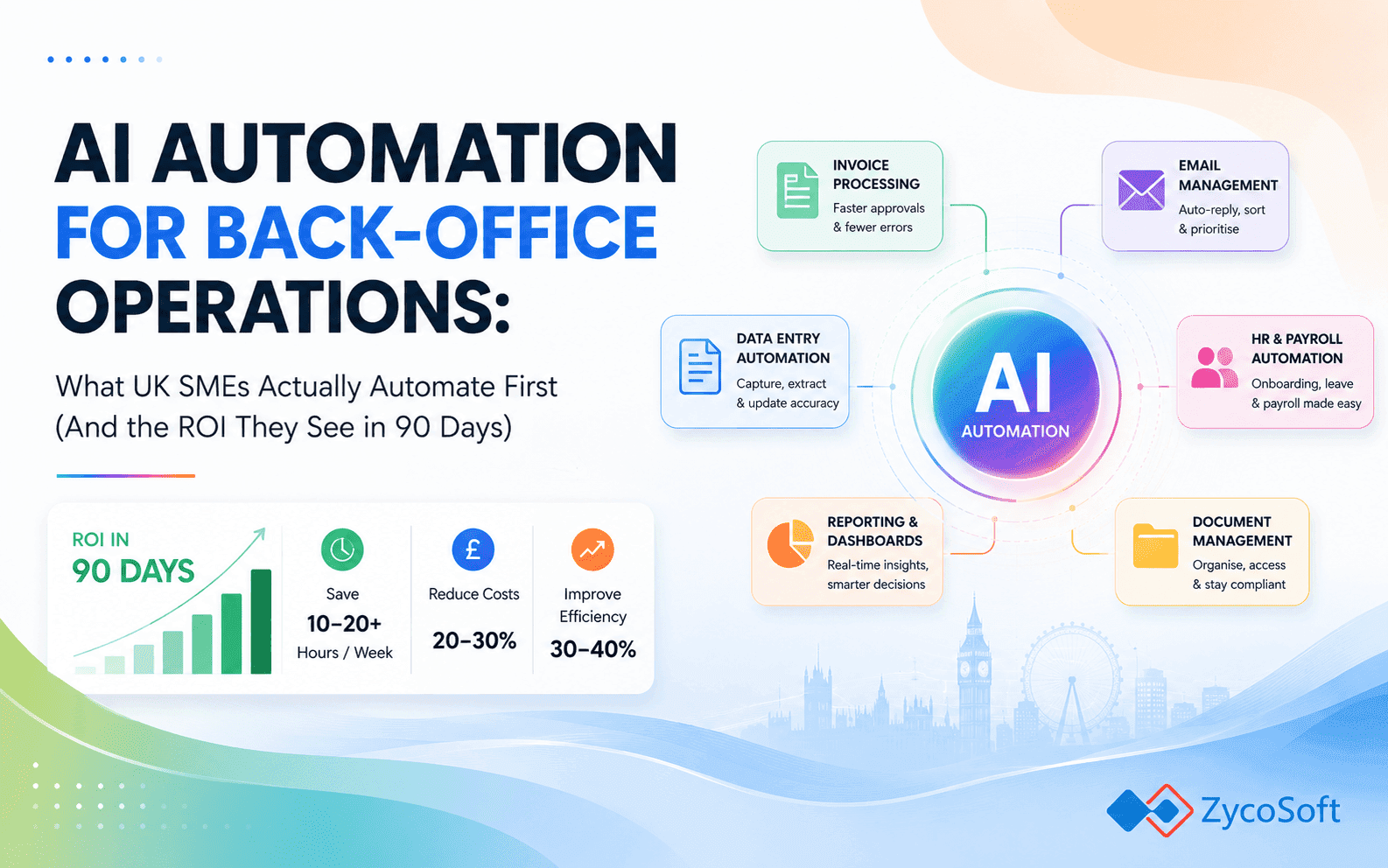
AI Automation for Back-Office Operations: What UK SMEs Actually Automate First (And the ROI They See in 90 Days)
The operations director at a 60-person professional services firm in Leeds had the same conversation every Monday morning. Her finance assistant would arrive with a stack of supplier invoices exported from three different portals, none of which matched the format expected by their accounting platform. Two people spent the better part of Tuesday cross-referencing line items, chasing missing PO numbers, and manually keying totals into Xero. By Wednesday afternoon, the reconciliation was done. By the following Monday, the cycle started again.
Nobody in that business thought of it as a problem worth solving. It was just how things worked. The real cost, somewhere in the region of 28 staff hours per month across two roles, never appeared on any report. It lived in the background, quietly consuming capacity that could have been directed at client delivery, forecasting, or growth.
That firm is a composite, but the situation is not unusual. It describes the starting point for the majority of UK SMEs that engage with AI automation services for reducing manual back-office tasks. The question is never whether the problem exists. The question is which problem to tackle first, and what the return looks like before the next board meeting.
Why the First Automation Choice Determines Whether the Programme Survives
Most AI automation programmes at SME level stall not because the technology fails, but because the first use case was chosen for the wrong reasons. Picking something ambitious, a full CRM migration pipeline or an end-to-end client onboarding workflow, burns time and budget before a single hour of staff capacity is recovered. The programme loses internal credibility before it has produced a single win.
The processes that survive scrutiny and deliver measurable ROI inside 90 days share three characteristics. They are high in volume, meaning they happen daily or weekly rather than quarterly. They have a documented error rate, even an informal one. And they consume a disproportionate amount of staff time relative to the value of the decision being made.
Invoice reconciliation, inbound document processing, CRM data entry, and scheduled reporting pipelines meet all three criteria in the vast majority of UK SMEs with 20 to 200 staff. They are also the processes where AI automation for UK SMEs delivers the clearest before-and-after numbers, which matters when you are building a business case for the next phase.
The Four Workflows UK SMEs Automate First (And What the Numbers Look Like)
Invoice Reconciliation
Invoice reconciliation is the most common first automation project, and for good reason. The inputs are structured enough for an LLM-driven pipeline to parse reliably, the logic is repeatable, and the error cost is tangible. A typical deployment extracts line-item data from PDF invoices, matches it against purchase orders in the ERP or accounting platform, flags discrepancies, and routes exceptions to a human reviewer rather than the full document stack.
SMEs running this workflow manually typically recover between 20 and 40 staff hours per month after automation. Error rates on matched invoices drop by 70 to 90 percent in the first 60 days. For a business processing 200 or more invoices monthly, that represents a meaningful shift in finance team capacity.
Inbound Document Processing
Any business that receives contracts, applications, compliance documents, or supplier forms by email is processing documents manually somewhere. Staff read the document, extract the relevant fields, and enter them into a CRM, a case management system, or a spreadsheet. This is a direct candidate for AI automation services for reducing manual back-office tasks.
An n8n-based pipeline with an LLM extraction layer can receive the document, classify it, extract named fields with high accuracy, validate against a schema, and push the structured data to the target system, all without human intervention unless confidence thresholds are not met. The human reviewer handles exceptions only, not the full volume. Moving from manual document handling to LLM-driven pipelines is one of the highest-impact transitions available to a back-office team at this scale.
CRM Data Entry and Enrichment
Sales and account management teams at UK SMEs consistently report that 20 to 35 percent of their CRM records are incomplete, outdated, or duplicated. The root cause is almost always manual entry under time pressure. Reps log calls inconsistently, emails go uncaptured, and contact records accumulate errors over months.
Automating CRM data entry means connecting the communication layer (email, calendar, call logs) to the CRM via a workflow that extracts entities, matches them to existing records, and writes structured updates on a defined schedule. The result is not just cleaner data. It is recovered selling time, and it makes downstream reporting usable for the first time.
Scheduled Reporting Pipelines
Weekly management packs, monthly board reports, and operational dashboards are frequently assembled by hand. Someone pulls exports from three or four systems, pastes them into a spreadsheet, applies formatting, and emails the file. The process takes two to four hours each cycle and is usually owned by whoever has the relevant system access, not whoever has the analytical skills.
Automating this pipeline means the data collection, transformation, and delivery happen on a schedule without human input. The person who previously built the report shifts to interpreting it. This is a straightforward ROI conversation: hours recovered multiplied by fully loaded cost, offset against build and maintenance investment.
The Prioritisation Framework: Scoring Your Processes Before You Build Anything
Before committing to any build, operations leaders should score candidate processes against four criteria. This produces an objective ranking and a defensible business case.
- Monthly transaction volume: How many times does this process execute per month? Below 50 is rarely worth automating first. Above 200 is a strong signal.
- Staff hours consumed: Log actual time for two weeks, including prep, execution, and error correction. Annualise it and attach a fully loaded hourly cost.
- Error rate and correction cost: How often does a manual error require downstream remediation? Every hour spent fixing errors is a hidden cost that automation eliminates.
- Integration complexity: Does the process touch one system or five? Single-system automations deploy faster and carry less technical risk in the first 90 days.
Score each candidate process out of ten on each criterion and rank them. The highest-scoring process is your first build. Do not attempt to automate two processes simultaneously in the first quarter. Parallel builds stretch attention, create dependency conflicts, and delay the moment you can declare a measurable win.
For a deeper comparison of the tools best suited to this kind of workflow automation at SME scale, this practitioner comparison of n8n, Zapier, and Make covers the architectural trade-offs honestly.
What 90-Day ROI Actually Looks Like in Practice
The firms that report the clearest returns share one habit: they measured the baseline before they built anything. They logged hours, counted transactions, and documented error rates. That discipline makes the post-automation comparison straightforward and credible to a board or CFO.
A realistic 90-day outcome for a UK SME automating invoice reconciliation and document intake simultaneously looks like this:
- 60 to 100 staff hours recovered per month across both workflows
- Finance team error rate on reconciled invoices down by more than 80 percent
- Document processing turnaround reduced from 24 to 48 hours to under two hours
- Payback period on build investment between three and five months
These numbers are not projections. They reflect the outcomes seen in production AI automation for UK SMEs deployments built on n8n with LLM extraction layers. The variation depends on baseline volume and the quality of data in the source systems, both of which are knowable before you commit to a build. Understanding the full ROI picture before you start is what separates programmes that survive their first quarter from those that stall.
The Decision That Determines Speed: Build, Configure, or Partner
UK SMEs evaluating AI automation services for reducing manual back-office tasks face a consistent decision point: internal build, configuration of existing tools, or engagement with a specialist automation partner. Each path has a different speed-to-value profile.
Internal builds with existing IT resource are the slowest option when back-office automation is not the team's primary focus. Configuration of off-the-shelf tools (Zapier, Make) is faster but hits architectural limits quickly when LLM processing, conditional routing, or GDPR-compliant data handling is involved. An embedded team with production experience in n8n and LLM pipeline deployment can move from scoped brief to live automation in four to six weeks without consuming internal engineering capacity.
The firms that recover ROI fastest are the ones that made the scoping decision early. They documented their target process, defined success metrics, and approached an automation partner with a brief rather than a vague ambition. That discipline, more than any technology choice, is what determines whether the 90-day window closes with a result or another internal review.
The operations director in Leeds eventually ran the numbers. Forty-two staff hours per month, across two roles, at fully loaded cost. The annualised figure landed at just over £18,000. The automation build cost a fraction of that and was in production within five weeks. The Monday morning conversation still happens, but it is now about exceptions, not the entire pile.
If your operations team is carrying a similar weight and you want to identify which process to automate first, speak to the ZycoSoft team. We scope, build, and deploy production AI automation pipelines for UK SMEs and scale-ups, with measurable outcomes defined before a single line of code is written.
Frequently Asked Questions
Invoice reconciliation, inbound document processing, and CRM data entry consistently deliver the fastest ROI for UK SMEs. These processes share three traits: high transaction volume, repetitive logic, and measurable error rates. Automating them first produces results inside 90 days and creates a defensible internal business case for further investment in AI workflow automation.
Most UK SMEs targeting invoice reconciliation or document processing see between 60 and 120 staff hours recovered per month within the first 90 days. Error rates on reconciled invoices typically drop by 70 to 90 percent. The combined effect on operational overhead is measurable within the first billing cycle after go-live, making it easier to justify further automation spend internally.
n8n is particularly well suited to UK SMEs because it supports self-hosted deployment, which simplifies GDPR compliance, and handles complex multi-step workflows without the per-task pricing that makes Zapier expensive at scale. For back-office pipelines that involve LLM processing, conditional logic, and integrations with accounting or CRM platforms, n8n offers more architectural flexibility than most no-code alternatives.
Start by logging staff hours spent on three to five repetitive processes over a two-week period. Attach a fully loaded hourly cost to each. Then calculate the error correction time on top. Present the total as an annualised cost, compare it against a realistic build and run estimate, and target a payback period of six months or less. Processes with payback under six months are straightforward to approve internally.
It can be, but compliance depends on how the pipeline is architected. Self-hosted tools like n8n avoid sending data to third-party servers. LLM processing should use private or on-premise model deployments where personal data is involved. Any automation touching employee or customer data needs a documented data flow, a lawful basis, and a retention policy. Working with a partner experienced in GDPR-compliant automation architecture is strongly advisable.
For a single well-scoped workflow such as invoice reconciliation or document intake, a build-to-deployment timeline of four to six weeks is realistic. The critical variable is data access and integration readiness on the client side. Teams that have documented their current process in advance and can provide API or export access to their existing tools move significantly faster than those that scope during the build.