
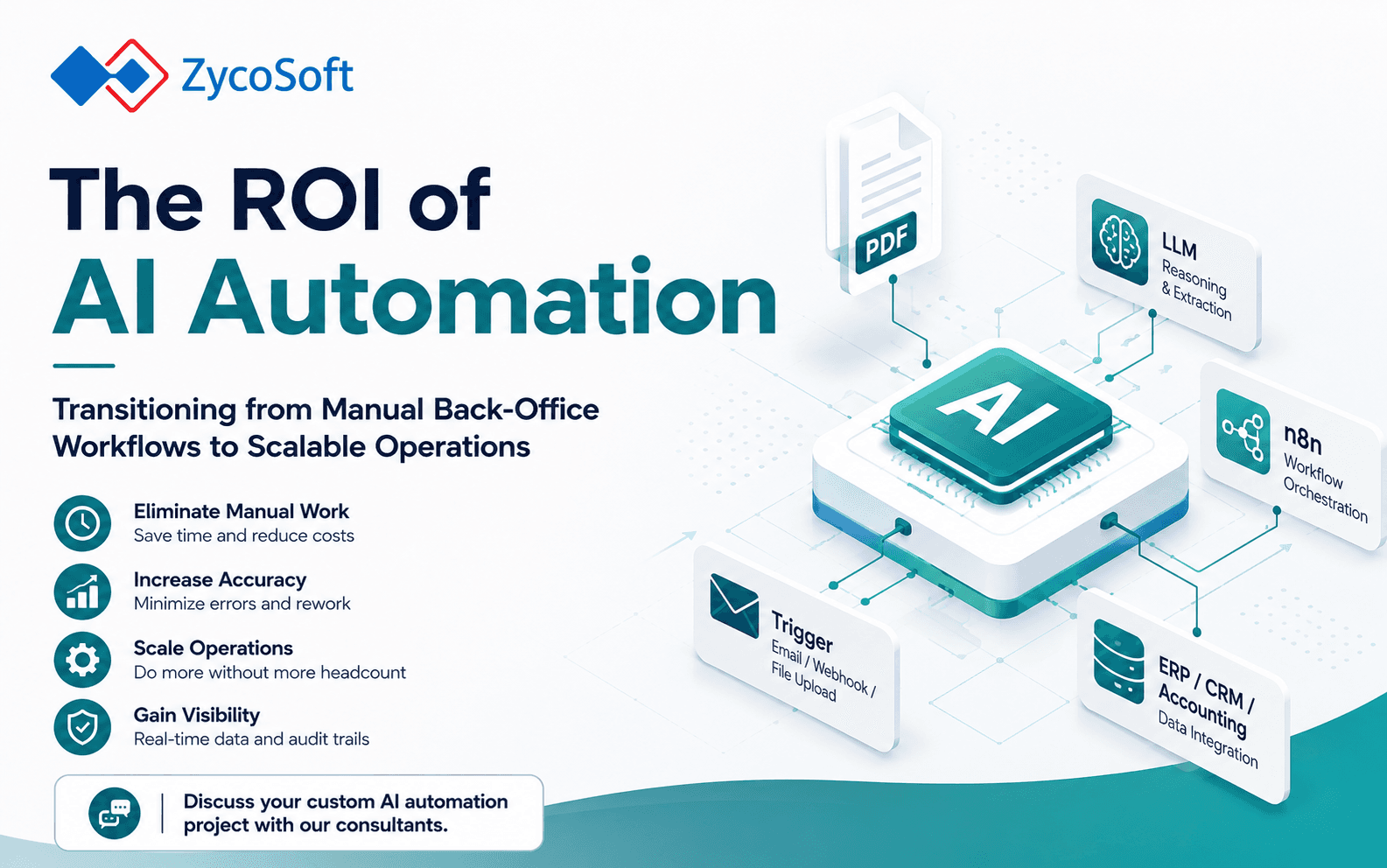
The ROI of AI Automation: Transitioning from Manual Back-Office Workflows to Scalable Operations
Manual data entry is a silent killer of operational margins. Every hour a skilled employee spends copying data from a PDF invoice into an ERP system is an hour stolen from strategic growth. For many COOs, the challenge is not a lack of ambition, but a deluge of administrative bottlenecks that prevent the business from scaling. The solution is not simply more staff, but a fundamental shift toward ai automation services for reducing manual back office tasks through custom AI pipelines.
The market is currently saturated with superficial "AI tools" that act as glorified chatbots. While chatbots have a place in customer-facing interfaces, they do nothing to solve the core problem of internal operational friction. To achieve true scalability, businesses must move toward high-integrity automation using Large Language Models (LLMs) and orchestration engines to handle the heavy lifting of data processing, validation, and movement.
Beyond Chatbots: Implementing Custom AI Pipelines
A common mistake in the current market is confusing conversational AI with workflow automation. A chatbot responds to a prompt; a custom AI pipeline executes a business process. When we talk about automating back-office operations with LLMs, we are referring to a sophisticated architecture where the AI acts as a reasoning engine within a much larger automation framework.
For example, consider a standard accounts payable process. A legacy approach requires a human to read an invoice, verify the line items against a purchase order, and manually type the data into a financial system. A custom AI pipeline uses OCR to read the document, an LLM to interpret the context and extract specific data points, and an orchestration tool like n8n to verify those points against your database before automatically pushing the data into your accounting software.
This transition shifts the human role from "data entry clerk" to "exception manager." Instead of performing the task, the human only intervenes when the AI flags a discrepancy that falls outside of predefined logic. This is how you achieve real scalability without a linear increase in headcount.
The Architecture of High-Integrity Automation
To implement effective AI workflow automation for UK SMEs and larger enterprises alike, the architecture must be robust. You cannot rely on a single LLM to "figure it out." Success requires a multi-layered approach that ensures data integrity and prevents the "hallucinations" often associated with AI models. An effective automation stack generally consists of three layers:
- The Trigger Layer: The event that starts the process, such as receiving an email, a new row in a spreadsheet, or a webhook from a payment provider like Stripe or Mollie.
- The Reasoning Layer: The LLM that parses the unstructured data, categorises the intent, and extracts the necessary parameters.
- The Action Layer: The integration that pushes the processed data into the final destination, such as a CRM, an ERP, or a proprietary database.
>
By separating these layers, you create a system that is easy to audit and maintain. If a new payment provider is added, you only need to update the Trigger Layer. If you switch from one LLM to another to improve accuracy, you only update the Reasoning Layer. This modularity is essential for any scalable business operation.
Quantifying the ROI of AI Automation Services
Deciding to invest in ai automation services for reducing manual back office tasks requires a clear understanding of the financial impact. The return on investment is not just about "saving time"; it is about increasing throughput and reducing the cost of error. When manual processes fail, they fail via human error incorrectly entered amounts, missed deadlines, or duplicated records. The cost of rectifying these errors often exceeds the initial cost of the automation itself.
Consider the following comparison of operational models:
- Manual Model: Scaling requires a linear increase in staff. Error rates increase as volume grows. Knowledge is siloed in individual employees.
- Rule-Based Automation Model: Scalable for simple, predictable tasks (e.g., moving data from Field A to Field B). Fails when faced with unstructured data or unexpected formats.
- AI-Driven Pipeline Model: Scalable without proportional staff increases. Handles unstructured data with high precision. Provides a digital audit trail for every single operation, ensuring total transparency.
When you factor in the ability to handle sudden spikes in transaction volume without hiring temporary staff, the business case for custom AI pipelines becomes undeniable. It transforms a variable cost (staff) into a fixed, predictable cost (technology).
Eliminating Data Entry Bottlenecks with n8n and LLMs
The core of modern back-office transformation lies in the ability to handle unstructured information. Most business data is not neatly organized in tables; it lives in emails, chat logs, scanned documents, and varying PDF formats. This is where custom AI pipelines for business excel.
Using n8n as an orchestrator allows for complex conditional logic that traditional automation tools cannot match. You can build workflows that ask the AI to perform specific tasks: "Extract the total amount, tax rate, and vendor name from this email attachment. If the tax rate is not 20%, flag it for manual review. If it is correct, send the data to the Stripe reconciliation folder." This level of precision is what turns a theoretical concept into a functional business asset.
This approach doesn't just speed up work; it improves the quality of your business intelligence. When data is entered manually, it is often inconsistent. When it is processed by a controlled AI pipeline, the data remains clean, structured, and ready for immediate analysis. This enables more accurate forecasting and better decision-making at the executive level.
Strategic Implementation: A Roadmap for COOs
For an Operations Director, the move toward AI automation should be phased to mitigate risk. You should not attempt to automate your entire back office at once. Instead, follow this deployment framework:
- Identify: Map out all repetitive, high-volume tasks that involve unstructured data.
- Pilot: Select a single, low-risk workflow (e.g., invoice processing or lead triage) and build a custom pipeline.
- Validate: Measure the accuracy of the AI output against manual performance to ensure data integrity.
- Scale: Once the pilot is proven, deploy the same architecture to more complex departments like procurement, HR, or customer success.
This structured approach ensures that your automation efforts deliver immediate value while building the internal technical competency required to maintain a modern, AI-augmented operation.
If you are ready to move beyond basic tools and implement high-integrity AI automation, contact us to discuss your requirements.
Discuss your custom AI automation project with our consultants.
Frequently Asked Questions
AI automation reduces manual tasks by using LLMs to extract, categorise, and validate data from unstructured sources like emails or PDFs. By implementing custom pipelines using tools like n8n, businesses can automate decision-making processes and data transfers, ensuring that human operators focus on high-value strategic work rather than repetitive administrative entry.
A chatbot is typically a conversational interface designed for basic user queries. A custom AI pipeline is a backend architectural setup where LLMs and automation tools work together to process complex business workflows, such as automatically updating a CRM from an invoice or validating compliance documents without human intervention.
Security depends on the architecture. When using GDPR-compliant workflows and enterprise-grade LLM APIs, data can be processed within strict privacy parameters. Professional implementation focuses on ensuring that data extraction and processing occur within secure, audited environments to maintain high integrity and compliance.
Modern orchestration tools like n8n are highly effective because they allow for complex, multi-step logic and seamless integration with various APIs. When combined with Large Language Models, these tools can handle unstructured data, making them far more capable than traditional rule-based automation software.
ROI is measured by comparing the time spent on manual tasks before and after deployment, the reduction in error rates during data entry, and the increased capacity of existing staff to handle higher volumes of work without increasing headcount.