
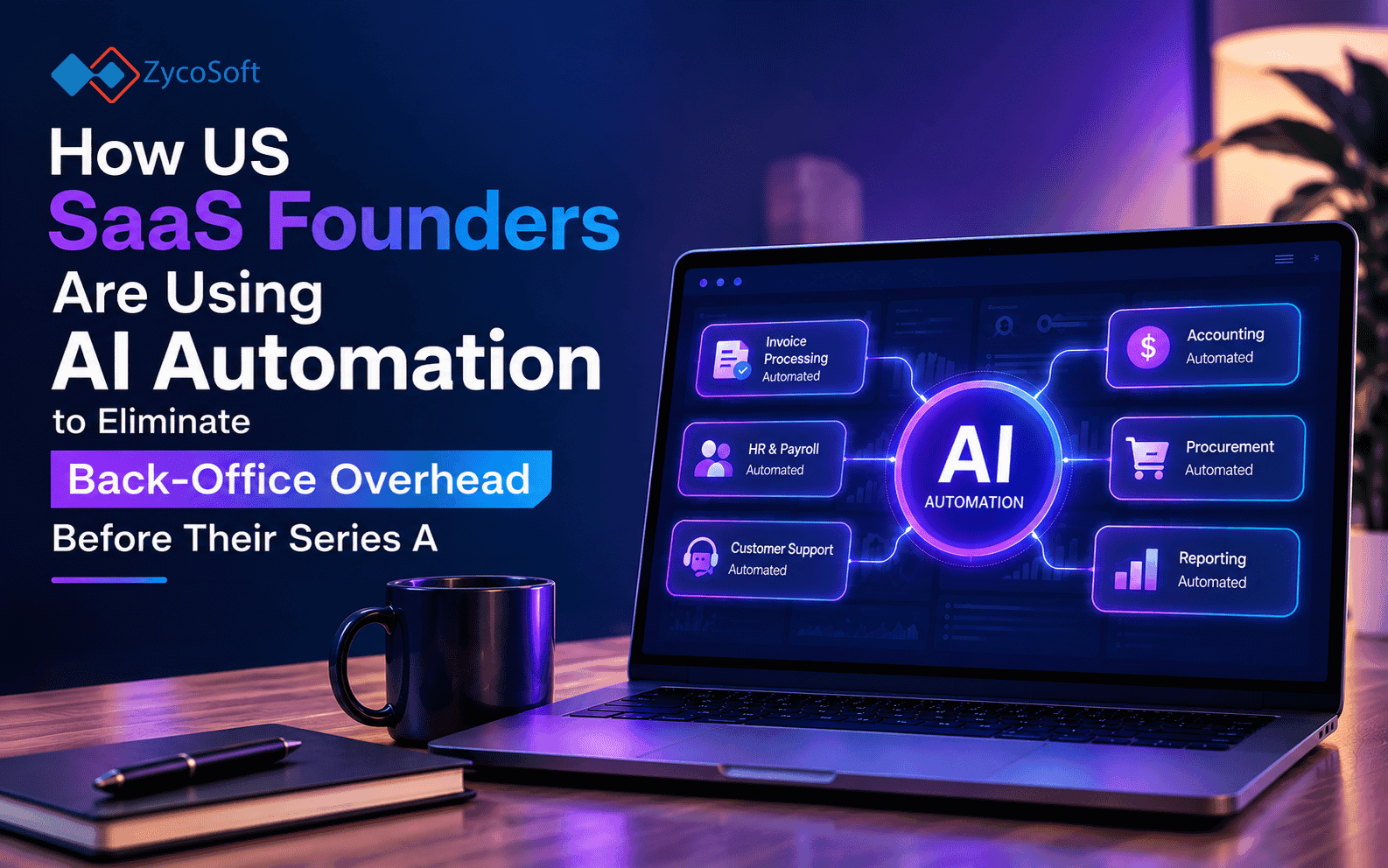
How US SaaS Founders Are Using AI Automation to Eliminate Back-Office Overhead Before Their Series A.
The ops lead at a B2B SaaS company, around 18 months post-launch with just under $800K ARR, spent most of her Mondays the same way. She would pull the weekend's trial signups from the product database, cross-check them against HubSpot, update deal stages manually, flag churned trials for the sales team, and compile a revenue summary for the founder standup. The whole process took three to four hours, every single week, without exception.
When the company entered serious conversations with a Series A lead, the investor's first data request was not about product roadmap or TAM. It was operational: what does your revenue-per-FTE look like, how many manual processes touch your financial data, and what does your ops cost per customer look like at 2x current volume? The ops lead had never been asked to quantify any of that before. The answers, once assembled, were uncomfortable. The company was spending roughly $22,000 per month on manual operational work that generated no direct revenue. That figure did not kill the raise.
But it delayed it by a quarter and triggered a condition:
demonstrate operational leverage before close. What followed was a focused, eight-week push to implement AI automation services for reducing manual back-office tasks. The results changed both the unit economics and the story the company could tell investors. This post breaks down exactly what they did, and what you should do first.
Why Series A Investors Now Scrutinise Operational Efficiency Before Committing:
Series A due diligence has shifted. Investors who were once focused almost exclusively on ARR growth and churn are now spending significant time on operational cost structure, particularly the ratio of manual labour to revenue throughput.
The underlying logic is straightforward. A company that is scaling revenue while scaling headcount at the same rate is not demonstrating leverage, it is demonstrating replication. Investors want to see that your business can handle 3x the transaction volume without 3x the operational staff. AI automation is one of the clearest ways to prove that.
Specifically, investors are looking for:
- Revenue per FTE, benchmarked against sector averages.
- Manual process cost as a percentage of gross margin.
- Time-to-onboard new customers without ops team involvement.
- Burn rate trajectory relative to ARR growth.
- Evidence of systems that scale without proportional headcount additions.
If you cannot answer those questions with real numbers, the data room conversation becomes harder than it needs to be. The good news is that AI automation for back-office operations directly addresses every one of them.
The Four Back-Office Workflows to Automate Before Your Series A :
Not every manual process is worth automating first. The right sequence prioritises workflows that are high-volume, structurally repetitive, and directly connected to a metric investors will ask about.
1. Sales Data Entry and CRM Hygiene:
Manual CRM updates are one of the single largest drains on ops and sales team hours in pre-Series A SaaS companies. AI automation to eliminate manual sales data entry typically involves connecting your product database, email platform, and CRM through a pipeline that captures signals (trial starts, feature activations, pricing page visits) and updates deal stages, contact records, and task queues automatically.
A well-built pipeline here can eliminate 10 to 15 hours of weekly manual work for a team of two sales reps and one ops person, and the data quality actually improves because human error is removed from the chain.
2. Invoice Generation and Payment Reconciliation:
For SaaS businesses running usage-based or hybrid billing, invoice generation is frequently semi-manual. Someone pulls usage data, calculates the charge, generates the invoice in the billing tool, and then checks the payment status days later. An AI automation pipeline connects your usage data source, your billing platform (whether Stripe, Mollie, or a custom system), and your accounting tool, and handles generation, delivery, and reconciliation without human input.
3. Customer Onboarding Sequences:
Onboarding is where manual ops work hides at scale. Welcome emails, account setup confirmations, check-in sequences, and handoffs to customer success are often triggered manually or via disconnected point tools. A custom automation pipeline orchestrates the full sequence based on real product behaviour: when a user completes step one, the next touchpoint fires automatically, personalised using LLM-generated content where appropriate.
4. Financial and Operational Reporting:
Weekly and monthly reporting is almost always manual at the pre-Series A stage: someone queries the database, drops numbers into a spreadsheet, formats a summary, and sends it to the leadership team. An AI workflow automation for SaaS startups replaces this with a scheduled pipeline that pulls from your data sources, formats the output, and delivers the report to the right people without anyone touching a spreadsheet.
How to Build a Custom AI Automation Pipeline Without Adding Headcount:
The architecture question most founders get wrong is scope. They either try to automate everything at once and stall on complexity, or they bolt together no-code tools that break at volume. The right approach is a focused, API-connected pipeline built on a platform that can handle conditional logic and LLM processing steps.
n8n is the platform of choice for production-grade back-office automation at this stage. Unlike Zapier or Make, n8n supports the kind of custom logic and self-hosting that SaaS companies need when their data cannot live inside a third-party automation platform's servers. You can build multi-step workflows that pull from your database, route through an LLM for classification or content generation, update your CRM, and trigger a follow-up action, all in one pipeline.
A realistic build sequence for a pre-Series A SaaS company looks like this:
- Audit: Map every manual ops task by frequency and hours consumed per week.
- Prioritise: Rank by hours saved multiplied by cost per hour. Automate the top three first.
- Connect: Identify the APIs for every system involved in those workflows.
- Build: Construct the pipeline in n8n with error handling, logging, and alerting built in from day one.
- Test: Run in parallel with the manual process for two weeks before switching off the manual version.
- Measure: Capture the before and after hours, costs, and error rates. These numbers go into your data room.
Working with a remote engineering partner that specialises in custom AI automation pipelines means you are not pulling an existing engineer off product work to build this. The engagement is scoped, time-bounded, and produces a production system, not a prototype.
What Operational Efficiency Metrics to Put in Your Series A Data Room:
Once you have automated your highest-impact workflows, the metrics story changes materially. Investors want to see specific numbers, not a slide that says "we use AI for operations."
The metrics that carry weight in a Series A conversation include:
- Manual ops hours per customer, before and after automation.
- Cost per invoice processed (automated vs. manual baseline).
- Time-to-fully-onboarded for a new customer, in hours or days.
- Revenue per FTE, tracked monthly over the preceding six months.
- Operational cost as a percentage of gross margin, trending down.
The direction of travel matters as much as the absolute number. An investor seeing revenue per FTE move from $120K to $190K over six months while headcount held flat is seeing exactly the kind of efficiency curve that justifies a growth-stage valuation. Reducing operational overhead with AI is not a cost-cutting story; it is a scalability story.
The ROI calculation is also worth presenting explicitly. If you were spending $22,000 per month on manual ops labour and you have reduced that to $9,000 through automation, you have freed $13,000 per month in runway, which at a 24-month runway horizon is over $300,000 in preserved capital. That is a number worth putting on a slide.
The Compounding Effect: What Happens After You Automate
The ops lead from the opening scenario ran her company's automation sprint over eight weeks. By the end, CRM updates were running without human input, invoices were generating and reconciling automatically, onboarding sequences were firing based on real product events, and the Monday reporting process had been reduced from four hours to a ten-minute review of an automatically delivered summary.
The monthly ops labour cost dropped from $22,000 to just under $8,500. Revenue per FTE improved by 38 percent in one quarter. The Series A closed six weeks after those numbers were presented. The investor's condition had been met, and then exceeded.
This is what back office automation before Series A actually delivers: not just lower costs, but a fundamentally different answer to the investor question of whether your business can scale without linear headcount growth. The companies that get to Series A cleanly are increasingly the ones that can demonstrate they have already solved this problem, not the ones who plan to solve it with the new capital.
If you are inside 12 months of a planned raise and your back-office is still running on manual processes, the right time to build those pipelines is now. Talk to ZycoSoft about scoping a custom AI automation engagement that targets your highest-impact workflows and delivers production-ready pipelines within eight weeks.
Frequently Asked Questions
Start with the workflows that consume the most staff hours and produce structured, repeatable outputs: sales data entry and CRM updates, invoice generation and payment reconciliation, customer onboarding sequences, and financial reporting. These four areas typically yield the fastest measurable reduction in manual overhead and produce the operational efficiency metrics investors want to see in a Series A data room.
Series A investors scrutinise burn rate and the ratio of revenue to operational headcount. A company processing $1M ARR with five operations staff tells a different story than one processing the same revenue with two. Demonstrable AI automation shows investors that the business can scale revenue without proportional headcount growth, which directly improves the efficiency narrative during due diligence.
The reduction varies by workflow and volume, but structured implementations typically eliminate 60 to 80 percent of manual hours on targeted tasks such as data entry, invoice processing, and report generation. For a startup spending $15,000 per month on manual ops labour, a well-scoped AI automation pipeline can reduce that figure to under $6,000 within 90 days, without adding headcount.
n8n is an open-source workflow automation platform that allows developers to build complex, multi-step automation pipelines connecting APIs, databases, CRMs, and LLMs. SaaS startups favour it because it supports custom logic, self-hosting for data control, and deep integrations that no-code tools like Zapier cannot handle. It is particularly effective for building AI automation pipelines that involve conditional logic, LLM processing steps, and internal data routing.
A focused engagement typically delivers a production-ready pipeline within four to eight weeks, depending on the number of systems being connected and the complexity of the business logic involved. Discovery and mapping take one to two weeks. Build and testing take two to four weeks. A staged rollout follows. The key is scoping tightly to the highest-impact workflows rather than attempting to automate everything simultaneously.
Yes. Custom AI automation pipelines are built to integrate with your existing stack via API. Whether your CRM is Salesforce or HubSpot, your billing tool is Stripe or QuickBooks, or your support desk is Intercom or Zendesk, a properly architected pipeline pulls data from and pushes outputs to these tools without replacing them. The automation layer sits between your systems and handles the manual steps that currently require human intervention.