
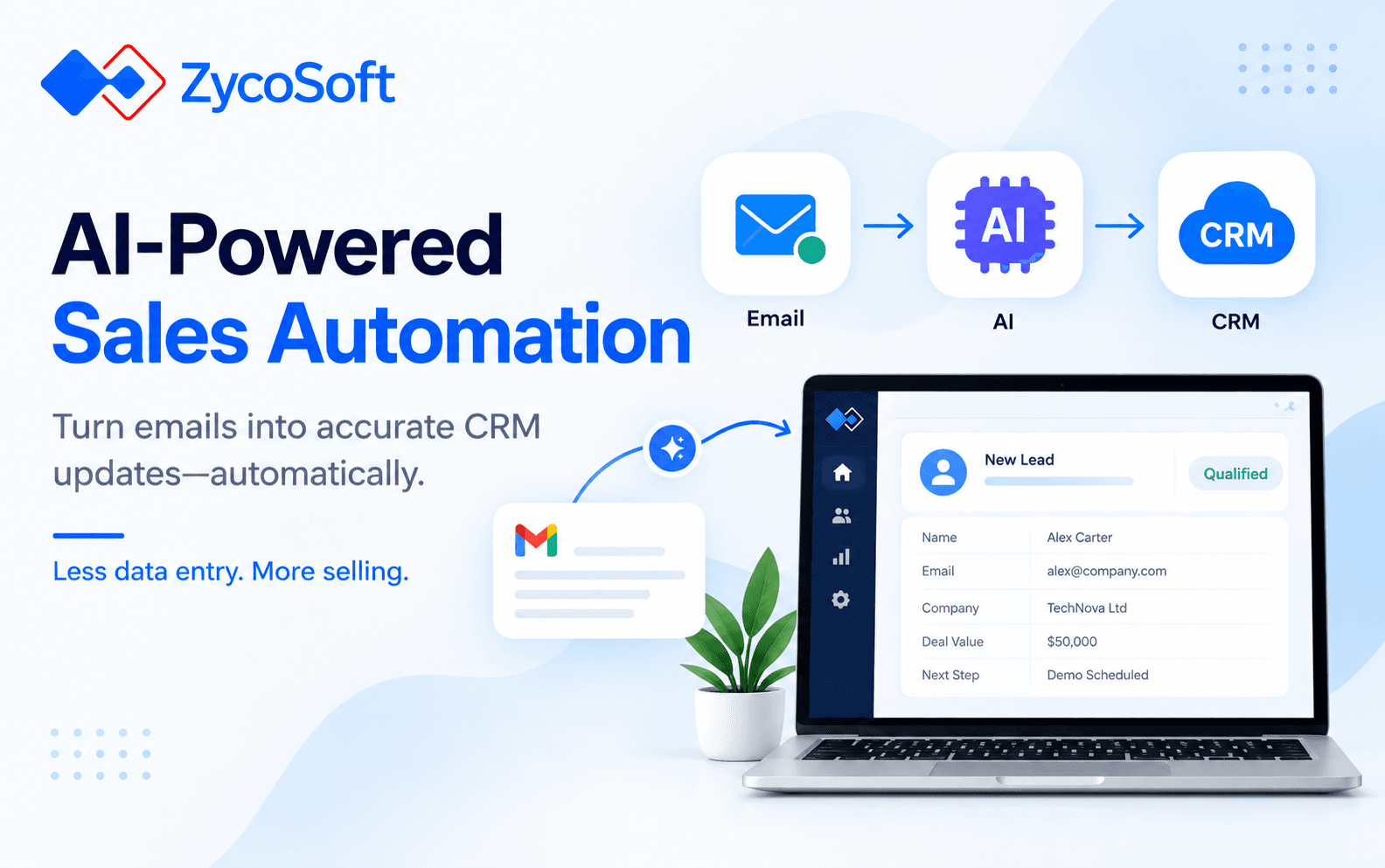
Sales Operations Managers often face a recurring crisis: the discrepancy between the volume of incoming leads and the accuracy of the CRM. When high-value sales executives spend even thirty minutes a day manually updating lead status, contact details, or meeting notes, the cumulative loss in productivity is staggering. For a team of ten, that is twenty-five hours of selling time lost every single week. The objective is not just to speed up work, but to use ai reduce manual data entry sales strategies to ensure that data flows from a prospect's email directly into your pipeline without human intervention.
Transitioning to LLM-driven data pipelines allows teams to move from reactive data management to proactive sales intelligence. This shift requires moving away from simple "if-this-then-that" rules and towards intelligent reasoning engines that understand context, sentiment, and intent within unstructured text.
Implementing LLM-Driven Data Pipelines for Sales
Traditional automation relies on rigid triggers. If an email does not contain a specific keyword, the automation fails. Modern LLM-driven data pipelines solve this by using Large Language Models to interpret meaning. Instead of looking for the word "budget," the AI understands that "we are looking at a $50k allocation for next quarter" implies a budget parameter. This level of intelligence is essential for transforming messy, conversational email threads into structured CRM records.
To implement this, organizations typically deploy a workflow that follows these steps:
- Extraction: An LLM parses unstructured text from an incoming source (email, transcript, or chat).
- Normalization: The extracted data is converted into a standard format (e.g., ISO date formats or specific currency codes).
- Validation: The data is checked against existing CRM records to prevent duplicates or conflicting information.
- Injection: The validated data is pushed via API to the target system, such as Salesforce or HubSpot.
By utilising tools like n8n, engineering teams can build these sophisticated workflows that bridge the gap between various SaaS platforms, ensuring that no lead is lost due to an unrecorded conversation.
The Architecture of Automated Sales Workflows
To achieve true scale, companies must move beyond basic integrations. A robust architecture for AI workflow automation for UK SMEs involves a multi-layer approach that prioritises data integrity. The most common failure point in sales automation is "dirty data"-incorrectly mapped fields or duplicate entries that confuse forecasting models. To prevent this, you must implement a verification layer between the AI and your CRM.
Consider the following comparison of manual versus automated sales operations:
- Manual Process: Sales rep reads email -> Manually opens CRM -> Search for existing contact -> If not found, create contact -> Manually type notes -> Manually update deal stage. Result: High error rate, high time cost.
- Automated Process: Email arrives -> n8n triggers LLM -> LLM extracts intent and entities -> System checks CRM for duplicate -> System updates deal stage and adds notes. Result: Zero manual input, 100% consistency, instant updates.
This architecture turns your CRM from a static database into a living, breathing reflection of your sales activity. When your data is updated in real-time, your forecasting becomes significantly more accurate, allowing the COO to make decisions based on facts rather than estimates.
Mitigating Risk with AI Automation Services for Reducing Manual Back Office Tasks
As you increase the volume of automated tasks, the complexity of your tech stack grows. The primary risk is the "black box" effect, where sales managers are unsure how data was entered or why an incorrect update occurred. To mitigate this, you must implement observability into your AI pipelines. This means every action taken by an LLM must be logged and, where possible, flagged for human review if the confidence score falls below a certain threshold.
For example, if an LLM is 95% confident that a prospect is interested in a specific product tier, the update happens automatically. If the confidence score is only 60%, the system should instead create a "To Review" task for the sales rep. This hybrid approach-AI-driven speed combined with human oversight-is the most effective way to scale sales operations without losing control of data quality.
Scaling Sales Operations with a Dedicated Engineering Partner
Implementing these advanced AI workflows is not a "set and forget" task. It requires ongoing maintenance, fine-tuning of LLM prompts, and constant monitoring of API health. For many scaling SMEs, the internal team is already stretched thin across product development and core sales duties. This is where a dedicated team extension becomes vital.
By engaging a remote engineering partner, you gain access to specialists who understand the full SaaS lifecycle-from the initial architecture of the data pipeline to the final deployment and scaling. This allows your core team to focus on your primary product while experts handle the complex logic of your sales automation engine. This model ensures that your automation infrastructure evolves at the same pace as your sales volume, preventing technical debt from accumulating as you grow.
Stop losing hours to repetitive tasks. Build a scalable sales engine that works while your team is selling. Contact ZycoSoft today to discuss your automation roadmap.
Frequently Asked Questions
AI automation reduces manual entry by using Large Language Models (LLMs) to parse unstructured data from emails, call transcripts, and LinkedIn messages. These models extract key entities like company size, budget, and pain points, then automatically push them into your CRM via API, ensuring your sales team spends more time selling and less time typing.
Yes, when configured with strict validation layers. By using structured output formats like JSON and integrating validation steps in automation tools like n8n, LLM-driven pipelines ensure that data entering your CRM is correctly formatted, deduplicated, and mapped to the correct fields, significantly reducing human error rates.
Effective sales automation typically requires a workflow orchestrator such as n8n, an LLM provider like OpenAI or Anthropic, and your existing CRM (e.g., HubSpot or Salesforce). For complex enterprise needs, a custom-built integration layer may be required to manage specific data privacy requirements and complex business logic.
AI automation is highly suitable for UK SMEs looking to scale without a proportional increase in administrative headcount. By implementing AI workflow automation for UK SMEs, companies can achieve enterprise-level operational efficiency, ensuring that sales operations are scalable and that data remains a reliable asset for forecasting.
The ROI is calculated by the reduction in billable hours spent on manual entry and the increase in sales velocity. When sales representatives spend 20% less time on admin, they can conduct more discovery calls. Additionally, the cost of error correction in inaccurate CRM data is eliminated.