
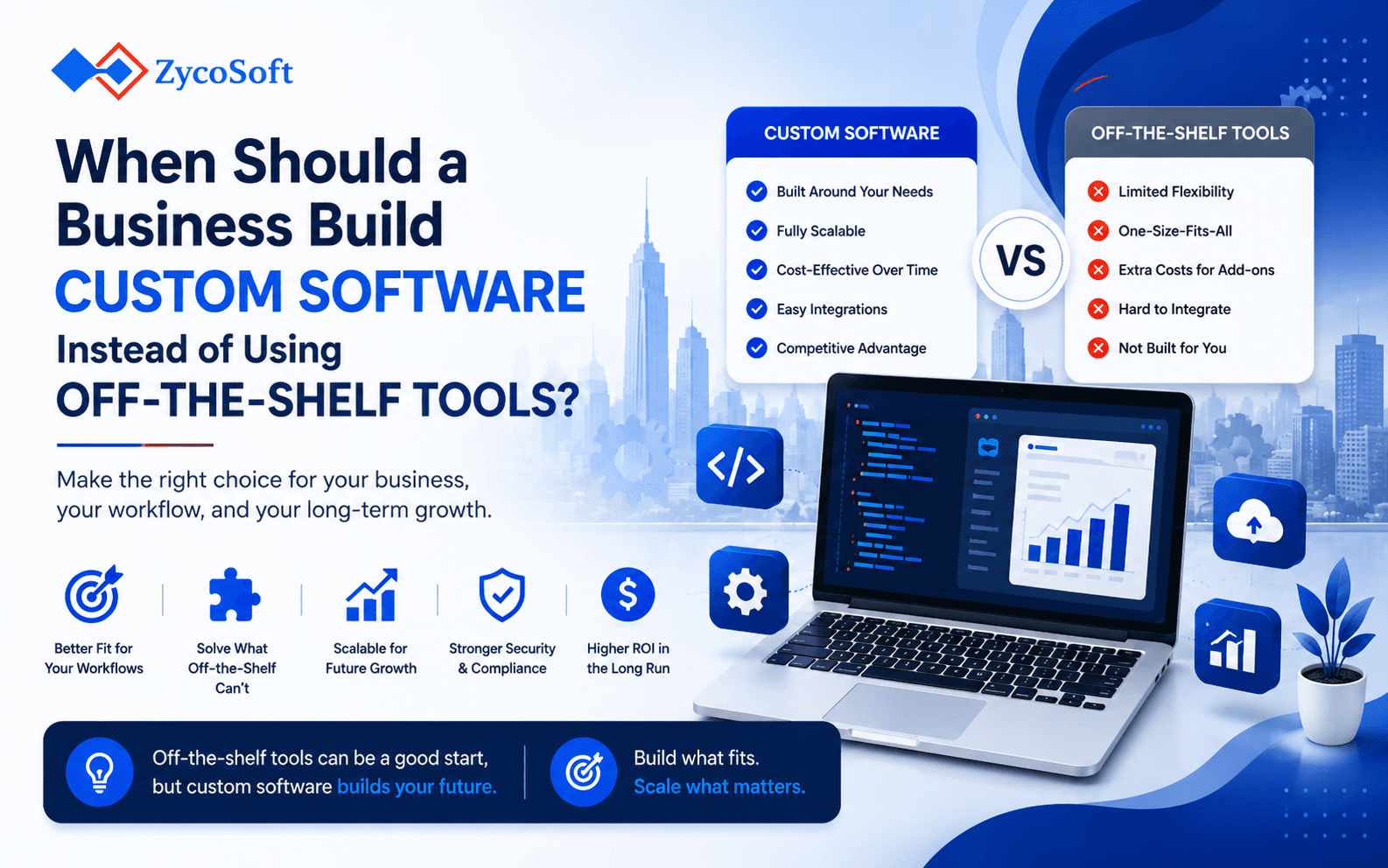
When Should a Business Build Custom Software Instead of Using Off-the-Shelf Tools?
Introduction: Build vs Buy Is More Nuanced Than Cost
On the surface, the decision between custom software and off-the-shelf tools looks simple. Off-the-shelf is cheaper upfront, so buy it. Custom software costs more, so avoid it unless there's no alternative.
That logic breaks down for most businesses because it focuses on the wrong variable. Cost isn't the real question. Fit is. A tool that's cheap but forces your team to work around its limitations every day isn't a bargain it's a slow, compounding tax on productivity. A £5,000-a-year SaaS subscription that doesn't match how your business actually operates is expensive, no matter what the invoice says. Conversely, a £50,000 custom build that solves your exact problem, first time, can be the better financial decision within a year.
The real question isn't "build or buy?" It's: which option delivers the most value for your business, given how you actually work?
This article sets out a practical way to answer that honestly covering the signs you've outgrown off-the-shelf tools, the signs you haven't, how to calculate the true cost of each path, and the questions worth asking before you commit either way.
5 Signs You've Outgrown Off-the-Shelf Tools
1. Your Workflows Are Rigid
Off-the-shelf software is built to serve the majority. If your business operates the way most businesses in your sector do, that's a genuine advantage you get a mature, well-supported product without paying for bespoke development.
But if your workflow doesn't fit that standard shape, you'll spend months trying to bend your process to match the software's assumptions, rather than the other way round. You'll bring in someone whose main job is managing the workarounds. You'll invent manual steps to plug the gaps the software leaves behind. Productivity leaks away, a little at a time, in the space between what the tool does and what your business actually needs.
Red flag: you catch yourself saying, "the system doesn't quite do it, but we've adapted."
2. Integration Is Breaking Down
Most businesses don't run on one piece of software. They run on four or five, stitched together with a mixture of hope, spreadsheets, and someone's Sunday evening. Your sales platform doesn't talk to your accounting system. Your project management tool doesn't sync with your CRM. Data gets exported from one system and re-imported into another, by hand, on a loop.
Off-the-shelf tools are generally excellent at solving one problem well. They are far less good at solving the ecosystem problem making information flow cleanly between every part of the business without a person in the middle, manually keeping it all in sync.
Red flag: your team spends hours every week moving data between systems that should already be talking to each other.
3. Data Is Fragmented Across Platforms
Closely related to the integration problem, but distinct enough to matter on its own: when the same information lives in three different places, nobody actually has the full picture. Your accounting software reports one revenue figure. Your sales tool reports another. Customer data is split across platforms that were never designed to reconcile with each other.
This fragmentation isn't just inconvenient it creates blind spots. Reporting becomes a manual exercise in cross-referencing rather than a quick pull of a dashboard, and decisions get made on incomplete or outdated information because nobody has the time to reconcile every source before a meeting.
Red flag: you can't produce an accurate business report without manually combining data from more than one system.
4. Compliance Requirements Aren't Met
If your industry carries specific regulatory obligations GDPR, HIPAA, FCA rules, data residency requirements, sector-specific audit standards generic off-the-shelf tools weren't necessarily built with your constraints in mind. They're built for the broadest possible market, which means compliance features tend to be generic, bolted-on, or simply absent.
In regulated industries, custom software built around your specific compliance requirements isn't a nice-to-have. It's often the only realistic way to satisfy both the regulator and the auditor without introducing risk you can't fully control.
Red flag: you're uneasy about regulatory exposure or audit trails that your current tools weren't designed to handle properly.
5. Differentiation Requires Different Technology
If part of your competitive advantage comes from how you operate not just what you sell then running the same off-the-shelf stack as everyone else in your market does nothing to protect that advantage. It may actively work against it.
Amazon doesn't run its warehouse and logistics operations on generic inventory software. Netflix didn't build its recommendation engine and streaming infrastructure from a template. In both cases, the technology itself is part of the competitive moat, not just a background utility.
Most businesses aren't operating at that scale, and don't need to be. But if your business model genuinely depends on doing something differently from the way everyone else in your sector does it, custom software stops being a luxury and becomes a strategic asset.
Red flag: your strongest competitors are using meaningfully different tools or technical approaches than what's available off-the-shelf and it shows in their result.
5 Signs Off-the-Shelf Is Still the Right Call
It's worth being just as honest about the other side of the decision. Building custom software when you don't need it is one of the most common and most expensive mistakes a growing business can make.
Your Process Is Standard
If your business is doing what thousands of others do managing invoices, scheduling appointments, running customer support off-the-shelf tools exist precisely because they solve these problems well, and have done for years. Resist the urge to customise for its own sake. A mature, widely-used product comes with continuous updates, established support channels, and a broad ecosystem of integrations. That maturity is genuinely valuable, and it's hard to replicate with a bespoke build.
You Don't Have Complex Integration Needs
If your tech stack is genuinely simple one or two core tools that don't need to exchange data with anything complicated off-the-shelf remains the practical choice. Integration complexity is one of the most common triggers that pushes businesses towards custom development. If that complexity doesn't exist in your operation, there's no reason to pay for solving a problem you don't have.
Budget and Timeline Are Tight
Custom software takes time and money to do properly. If you need something running within weeks, and your budget sits in the low thousands rather than the tens of thousands, off-the-shelf is the only realistic path. Build custom only when you have the runway both financial and time to do it well. A rushed custom build, done without proper scoping, tends to produce worse outcomes than a well-configured off-the-shelf tool.
You're Testing a New Business Model
Before committing resources to bespoke infrastructure, it's usually wiser to validate the idea using off-the-shelf tools first. Prove the model works. Understand exactly what your requirements are, in practice rather than in theory. Once that's established, a custom build becomes a considered investment rather than a guess.
Your Needs Aren't Unique
If your requirements are shared by thousands of other businesses, someone else has almost certainly already built and refined a solution to that problem. Paying for the benefit of their years of iteration is usually smarter than starting from scratch. Reserve custom development for the parts of your business where your needs are genuinely different from the market not for the parts that are already well served.
How to Evaluate the Real Cost: Total Cost of Ownership
The most common mistake in this decision is comparing only the upfront price. A £50,000 custom build looks expensive set against a £500-a-month SaaS subscription. That comparison ignores almost everything that actually matters over time.
Off-the-shelf tools: the true cost includes
- Licensing: typically £500 - £5,000 a month across multiple tools
- Integration effort: staff time or contractor fees to connect systems that don't talk to each other natively
- Workarounds: the ongoing cost of team members managing manual processes the software doesn't cover
- Opportunity cost: your team adapting to the tool's limitations, instead of solving actual business problems
- Switching cost: if you outgrow the tool, migrating data and retraining staff is rarely cheap or quick
Typical 5-year cost: often £50,000 - £300,000+
Custom software: the true cost includes
- Development: typically £30,000 - £150,000, depending on complexity and scope
- Maintenance: roughly £3,000 - £10,000 a year for updates, fixes, and support
- Training: a one-off cost to bring the team up to speed
- Scaling: costs grow alongside the business, but so does the tool's ability to meet new needs
Typical 5-year cost: often £60,000 - £200,000
When the comparison is run over a five-year horizon rather than a first-year invoice, custom software is frequently competitive on cost and it comes with the added benefit of being built around your business, rather than requiring your business to be built around it.
Questions to Ask Before Deciding
Before committing to either path, it's worth working through these honestly:
About your business
- What does your core workflow actually look like is it standard, or genuinely different from the market norm?
- How frequently do your processes change?
- Are compliance or integration requirements critical to how you operate?
- Which of your competitive advantages depend on technology specifically?
About practicality
- Do you have 3 - 6 months and £30,000 or more available for a custom build?
- Can you clearly define what success looks like before development starts?
- Is there someone internally who understands your requirements in real depth?
About risk
- What does it cost you if you choose wrong in lost revenue, team frustration, or security exposure?
- How well will this choice hold up in two years' time?
- If this doesn't work out, what's your way out?
The Decision Framework
Build custom if:
- Your workflows are genuinely different from the standard
- Integration and unified data are critical to how the business runs
- You have the budget and timeline to do it properly
- Your competitive advantage depends on technology
- The limitations of off-the-shelf tools outweigh the cost of building something better
Buy off-the-shelf if:
- Your process is standard
- You need a working solution quickly
- Your budget is limited
- You're still validating a new business model
- Your integration needs are minimal
In practice, most growing businesses land somewhere in between: custom software for the parts of the operation that drive competitive advantage, off-the-shelf tools for the standard, well-solved parts of the business. That mixed approach is often the most capital-efficient path available.
Getting the Decision Right
The build vs buy decision is one of the most consequential technology choices a growing business will make. Getting it wrong costs money, time, and often the hardest to recover team morale and momentum.
If you're not sure where your business sits, it helps to talk it through with someone who has guided other founders and operators through exactly this decision. ZycoSoft works with startups, agencies, and enterprises to scope projects properly, weigh build vs buy options on their real merits, and deliver software that's built to grow with the business rather than hold it back.
Ready to evaluate your options? Book a consultation with ZycoSoft to talk through your specific situation. We'll help you work out whether custom software makes sense for your business or whether off-the-shelf is genuinely the right call.