
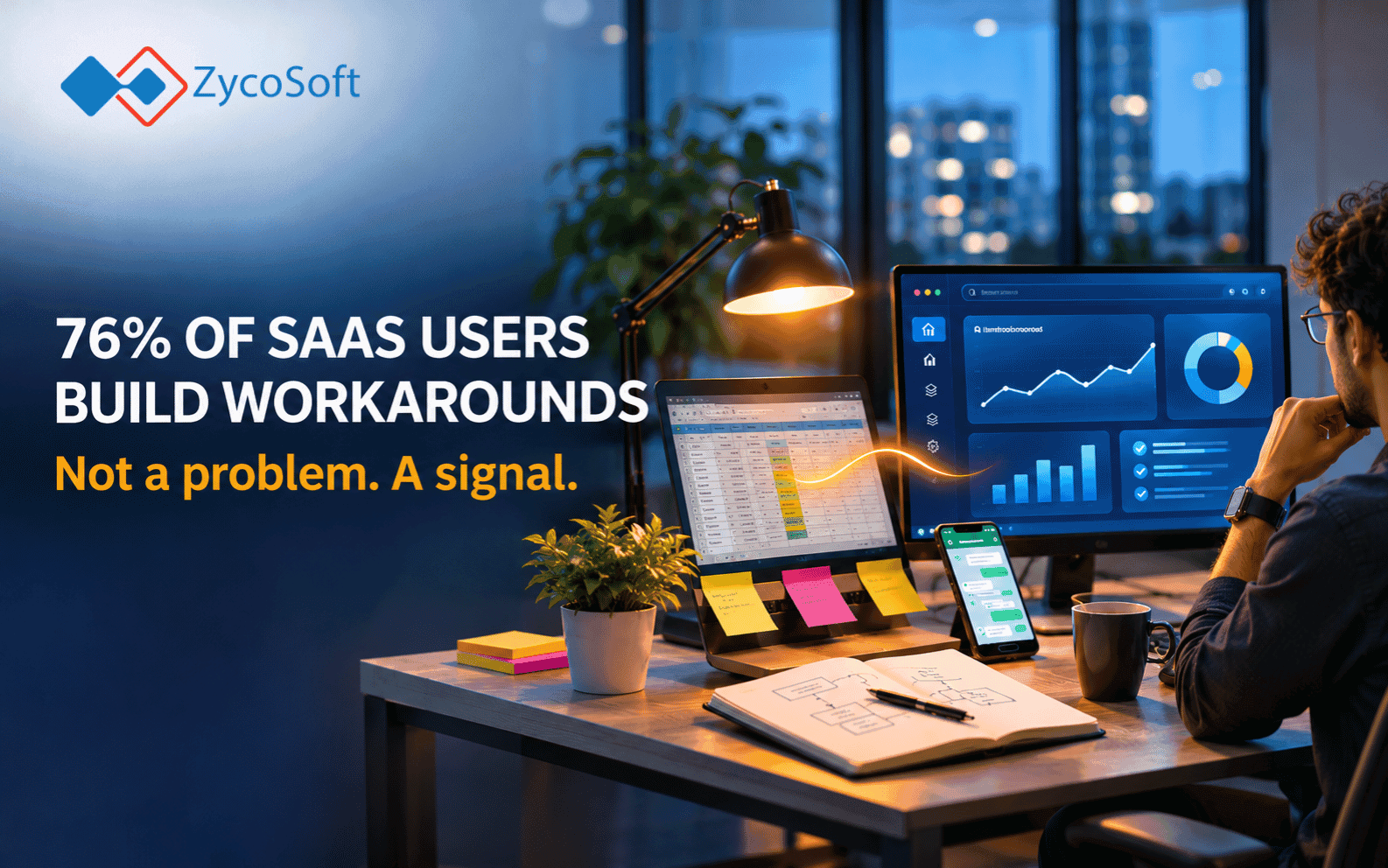
76% of SaaS Users Are Building Workarounds Outside Their Platform. That Is Not a Problem. It Is a Signal.
A survey published this week by Legato found that 76% of B2B SaaS platform customers have used external AI tools to build workarounds, automations, reports, or workflows that their platform couldn't deliver. The top two reasons: speed (53%) and the ability to work across systems (53%).
That number has been framed as a problem for SaaS vendors. It is not your problem in the same way. For ops teams and founders running a stack of four to twelve tools, it is a description of what you're already doing and it tells you something important about where the real automation layer of your business lives.
What the Survey Actually Says :
The Legato "2026 State of SaaS Platforms in the AI Race" report surveyed 87 people working at B2B SaaS platforms, including product, sales, and customer success leaders.
A few numbers worth sitting with:
- 71% of platforms already offer workflow automation capabilities
- Only 13% are generating meaningful revenue from AI and automation services
- 76% of customers have gone outside the platform anyway
- The gap between "has automation" and "automation people actually use" is the real story. Platforms are shipping workflow builders. Customers are shipping around them.
Why Waiting for Your SaaS Vendor's AI Roadmap Is the Wrong Move -
Every SaaS vendor is running the same playbook right now : add an AI tab, ship a workflow builder, announce GPT integrations, and collect the upgrade revenue. Some of that is genuinely useful. Most of it solves one-system problems in a world where your work spans many systems.
The 53% of customers who cited "working across systems" as their reason for going external are describing a structural fact, not a product gap. No single SaaS platform owns enough of your operation to automate the workflows that actually matter. Your support triage pulls from Intercom, your Shopify order data, your Notion runbooks, and your Slack. Your financial reporting pulls from Stripe, your accounting tool, and a spreadsheet someone built in 2022. No vendor roadmap fixes that because it is not in any one vendor's interest to fix it.
The workarounds your team is building outside your SaaS stack are not signs of platform failure. They are the actual automation layer of your business, assembled by hand, one script or Zapier flow or ChatGPT conversation at a time.
That is worth taking seriously.
What to Do Instead of Waiting :
Map what your team is actually doing outside your platforms.
This is the one concrete action to take this week. Ask your ops team, your support lead, your finance person: where are you pulling data from multiple tools to do something the tools don't do themselves? Write it down. Don't try to fix it yet just surface it.
What you will find is a list of cross-system workflows that your team is running manually or semi-manually. Each one is a candidate for a real automation. Each one is also a fragility point: it depends on a person remembering to do it, a spreadsheet staying accurate, or a tool continuing to export in the same format.
The patterns repeat across companies. Customer escalations that touch support data, order data, and CRM data. Approval chains that span Slack, email, and a project tool. Weekly reports assembled by hand from three dashboards. These are not edge cases. They are the actual connective tissue of how the business runs.
Build the Glue, Own the Automation Layer
The alternative to waiting for a vendor to solve cross-system automation is building the layer yourself or having it built for you.
That does not mean replacing your SaaS stack. It means building the workflows that connect it. An automation layer that reads from your support tool, checks your order management system, runs the logic your team runs manually, and routes the output to the right place. No dashboard required. No new platform to learn.
This is what 76% of your peers are trying to do when they go external. The difference between a workaround and a real automation is whether someone has sat down with how your operation actually works and built for that not for a generic use case.
The Practical Starting Point
Before this week is out, do this:
Open a blank doc. Title it "Workflows we run outside our tools." Ask three people on your team to add one item each. You'll have your first automation backlog by Friday.
That list is more useful than any vendor roadmap.
If you want help reading that list and figuring out what to build first, that's what ZycoSoft does. Book a 30-minute call: zycosoft.com/consultation
Source: Legato, "2026 State of B2B SaaS Platforms in the AI Race" survey conducted August 16–September 5, 2026, 87 respondents. Full report: legato.ai. Press release: prnewswire.com/news-releases/legato-survey-delivery-times-and-integration-gaps-are-sending-saas-customers-to-external-ai-tools-302942089.html
Rate this article
Choose a star rating, then submit.
Frequently Asked Questions
The main reasons are speed and the need to work across multiple systems. Most SaaS platforms automate within their own product but cannot connect workflows that span your full stack — support tools, order management, finance, and CRM. External AI tools fill that gap by design.
An automation layer is the set of workflows that connects your existing tools and runs the logic your team currently handles manually. It sits across your SaaS stack rather than inside any single platform. Building it means identifying your cross-system workflows, mapping the logic, and implementing automations that run without someone having to remember to trigger them.
No. The automation gap is not a platform quality problem — it is a structural fact of running multiple specialized tools. Replacing tools doesn't close the gap; building the connective tissue between them does. Your existing stack is probably the right stack. What is missing is the layer that makes it work together.
Start by surfacing what your team already runs manually or outside your platforms. Ask three people on your ops, support, or finance team where they pull data from multiple tools to get something done. The workflows that come up most frequently, or that break most often, are your highest-priority automation candidates.
A workaround is fragile: it depends on someone remembering to run it, a spreadsheet staying formatted correctly, or a manual step that gets skipped under pressure. A real automation encodes the logic, runs on a trigger, handles exceptions, and doesn't require a person to hold it together. The goal is to convert your team's best manual workflows into automations that run reliably without supervision.
ZycoSoft maps how your operation actually works, identifies the cross-system workflows your team is running manually or semi-manually, and builds the automation layer that connects your tools. We stay on retainer to maintain and extend it as your stack evolves. Book a 30-minute consultation at zycosoft.com/consultation.
Comments
No comments yet. Be the first to share your thoughts.
Leave a comment
Comments are reviewed before they appear publicly.