
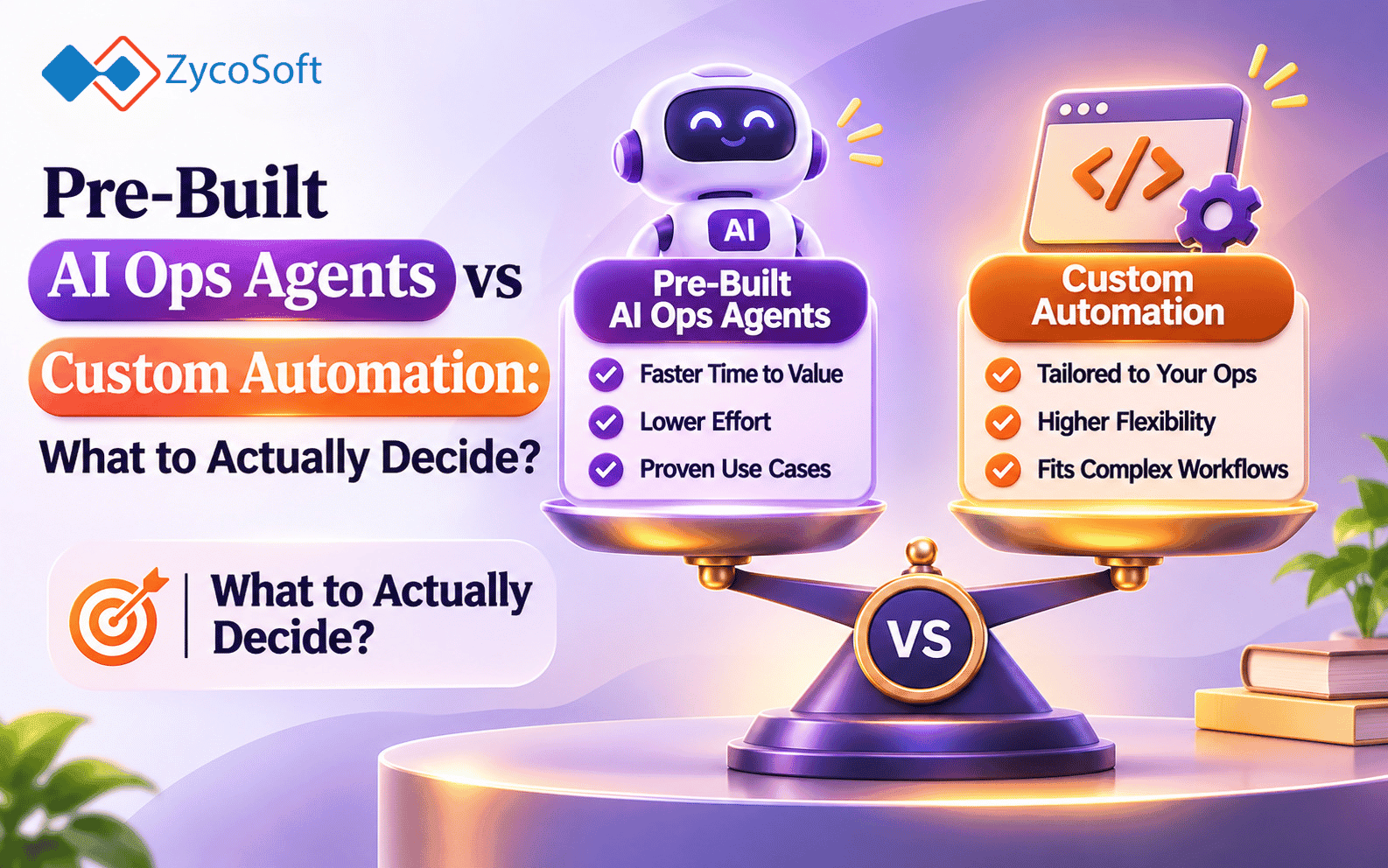
Pre-Built AI Ops Agents vs Custom Automation: What to Actually Decide
Atomicwork shipped a marketplace of certified AI agents for IT ops roles this month: Access Ops Manager, Cloud Ops Engineer, SecOps Manager, Network Ops Engineer, Device Ops Engineer. Each one comes pre-built, pre-certified, and pre-wired to standard enterprise toolchains like AWS, Okta, and MDM platforms.
One benchmark they published is worth looking at. Access provisioning with a human-handled approval gate: median turnaround of 2.5 hours. The same workflow handled by their Access Ops Manager agent, without an approval gate: 18 seconds. (Source)
The gap tells you something about what becomes possible when routine decision logic gets automated. It also sets up a question that ops leads and founders at mid-size companies now have to answer: do you buy a generic pre-built AI agent, or do you have your actual workflows automated properly?
The answer depends on what your operations actually look like.
What pre-built agents cover well :
Pre-built roles like Atomicwork's work in environments where the toolchain is standard and the processes follow recognizable patterns. If your access requests come through Okta, your cloud alerts come from AWS or Azure, and your device management runs through a mainstream MDM -- a certified agent built for those integrations can handle a real share of the volume immediately.
The strength is speed to coverage. You do not spend months mapping processes, writing automation logic, and testing edge cases. The vendor has already done that work for the common cases. The 18-second provisioning time exists because the access flow -- intake, validation, provisioning, confirmation -- is a known sequence that the agent has been trained and tested against.
For teams that are genuinely understaffed on L1 and L2 IT ops, that coverage has value from day one.
Where pre-built agents stop :
The certification benchmarks Atomicwork published are detailed -- the Access Ops Manager alone is tested against 127 scenarios covering missing details, typos, slang, requests on behalf of other employees, non-English input, and urgency pressure. That is real rigor.
But the scenarios are enterprise IT scenarios. They cover how access requests typically arrive in a large org using standard identity tooling.
What they do not cover is your specific ops logic.
If your team has a custom approval chain that routes through a homegrown project management tool, the pre-built agent does not know about it. If your cloud environment uses a non-standard tagging convention that determines which team owns an alert, the Cloud Ops Engineer will not know how to route it. If your SaaS stack includes a vertical tool your industry uses that is not in the integration library, the agent cannot touch it.
This is not a criticism of the product. It is the boundary condition of any pre-built role. The agent was built to handle what most organizations in a category need. Your organization is not most organizations.
The edge cases are where ops breaks :
In practice, the high-volume routine tasks are rarely where operations fail. A provisioning request that follows the standard flow gets handled -- by a human today, by an agent tomorrow. What actually creates cost and risk is the exception: the access request that does not fit the form, the alert that fires from an integration three systems deep, the approval that should have been flagged but was not because the logic lives in someone's head.
Custom automation built to your actual process can capture that logic. It can account for the specific sequence your team follows, the conditions your business has decided matter, and the integrations you actually use -- not the ones a vendor assumed you use.
Pre-built agents handle the standard workflow. Custom automation handles your workflow, including the parts that only make sense if you understand your business.
When to use each :
Pre-built agents are the right call when:
- Your ops toolchain is standard (Okta, AWS/Azure, common MDMs, mainstream ticketing).
- The volume of routine work is genuinely overwhelming and the team needs relief now.
- You can live with the edge cases going to humans while the agent handles the volume.
- You have no internal capacity to build and maintain automation.
Custom automation is the right call when:
- Your workflows have business-specific logic that a generic agent will not know.
- You use non-standard or vertical tools not covered by pre-built integrations.
- Your approval and escalation chains are specific to how your company operates.
- You want automation that improves as your processes improve, not one locked to a vendor's update cycle.
For most mid-size companies, the honest answer is some of both. Standard IT ops tasks -- provisioning, device compliance, cloud alert triage -- are good candidates for pre-built coverage where the toolchain fits. The business-specific workflows that sit underneath those tasks are where custom automation earns its keep.
The actual decision to make :
The Atomicwork launch is useful because it makes visible what AI ops agents can now do when they are built and tested properly. That is a reasonable benchmark.
What it also makes visible is the gap between "certified to work in a standard enterprise environment" and "built to work in your environment." Closing that second gap is the actual work.
If you are evaluating whether pre-built AI agents cover your ops, or whether your workflows need automation built to your specific process, ZycoSoft works with ops teams on that exact question.
Rate this article
Choose a star rating, then submit.
Frequently Asked Questions
Pre-built AI ops agents are packaged automation roles -- like Access Ops Manager or Cloud Ops Engineer -- that come pre-configured with integrations for standard enterprise tools. They handle defined workflows such as access provisioning, alert triage, or device compliance without requiring custom development.
Pre-built agents make sense when your toolchain is standard (Okta, AWS, common MDMs, mainstream ticketing) and you need to reduce volume on routine tasks quickly. If your workflows match what the agent was tested against, you can deploy and get value immediately without building from scratch.
Pre-built agents cover standard enterprise scenarios. They do not know your business-specific approval logic, non-standard toolchains, vertical software your industry uses, or the exception-handling rules that live in your team's heads. Those gaps are where custom automation is necessary.
Pre-built agents are certified to work in standard IT environments. Custom automation is built to match how your specific business operates -- your approval chains, your integrations, your edge cases. Custom automation can also be maintained and updated as your processes change.
Yes, and that is often the practical answer. Standard IT ops tasks like access provisioning and cloud alert triage are good candidates for pre-built coverage. The business-specific workflows underneath those tasks -- the ones tied to your stack and your logic -- are where custom automation applies.
Start by asking where your ops breaks most often. If the failures are in high-volume routine tasks on standard tools, pre-built agents help. If the failures are in workflows unique to your business -- custom approvals, non-standard integrations, exception handling -- those need automation built to your process.
Comments
No comments yet. Be the first to share your thoughts.
Leave a comment
Comments are reviewed before they appear publicly.