
OSINT Platforms for Compliance and Due Diligence: What Financial Services and Insurance Companies Actually Need.
Most compliance teams using off-the-shelf OSINT tools are operating with equipment designed for a fundamentally different job. The tools that work well for a cybersecurity analyst or an investigative journalist are not the same tools that will satisfy an FCA supervisory review, a BaFin audit, or a GDPR accountability obligation. The gap is not a minor configuration issue. It is architectural. And for financial services firms, insurance underwriters, and legal practices conducting due diligence on individuals and entities, that gap carries direct regulatory and reputational risk.
This is the problem that a purpose-built OSINT platform development company is positioned to solve not by repackaging existing tools, but by building compliance-grade open source intelligence infrastructure from the ground up, scoped precisely to what regulated teams actually need.
Why Off-the-Shelf OSINT Tools Cannot Satisfy Regulatory Requirements
Commercial OSINT platforms were largely conceived for threat intelligence, competitive research, or investigative journalism. Their data collection logic is broad by design. They optimise for coverage and speed, not for the kind of constrained, documented, and auditable processing that GDPR and financial regulation demand. When a compliance officer runs a subject check through a consumer-grade OSINT tool, they may retrieve accurate information but they cannot answer the question a regulator will eventually ask: on what lawful basis was that data collected, how long was it retained, who accessed it, and what safeguards prevented the collection of data beyond what was necessary?
These are not administrative details. Under GDPR Article 5, data minimisation and purpose limitation are enforceable principles. Under Article 6, every act of processing personal data requires a documented lawful basis. Financial services firms typically rely on Article 6(1)(c) - compliance with a legal obligation - or Article 6(1)(f) - legitimate interests - depending on the specific due diligence context. Neither basis is self-executing. It must be assessed, recorded, and defensible. Off-the-shelf tools provide none of that infrastructure. They retrieve data; they do not govern it.
The FCA's Financial Crime Guide and BaFin's AML supervisory expectations both make clear that Know Your Customer and Know Your Business checks must be documented to a standard that survives external review. A screenshot from a commercial OSINT dashboard, with no timestamped record of what sources were queried, what was returned, and under what authorisation, does not meet that standard.
What a GDPR-Compliant OSINT Platform Must Actually Include
A purpose-built OSINT platform for compliance and due diligence is not simply a collection of API integrations. It is a governed data processing system. The architecture must enforce compliance requirements at the point of collection, not retrospectively. The following components are non-negotiable for any deployment in a regulated environment:
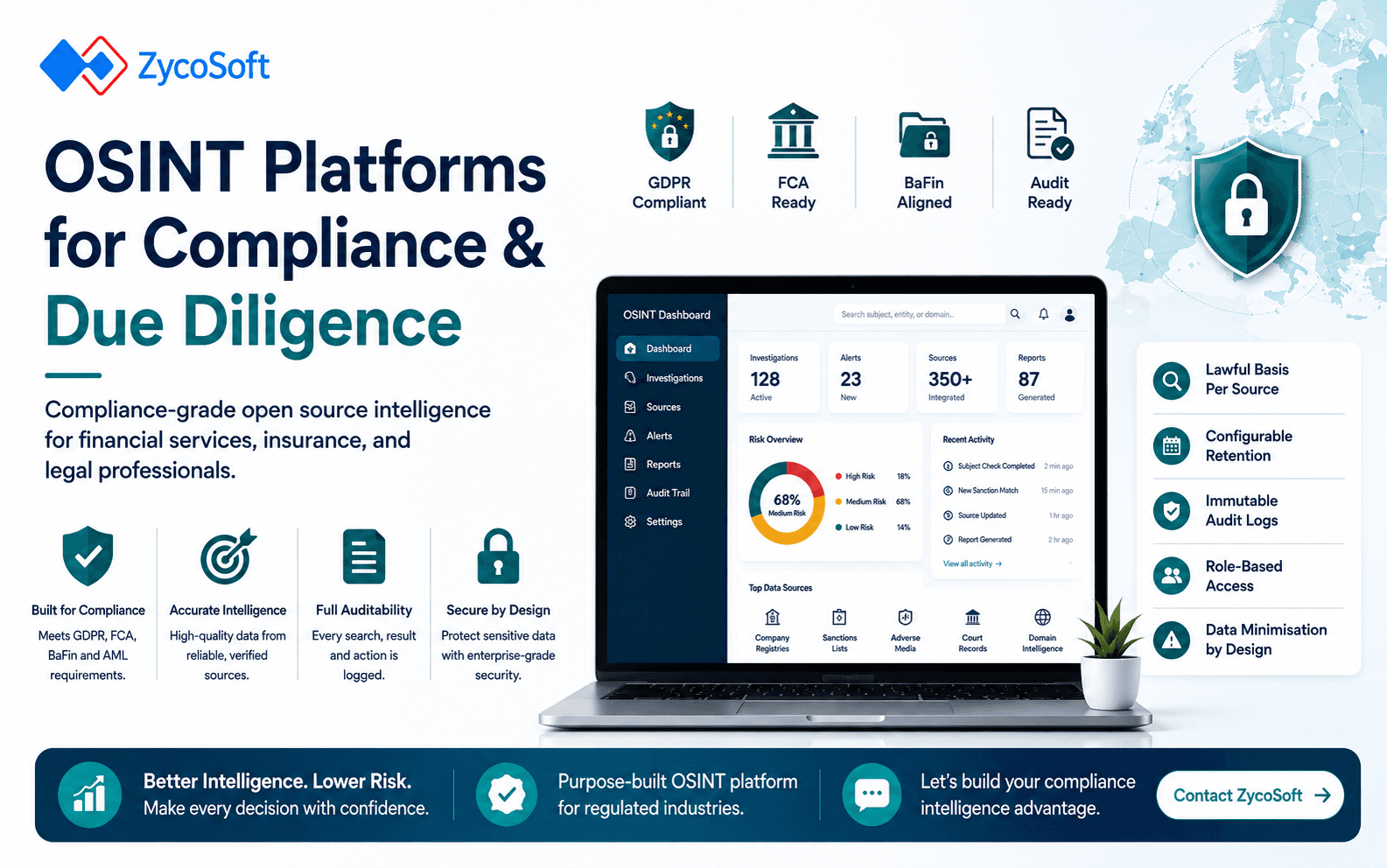
- Documented lawful basis per data source: Every source - company registries, sanctions lists, court records, adverse media feeds, domain history - must have an associated lawful basis assessment stored within the platform, visible to auditors.
- Configurable data retention limits: The platform must automatically apply retention rules by data type and jurisdiction, with hard deletion rather than soft archiving where required.
- Timestamped, immutable audit logs: Every query, every result set retrieved, every access event, and every export must be logged with user identity, timestamp, and purpose code. These logs must be tamper-evident.
- Role-based access control: Junior analysts should not have access to the same data sources or export capabilities as senior compliance officers. Access must be scoped and reviewed.
- Special category data flagging: The platform must identify when retrieved data potentially falls under GDPR Article 9 - health, political opinion, religion - and either block storage or require explicit justification before proceeding.
- Data minimisation by query design: Searches should be scoped to return only what is necessary for the stated purpose. Bulk harvesting of tangential data must be technically restricted, not just discouraged by policy.
These requirements are not optional enhancements. They are the minimum viable compliance posture. Any OSINT platform development company operating in this space must treat them as foundational architecture decisions, not features to be bolted on after launch.
Data Sources, Coverage, and the Jurisdictional Challenge
EU and UK financial services firms operate across multiple jurisdictions simultaneously. A mid-size insurer underwriting commercial risk across Germany, the Netherlands, and the UK needs OSINT coverage that reflects that geographic scope - not a tool optimised for a single market. This is where generic platforms fail most visibly. They aggregate well in markets where public data is structured and accessible. They perform poorly where it requires jurisdiction-specific parsing, language handling, or authentication against national registries.
A properly scoped compliance OSINT platform for EU financial services should cover, at minimum: Companies House and the EU Business Registers Network for entity verification; OFAC, UN, EU Consolidated, and HMT sanctions lists with daily refresh rates; Politically Exposed Persons databases with traceable source citations; structured adverse media ingestion from legally permissible news APIs rather than raw web scraping; WHOIS and domain registration history for fraud indicators; and court record sources where public access is legally established in the relevant jurisdiction.
The key distinction between a well-built custom platform and a generic aggregator is not the number of sources it is the quality, recency, and legal provenance of each source. A platform that pulls from 200 sources but cannot tell you when each was last verified or whether collection from that source satisfies GDPR is less useful than one that covers 30 sources with complete legal documentation and hourly refresh cycles on high-risk list data.
Workflow Integration and the Due Diligence Audit Trail
For a compliance team, an OSINT platform that operates in isolation from their case management system creates two problems. First, it introduces transcription risk analysts manually copying findings into case records, introducing error and removing the evidential chain between the raw data and the recorded conclusion. Second, it makes supervision difficult. A regulator examining a due diligence file should be able to trace every factual assertion back to a specific data retrieval event with a timestamp and a source record. Manual processes break that chain.
A production-ready compliance OSINT platform must therefore be designed with API-first architecture from the outset, enabling structured output to be pushed directly into Salesforce, Microsoft Dynamics, or specialist legal and compliance case management tools. The integration is not cosmetic. It is the mechanism by which the platform creates a defensible, unbroken audit trail from subject identification through to compliance sign-off.
Firms that have invested in AI-assisted review workflows gain additional value here. When OSINT output is structured and consistently formatted because it is generated by a governed platform rather than copied from ad hoc searches it can be passed to an LLM-based summarisation layer that produces a first-pass risk narrative for analyst review. This does not replace human judgement; it accelerates it. A senior compliance officer reviewing 40 due diligence files per week can assess a structured AI-generated summary in two minutes and focus their expertise on the cases that warrant deeper scrutiny.
Why Bespoke Development Is the Only Viable Path for Regulated Teams
The regulated industries market has a specific procurement problem when it comes to OSINT tooling. The large licensed data providers World-Check, Refinitiv, Moody's offer structured watchlist products that serve a defined purpose well. They are not OSINT platforms. They do not retrieve and process live public data across open sources. They provide curated datasets at significant licensing cost, and they still leave gaps in adverse media coverage, domain-level fraud indicators, and jurisdiction-specific registry data that a live OSINT capability can fill.
The alternative adapting a consumer-grade OSINT tool with policy controls and hoping it satisfies a regulatory audit has failed repeatedly in practice. Supervisory examinations of financial crime controls increasingly scrutinise the technical infrastructure behind due diligence processes, not just the documented policies. A tool that was not designed to produce audit-ready outputs will not produce them, regardless of what the policy document says.
ZycoSoft has delivered multiple custom OSINT platforms under NDA for clients in regulated sectors, each built to satisfy specific GDPR compliance requirements, integrate with existing operational infrastructure, and produce outputs that hold up under regulatory scrutiny. The work is not theoretical. It is production software, deployed and in active use by compliance teams who had exhausted the options the generic market could offer. As a specialist OSINT platform development company operating with full GDPR-compliant engineering practices, ZycoSoft works as an embedded team extension embedded in your compliance and technical requirements from discovery through to deployment and ongoing iteration.
If your compliance team is currently running due diligence checks through tools that were not designed for your regulatory environment, the risk is not future and theoretical. It is present and measurable. The question is whether you address it before or after a supervisory examination makes it unavoidable.
Speak to ZycoSoft about a purpose-built OSINT platform scoped to your compliance requirements. Contact us directly at https://www.zycosoft.com/contact.
Frequently Asked Questions
A GDPR-compliant OSINT platform for financial services must establish a documented lawful basis for each data collection activity under Article 6, enforce data minimisation by design, apply configurable retention limits, produce timestamped audit logs, and restrict access by role. It must also identify and flag special category data under Article 9 without storing it unless strictly necessary and legally justified.
Commercial OSINT tools are typically built for security researchers or investigative journalists, not compliance teams. They lack audit logging to regulatory standards, offer no lawful basis documentation, cannot be scoped to specific data sources required under FCA or BaFin frameworks, and produce outputs that are difficult to defend under supervisory scrutiny. They also rarely integrate with case management or CRM systems used in regulated workflows.
A compliance-grade OSINT platform should cover company registries such as Companies House and Handelsregister, sanctions and PEP lists including OFAC, UN, and EU consolidated lists, court records where publicly accessible, adverse media from structured news feeds, domain and WHOIS history, and social media presence using compliant access methods. Each source must be documented with its update frequency and jurisdictional scope.
A focused MVP covering five to eight core data sources with audit logging, a role-based access model, and basic workflow integration typically takes ten to fourteen weeks to deliver. Full-scale platforms with multi-jurisdiction data coverage, AI-assisted summarisation, and integration into existing case management systems generally require four to six months depending on data source complexity and internal IT requirements.
Yes. Purpose-built OSINT platforms can be designed with API-first architecture to push structured outputs directly into Salesforce, Microsoft Dynamics, or specialist legal and compliance case management tools. This eliminates manual transcription, creates a defensible chain of evidence, and ensures your compliance records reflect the actual data retrieved at the time of the due diligence check — a critical requirement under FCA and BaFin supervision.
A due diligence database such as World-Check or Refinitiv is a curated, licensed data product. An OSINT platform actively retrieves and aggregates publicly available information in near real-time across multiple sources. The two are complementary: licensed databases provide structured watchlist coverage, while a custom OSINT platform fills gaps with live public data, adverse media, and open registry checks that licensed products do not cover.