
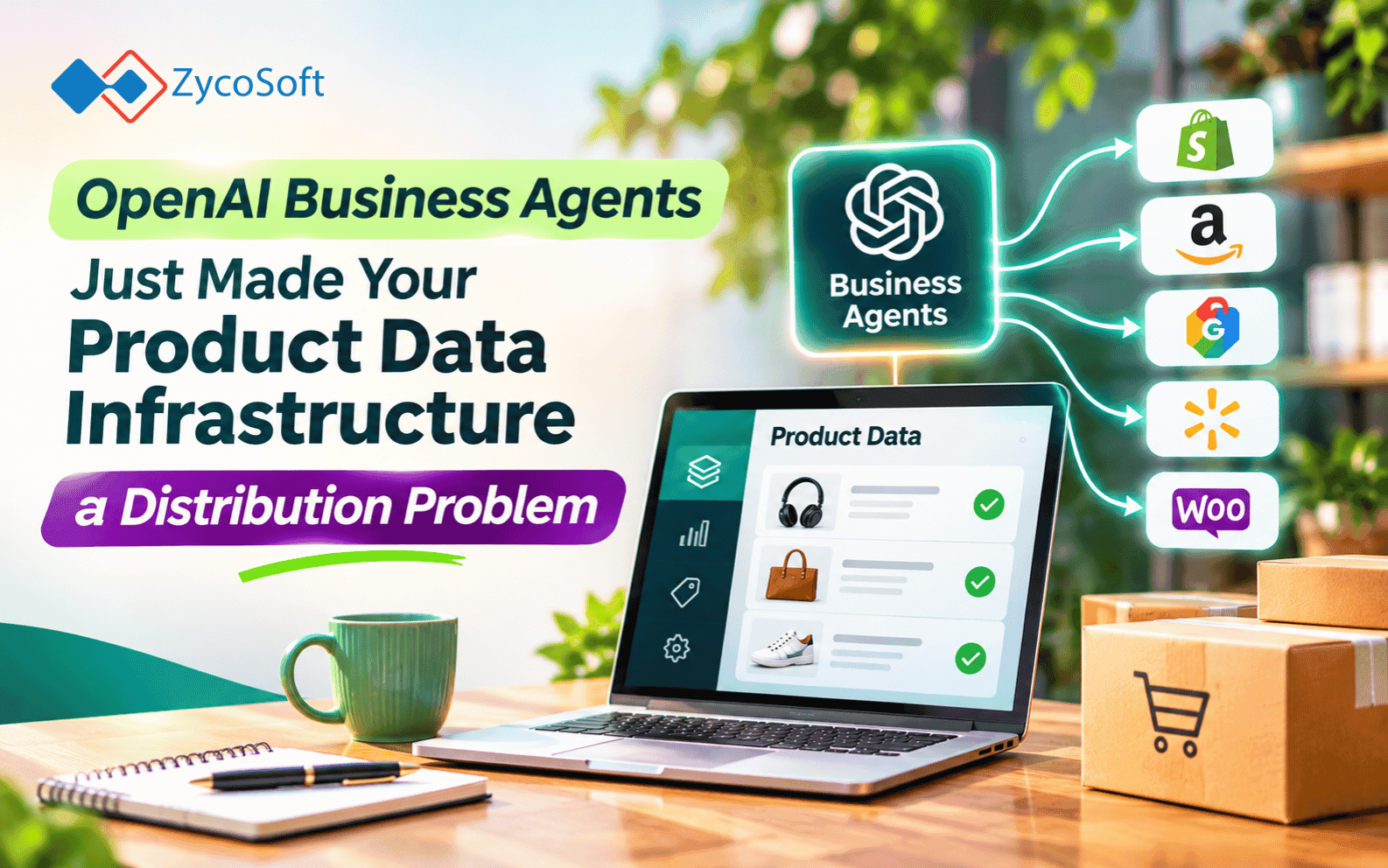
OpenAI Business Agents Just Made Your Product Data Infrastructure a Distribution Problem
On November 10, OpenAI quietly changed how customers find products.
They launched Business Agents in beta inside ChatGPT. Any eligible ecommerce or online service company in the US can now create a branded chat interface that lives inside ChatGPT, answers questions about their products, and routes ready-to-buy customers directly to the business site. Shopify merchants can connect through Business Hub or directly from the Shopify admin.
This is not a chatbot you host. It is a customer-facing channel you feed.
What actually launched
Through a tool called Business Hub, businesses can claim and verify their profile in ChatGPT, provide product feeds with pricing and availability, and publish a Business Agent that talks to customers on their behalf.
When a user inside ChatGPT asks about products in your category, your Business Agent can appear as the answer. It handles the product discovery conversation. When the customer is ready to buy, it sends them to your site.
OpenAI's VP of monetization described the Business Agent as the "organic experience" alongside a paid sponsored-agent option. Same agent, two routes in: one free, one paid. The organic version is free for now.
One important constraint: OpenAI builds and runs the agent from the data you supply. You do not get access to conversation transcripts. You get aggregated themes. You cannot host it yourself or customize it beyond the product feed and instructions you supply.
Who is affected first
The beta is US-only, targeting ecommerce and online service businesses. Shopify merchants have the most direct path in through native admin integration.
If your business sells products online to US customers, this is in your window now. Wait a few months and your competitors will have established agents while yours is still in setup.
Three things to do in the next 72 hours :
1. Audit your product feed for accuracy and freshness -
The Business Agent surfaces information from the feed you provide. If your product data has stale prices, out-of-stock items listed as available, or missing variants, the agent will confidently serve that bad data to customers. A customer who gets told a product is $49 and in stock, then reaches your site to find $67 and a two-week backorder, does not convert and does not come back.
Pull your current product feed. Check when it was last updated. Verify that prices match your storefront and that inventory flags reflect current stock. This is a data quality problem before it is a distribution problem.
2. Write a Business Agent brief that reflects how customers actually ask -
The Business Agent instructions you write shape how the agent talks about your products. Most product descriptions are written for browsing, not for conversation. A customer asking ChatGPT "what's the best running shoe for wide feet under $120" needs a different kind of answer than a product page title.
Look at your support tickets, your site search logs, and your customer reviews. What questions do customers actually ask before buying? Write your Business Agent brief around those questions, not around your existing marketing copy.
3. Connect your Shopify store if applicable -
Shopify merchants can connect through Business Hub or directly from the Shopify admin. If you are on Shopify, this is a 20-minute setup. The integration pulls product data automatically, which removes the manual feed maintenance problem for merchants whose product catalog is already well-maintained in Shopify.
If your Shopify catalog has the same data quality problems described above, connecting it faster just amplifies those problems. Fix the feed first, then connect.
The structural lesson :
For the past decade, distribution in ecommerce meant search engine rankings and paid ads. Your product data needed to be good enough for Google Shopping and accurate enough not to get flagged.
AI is now a distribution channel with a different requirement. ChatGPT does not display your product listing. It has a conversation about it on your behalf. The quality of that conversation depends entirely on the quality of the data you supply. Stale prices, thin product descriptions, and inconsistent inventory data do not just cost you a click. They produce a conversation that actively misleads a customer.
The businesses that show up well in this channel will be the ones whose ops data is current, structured, and maintained continuously, not the ones with the biggest ad budgets. That is a different problem than most ecommerce ops teams are set up to solve today.
If your ops data is not ready for this :
Connecting to OpenAI Business Agents takes minutes. Keeping the data behind that connection accurate is an ongoing ops problem.
If you are looking at your product feed right now and do not have confidence in its freshness, or if your Shopify catalog is maintained manually by someone in a spreadsheet, that is worth fixing regardless of this launch.
ZycoSoft works with ecommerce and online service teams to build the automation layer that keeps product data, inventory, and customer-facing information current without manual overhead. If that work is on your list, book a call and we can walk through what it would take for your stack.
Sources: Reuters/BND, November 10 2026 | Digiday, November 10 2026
Rate this article
Choose a star rating, then submit.
Frequently Asked Questions
OpenAI Business Agents are branded chat interfaces that live inside ChatGPT. Businesses provide a product feed and company information, and OpenAI builds an agent from that data. When a user asks about products in your category, your Business Agent can appear as the answer. The beta is currently available to US ecommerce and online service businesses.
Shopify merchants can connect their store through OpenAI's Business Hub or directly from the Shopify admin. The integration pulls product data automatically. Before connecting, make sure your Shopify catalog has accurate prices and current inventory data, since the agent surfaces that information directly to customers in conversation.
No. OpenAI does not share individual conversation transcripts with businesses. What you get are aggregated themes from conversations, not raw transcripts. OpenAI's VP of monetization confirmed this in their November 10 press briefing. Business Hub's Insights dashboard shows mentions, views, and website clicks in aggregate.
The Business Agent surfaces information directly from the product feed you provide. If your data has stale prices, out-of-stock items listed as available, or missing variants, the agent will confidently serve that incorrect information to customers in conversation. Unlike a product listing page, there is no easy way for a customer to notice the discrepancy until they reach your site.
OpenAI's VP of monetization described the Business Agent as the organic experience, free to use, alongside a paid sponsored-agent option. Business Hub and agents are free for now, though OpenAI has not ruled out a paid model in the future. The paid sponsored option places your agent as an ad destination within ChatGPT.
Comments
No comments yet. Be the first to share your thoughts.
Leave a comment
Comments are reviewed before they appear publicly.