
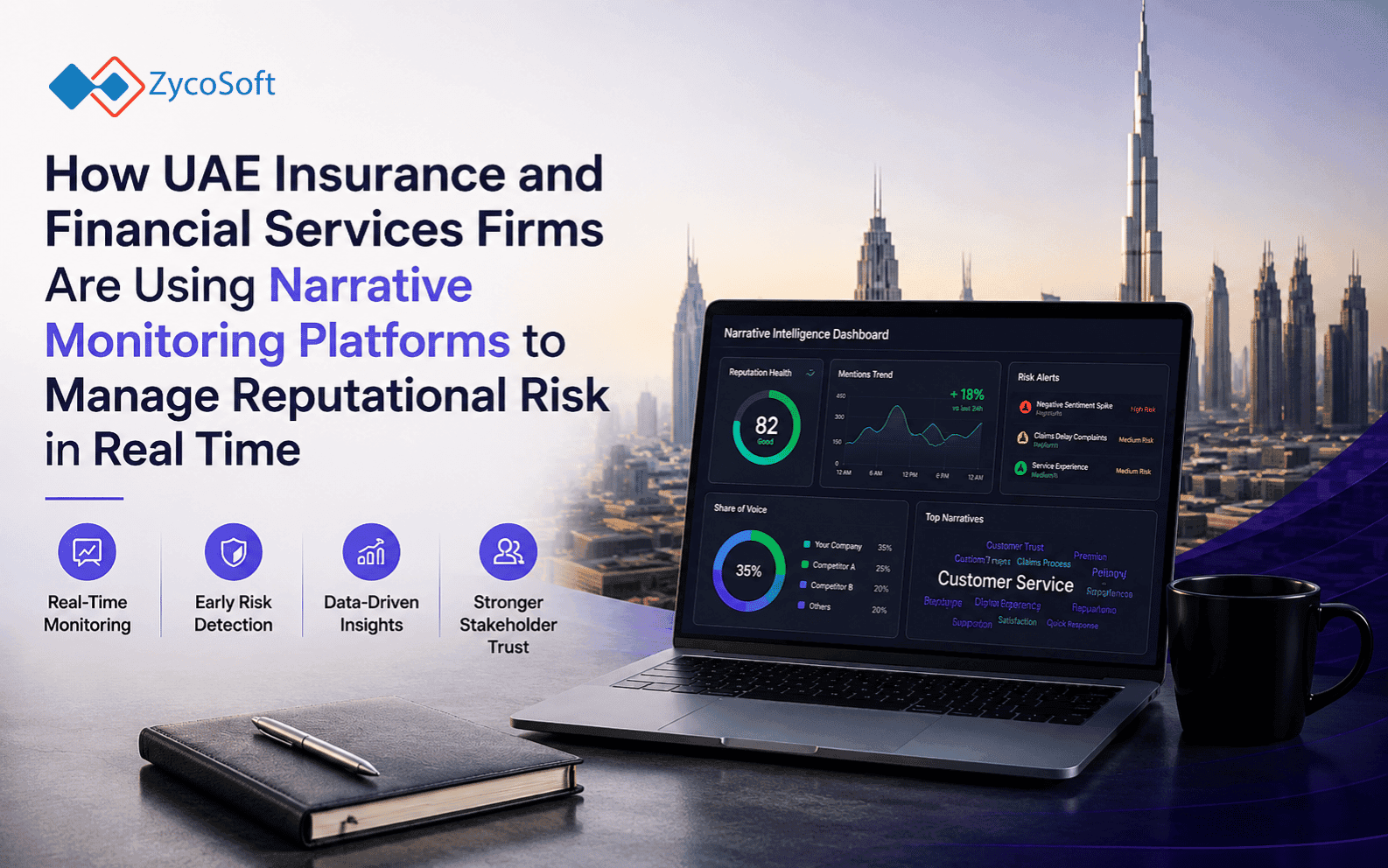
How UAE Insurance and Financial Services Firms Are Using Narrative Monitoring Platforms to Manage Reputational Risk in Real Time
At 7:43 on a Tuesday morning, the compliance lead at a mid-sized UAE insurer opened her daily media digest. Fourteen mentions. Nothing flagged. She forwarded it to the Group Risk Director with a single line: "Quiet week so far." By midday, three Arabic-language personal finance forums were circulating a claim that the firm had quietly changed its critical illness exclusions following a regulator inquiry. The claim was false. But by the time the communications team found it, the thread had been shared into four WhatsApp groups popular with financial advisors across Dubai and Abu Dhabi. The story had moved faster than any alert her tool was capable of generating.
The media monitoring platform the firm had used for four years was not broken. It was doing exactly what it was designed to do: count mentions in indexed news sources and flag brand keywords. What it could not do was track narrative. It could not see that a coordinated framing effort was underway. It could not measure how quickly sentiment was moving among a specific stakeholder segment. And it had no visibility into the semi-private channels where the reputational damage was already compounding.
This is not an edge case. It is the standard failure mode of legacy monitoring tools when deployed against modern reputational risk, and it is why a growing number of UAE financial services and insurance firms are replacing them with purpose-built strategic communication intelligence platforms.
Why Legacy Media Monitoring Fails Compliance Teams in UAE Financial Services
Legacy tools are built for volume and visibility. They tell you how often your brand appeared, in which publications, and whether the sentiment score was positive or negative. For a consumer brand managing a product launch, that is adequate. For a regulated financial institution managing its licence relationship, its policyholder trust, and its exposure to coordinated disinformation, it is dangerously insufficient.
The core problem is that narrative risk does not begin in indexed media. It begins in forums, closed groups, analyst commentary threads, and the framing choices made by a small number of influential voices before journalists pick up the story. By the time a legacy tool generates an alert, the narrative has already been established, and the compliance team is responding to a problem that is several stages old.
For UAE financial services firms specifically, this gap is compounded by the multilingual environment. A grievance that starts in Arabic on a regional forum, migrates to English-language financial media, and then resurfaces in regulator commentary on social channels requires a monitoring architecture that can track narrative continuity across languages and platforms, not just match keywords in one of them.
What Strategic Communication Intelligence Tools Actually Surface?
Strategic communication intelligence tools for UAE financial services are designed around a fundamentally different question. Not "where was the firm mentioned?" but "how is the narrative around the firm evolving, who is driving it, and what does the trajectory suggest about stakeholder confidence over the next 72 hours?"
A purpose-built narrative monitoring platform surfaces several layers of intelligence that legacy tools cannot reach:
- Sentiment trajectory: Not a single sentiment score, but a directional trend across defined stakeholder segments, policyholders, brokers, institutional investors, and regulatory contacts, tracked separately so the compliance team can see which audience is shifting and how fast.
- Narrative framing shifts: Changes in how the firm, its products, or its leadership are described across sources, even when the volume of mentions stays flat. A move from "stable insurer" to "under regulatory scrutiny" in analyst commentary is a reputational signal that no keyword alert will catch.
- Coordinated amplification patterns: Publishing velocity anomalies, account age clustering, and linguistic similarity analysis that indicate whether a negative narrative is organic or manufactured. This is the disinformation detection layer that compliance teams need but rarely have access to through generic social listening tools.
- Regulatory discourse tracking: Monitoring what the Central Bank of the UAE, the Insurance Authority, and sector analysts are discussing, so the firm can anticipate the framing of any regulatory engagement rather than react to it.
- Dark social and forum signals: Early-warning intelligence from the channels where retail financial grievances form before they become formal complaints or press coverage.
This is what distinguishes a strategic communication intelligence platform from a media clipping tool. The clipping tool answers the question you asked. The intelligence platform answers the question you should have been asking.
The Disinformation Problem Is a Compliance Problem, Not Just a Communications One :
Reputational risk in UAE financial services has a disinformation dimension that most compliance frameworks have not yet caught up with. A coordinated campaign of false or misleading claims about a firm's financial position, its regulatory standing, or its claims handling practices can trigger policyholder panic, affect the firm's ability to place reinsurance, and draw regulator scrutiny, all before a single article has been published in a mainstream outlet.
Treating disinformation detection as a marketing problem misses this entirely. When the compliance lead in our opening scenario eventually traced the false exclusion narrative, she found that the same claim had appeared across eleven separate accounts within a 40-minute window, each using slightly different phrasing. That pattern is not organic grievance. It is a coordinated signal, and identifying it early changes the response from crisis management to proactive stakeholder communication backed by documented evidence.
Critically, the output of a properly configured narrative monitoring platform is audit-ready. When a UAE insurer or private bank can demonstrate to the CBUAE or to its own risk committee that it identified a coordinated disinformation signal, assessed its reach, and responded within a defined SLA, that is no longer just a communications win. It is evidence of a functioning operational risk control. As discussed in our post on the difference between compliance monitoring tools and strategic communication intelligence, that distinction matters at the board level.
Building a Four-Layer Narrative Monitoring Architecture
UAE financial services firms achieving genuine reputational risk visibility are not running a single tool. They are operating a structured monitoring architecture across four distinct layers, each feeding intelligence into a shared compliance and communications workflow.
Layer 1: Owned Media Response Monitoring
Track how stakeholders are responding to the firm's own published content, regulatory filings, and official statements. Sentiment and engagement patterns on owned channels provide the baseline against which external narrative shifts become legible.
Layer 2: Earned Media Narrative Tracking
Monitor indexed media across Arabic and English sources, tracking not just mentions but framing. What descriptive language is being used? Which journalists or publications are setting the frame? Which stories are being picked up versus ignored by sector media?
Layer 3: Dark Social and Forum Intelligence
Monitor the semi-private channels where financial services grievances originate: personal finance forums, broker communities, and the category of signals sometimes described as dark social. This layer requires specialist tooling because standard social listening platforms do not index these sources.
Layer 4: Regulatory and Institutional Discourse
Track the framing used by CBUAE communications, Insurance Authority statements, and institutional analysts. When regulatory language begins shifting toward specific risk categories, firms with this layer active can anticipate supervisory engagement rather than react to it.
Firms that implement all four layers typically reduce their mean time to narrative risk identification from 48 to 72 hours (the typical lag for a legacy media monitoring tool) to under four hours for high-velocity signals. That window is the difference between getting ahead of a story and spending a week in reactive mode.
What to Require From a Narrative Monitoring Platform Before You Deploy
Not every platform marketed as a narrative monitoring or social listening solution is built for the specific demands of regulated UAE financial institutions. Before deployment, compliance leads and group risk directors should validate the following:
- GDPR-compliant data handling: Rare in the vendor market, but essential for any firm with EU-connected operations, reinsurance relationships, or cross-border fund structures. The platform should be able to demonstrate lawful basis, data residency controls, and retention policies by geography.
- Multilingual narrative tracking: Arabic-language sources must be natively indexed and analysed, not machine-translated as an afterthought. Sentiment models trained on English data perform poorly on Gulf Arabic social content.
- Coordinated inauthenticity detection: The platform should surface amplification pattern anomalies, not just sentiment scores. Ask vendors specifically how they identify coordinated behaviour versus organic negative sentiment.
- Stakeholder segment configuration: The platform should allow the firm to define and separately track distinct stakeholder audiences, policyholders, brokers, institutional investors, regulators, rather than aggregating all sentiment into a single score.
- Audit-ready output formats: Intelligence outputs should be exportable in formats compatible with risk committee reporting and regulatory disclosure requirements.
- Custom platform capability: The most demanding deployments in this space have been delivered as custom-built intelligence platforms under NDA, configured specifically for the firm's stakeholder map, regulatory environment, and risk taxonomy, rather than adapted from a generic social listening product.
The insurer from our opening scenario eventually commissioned a purpose-built narrative monitoring platform. Within the first month of deployment, it surfaced three coordinated negative narrative patterns that her previous tool had never detected: one originating in a broker forum, one driven by a small cluster of accounts with suspiciously similar posting patterns, and one embedded in regulatory commentary that, once tracked over time, signalled an emerging supervisory area of focus. None of those signals appeared in her daily media digest. All three would have mattered to her risk committee.
Act Before the Narrative Moves Without You
Reputational risk in UAE financial services does not wait for your monitoring tool to catch up. Narrative shifts happen in hours, not news cycles, and the firms that manage them well are the ones that built the capability to see what is forming, not just what has already appeared.
If your current monitoring approach would have missed the scenario described in this post, that is not a communications gap. It is a risk management gap, and it belongs on your risk register alongside every other operational control that has not been tested against current threat conditions.
ZycoSoft builds custom strategic communication intelligence platforms for financial services and insurance firms that need genuine narrative visibility, including GDPR-compliant OSINT capability, multilingual monitoring, disinformation signal detection, and audit-ready reporting. If you want to understand what a purpose-built platform would surface in your specific environment, speak to our team directly.
Frequently Asked Questions
A media monitoring tool tracks mentions of your brand across news sources and social channels. A narrative monitoring platform goes further: it maps how the story around your organisation is evolving, who is amplifying it, whether the framing is shifting, and whether coordinated signals suggest an organised disinformation effort. For UAE financial services firms, that distinction is the difference between knowing you were mentioned and understanding what that mention is doing to stakeholder confidence.
UAE financial institutions operate in a high-visibility regulatory environment under CBUAE and IA oversight, serve a multilingual, multi-jurisdiction client base, and face reputational risk from both local Arabic-language forums and international financial media simultaneously. Generic media monitoring cannot track narrative shifts across those channels with the nuance required. Strategic communication intelligence tools are built to surface the patterns that matter to compliance leads, not just the volume of mentions.
A purpose-built platform analyses publishing velocity, account age distributions, linguistic similarity across posts, and amplification patterns to identify coordinated inauthentic behaviour. For a UAE insurer or private bank, this means the compliance team receives an alert not just when negative content appears, but when the spread pattern suggests it is manufactured rather than organic. That distinction changes both the response strategy and the regulatory disclosure calculus.
It is available, but uncommon. Most social listening and OSINT vendors either ignore GDPR entirely or apply blanket data minimisation rules that reduce the intelligence quality. Firms that operate across UAE and European jurisdictions, such as reinsurers or fund platforms, need a platform built with data handling compliance as a design principle, not a retrofit. Purpose-built platforms can separate data residency, processing lawful bases, and retention policies by geography within a single dashboard.
A well-configured platform should surface at minimum: sentiment trajectory across defined stakeholder segments, share-of-narrative relative to sector peers, coordinated amplification alerts, regulatory discourse tracking (including what CBUAE communications and analyst commentary are framing), and early-warning indicators from forums and dark social channels where retail financial grievances often originate before they reach mainstream media or formal complaints.
A purpose-built platform configured for a specific UAE insurer or financial services firm typically reaches operational readiness within four to eight weeks. That window covers source onboarding, stakeholder segment definition, baseline narrative mapping, and alert threshold calibration. Firms that attempt to configure a generic social listening tool for the same purpose typically spend three to six months and still lack the narrative-layer intelligence that a specialist platform delivers from day one.