
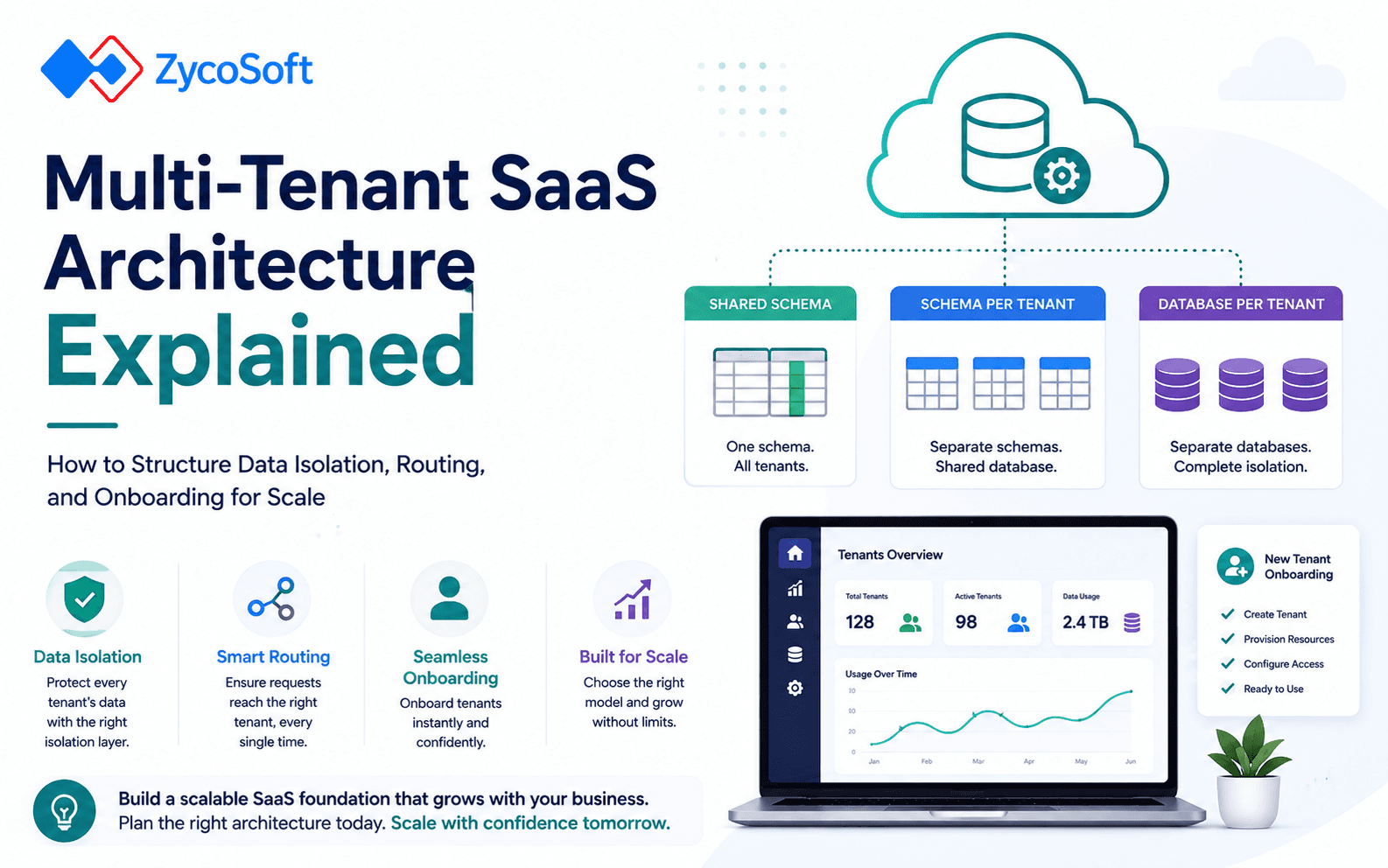
Introduction: The Architecture Decision You Cannot Afford to Get Wrong
Most SaaS founders treat multi-tenancy as a technical detail to sort out during development. It is not. It is one of the most consequential product decisions you will make - and unlike a broken feature or a slow query, getting it wrong cannot be patched. It requires a migration that can cost months of engineering time and frequently forces a rebuild of core product components.
The multi-tenancy model you choose before a single line of code is written will constrain every subsequent decision: your database schema design, infrastructure costs, compliance posture, onboarding pipeline, and how you respond to enterprise procurement questionnaires.
This guide gives you the complete technical trade-offs across all three primary multi-tenant SaaS architecture models - so you can make the right call the first time, not after six months of expensive mistakes.
What Is Multi-Tenant SaaS Architecture?
Multi-tenant SaaS architecture is the design pattern by which a single deployed application serves multiple customers - called tenants - from shared infrastructure, while keeping each tenant's data appropriately isolated.
The word "appropriately" matters enormously here, because data isolation in SaaS is not binary. It exists on a spectrum:
- Logical separation - enforced by application code and database policies
- Schema-level separation - enforced at the database namespace level
- Physical separation - dedicated database instances per tenant
Where you sit on this spectrum determines your compliance posture, infrastructure cost, operational complexity, and scalability ceiling.
Before selecting a model, answer these four questions honestly:
- How many tenants do you expect within 12 months - and within 36 months?
- Do any target customers operate under GDPR, HIPAA, SOC 2, or similar compliance frameworks?
- Will tenant data volume be uniform, or will enterprise customers generate significantly more data than smaller ones?
- What is your infrastructure budget at MVP stage versus at 500 tenants?
Your answers will point you directly to the right model. Let us examine each one.
Model 1: Shared Schema - The Default Starting Point
In a shared schema model, every tenant's data lives in the same database tables. A single tenant_id column on every row is the only logical boundary between customers.
Row-level security (RLS) policies - either enforced by the database engine or by application-layer query filters - ensure that tenant A cannot read tenant B's data. PostgreSQL RLS is the canonical implementation: a session variable is set on every connection (SET app.current_tenant = 'tenant_uuid'), and a policy on each table restricts all operations to rows matching that variable. Every query automatically scopes to the current tenant - no manual WHERE clauses required.
✅ Advantages of Shared Schema
- Single database instance to manage, monitor, and back up
- Instant tenant onboarding - a single
INSERTinto a tenants table, no infrastructure provisioning - Simple migrations - run once, apply to all tenants immediately
- Low infrastructure cost - 100 tenants costs roughly the same as 10 in operational overhead
⚠️ Where Shared Schema Breaks Down
- Noisy neighbour problem: One high-volume tenant can saturate shared database resources and degrade performance for all others
- Compliance risk: Enterprise buyers in regulated sectors will ask how you can prove their data is isolated. "We use a tenant_id column" is a weak answer in a security questionnaire
- Single point of failure: A bug that drops or missets the tenant context can expose one tenant's data to another - with no database-level safety net beyond the RLS policy itself
Best for: Early-stage products with fewer than 200 tenants, no regulated enterprise buyers, and a primary focus on product-market fit.
Model 2: Schema-Per-Tenant - The Practical Middle Ground
Schema-per-tenant provisions a separate PostgreSQL schema - or equivalent namespace - for each tenant. All tenants share the same database server and connection pool, but their tables are namespaced separately.
Switching between tenants in the application means changing the search path: SET search_path TO tenant_abc_schema, public.
This model eliminates the noisy-neighbour data problem at the schema level. A query running in tenant_abc_schema physically cannot accidentally read tenant_xyz_schema rows - because the tables themselves are separate objects.
✅ Advantages of Schema-Per-Tenant
- Stronger isolation than shared schema - tables are physically separate objects
- Satisfies most GDPR data isolation requirements when combined with proper access controls
- No cross-tenant data leakage risk at the query level
- Moderate infrastructure cost - shared server, separate namespaces
⚠️ Where Schema-Per-Tenant Breaks Down
- Migration complexity: You must apply migrations across every tenant schema - requiring a migration runner that iterates through all schemas and applies changes in sequence or parallel
- Operational overhead scales with tenants: Above 500 tenants, managing hundreds of schemas, tracking migration state, and debugging schema-specific drift becomes significant
- Does not satisfy enterprise buyers who specifically require fully dedicated infrastructure
Best for: Products with 50–500 tenants, some compliance requirements, and a mixed SMB and mid-market customer base.
Model 3: Database-Per-Tenant - Maximum Isolation at Real Cost
Database-per-tenant provisions a dedicated database instance for every customer. A central tenant registry resolves a connection string per tenant, directing all queries to their dedicated instance. There is no shared storage layer between tenants at all.
✅ Advantages of Database-Per-Tenant
- GDPR right-to-erasure is trivial: Drop the tenant database - data is provably gone
- Data residency compliance: Provision each tenant's database in the correct geographic region (UK GDPR, EU data localisation)
- Complete performance isolation: One tenant's workload cannot affect another's
- Enterprise security audits are straightforward: You can point to a dedicated instance
· A breach in one tenant's database does not expose any other tenant's data
⚠️ Where Database-Per-Tenant Breaks Down
- Significant infrastructure cost: 100 tenants with dedicated instances represents a substantially larger AWS RDS bill than a single shared instance
- Connection pooling becomes a first-class engineering problem: You need a proxy layer (PgBouncer or RDS Proxy) that manages connections dynamically per request
- Migration coordination: Migrations must be applied across all instances, with tooling to track state per tenant and handle partial failures
· Operational complexity scales directly with tenant count
Best for: SaaS products targeting regulated industries (fintech, healthtech, legaltech), products with enterprise contracts requiring dedicated infrastructure, and products where individual tenant data volumes could be large and unpredictable.
Tenant Routing: The Layer Most Teams Underestimate
Regardless of which isolation model you choose, your tenant routing layer needs to be designed as a proper system - not bolted on after the first customer signs up.
Tenant routing typically resolves via one of three mechanisms:
1. Subdomain Routing tenant.app.com resolves to a shared IP. A middleware layer extracts the subdomain and looks up the tenant record before the request reaches any application logic. Simple, widely used, easy to implement.
2. Custom Domain Mapping The tenant points their own domain at your platform. A domain-to-tenant-id map in a fast lookup store (Redis or a small lookup table) resolves the identity on every request. Required for white-label SaaS products.
3. JWT Claim Routing The tenant identifier is embedded in the authentication token. Works well for API-first products - but requires that tenant context is always present in authenticated requests.
Critical constraint: Tenant identity must be resolved before the authentication middleware runs. If you resolve it after, you risk the auth layer querying the wrong tenant's user store during the resolution phase itself - a subtle but dangerous race condition.
Onboarding Automation: The Pipeline Teams Always Underinvest In
Tenant onboarding is consistently the area engineering teams underscope - and it becomes a painful bottleneck the moment the sales pipeline accelerates.
In a shared schema model, tenant creation is straightforward: a database insert and a subdomain DNS record.
In a database-per-tenant model, onboarding involves:
- Provisioning a dedicated database instance
- Running initial migrations against the new instance
- Registering the connection string in your tenant registry
- Health-checking the instance before the first request is routed to it
This pipeline must be fully automated from day one, tested in staging, and capable of completing without any human intervention. If onboarding a new customer requires manual infrastructure steps, it will become your growth bottleneck - right when you can least afford it.
A Decision Framework: Choosing the Right Model for Your Stage
Work through these criteria in order to identify the right model for your product:
Early Stage (Fewer than 200 tenants, no regulated enterprise buyers): → Start with shared schema and PostgreSQL RLS. Keep the architecture simple and focus entirely on product-market fit. You can migrate later - but only if you build clean abstraction layers from the start.
Growth Stage (50–500 tenants, some compliance requirements, mixed SMB and mid-market): → Schema-per-tenant gives meaningful isolation without the operational cost of dedicated instances. Invest in a robust migration runner before you need it.
Enterprise Stage (Any tenant count, regulated industry, enterprise contracts): → Database-per-tenant from day one. Price the infrastructure cost into your unit economics early so it is not a surprise at Series A. Fintech, healthtech, and legaltech products in the UK and EU should default to this model.
Mixed Requirements (SMB + enterprise in the same product): → Build the application to support multiple isolation models behind a single routing abstraction. Onboard SMB tenants to shared schema and enterprise tenants to dedicated instances. This requires more upfront architecture work - but avoids a complete rebuild when you land your first regulated enterprise customer.
GDPR and Compliance: Why Your Architecture Is a Legal Decision
For SaaS products operating in or serving the UK and EU markets, multi-tenancy model selection is not purely a technical decision - it is a legal one.
Article 17 (Right to Erasure): In a shared schema model, you must delete all rows with the tenant's tenant_id and then prove to a Data Protection Officer that the data is genuinely gone - including backups, logs, and derived data. In a database-per-tenant model, you drop the instance. The erasure is complete and provable.
Article 20 (Data Portability): Exporting a single tenant's complete dataset is trivial in database-per-tenant. In shared schema, it requires careful filtering across every table.
Article 32 (Appropriate Technical Measures): Enterprise procurement teams and regulators will ask how you ensure one tenant cannot access another's data. Physical separation is a far stronger answer than application-layer RLS policies.
GDPR compliance should be architected from the data layer up - not added as a feature sprint before a compliance audit.
Conclusion: Make the Architecture Decision Before You Write the Code
The multi-tenancy model you choose is one of the few architectural decisions in SaaS that is genuinely expensive to reverse. Unlike most product decisions, you cannot A/B test your way to the right answer - you have to get it right before development starts.
The framework is straightforward:
- Simple product, early stage, no regulated buyers → Shared schema
- Growing product, mixed customer base, moderate compliance → Schema-per-tenant
- Enterprise product, regulated industry, serious compliance requirements → Database-per-tenant
What makes the decision complex is the nuance between your current stage and your 18-month growth scenario. Architect for where you need to be in 18 months - not for today, and not for the theoretical ceiling.
If you are about to make architecture decisions for a SaaS product, the right time to get this right is now - before a single line of code is written.
Frequently Asked Questions (FAQ)
1. What is multi-tenant SaaS architecture?
Multi-tenant SaaS architecture is the design pattern where a single deployed application serves multiple customers - called tenants - from shared infrastructure, while keeping each tenant's data isolated. The level of isolation varies by model: shared schema uses row-level policies, schema-per-tenant uses database namespaces, and database-per-tenant uses fully dedicated instances per customer.
2. What is the difference between shared schema and database-per-tenant?
In a shared schema model, all tenants share the same database tables, separated only by a tenant_id column and row-level security policies. In a database-per-tenant model, each customer has a completely separate database instance with no shared storage layer. The key trade-offs are cost and compliance: shared schema is cheaper and simpler but harder to defend in enterprise security audits; database-per-tenant is expensive but provides the strongest isolation and compliance posture.
3. Which multi-tenant architecture is best for GDPR compliance?
Database-per-tenant is the strongest model for GDPR compliance. It makes right-to-erasure requests (Article 17) trivially provable - you drop the tenant's database - and data residency requirements can be satisfied by provisioning each tenant's instance in the correct geographic region. Schema-per-tenant satisfies most GDPR isolation requirements when combined with proper access controls. Shared schema requires careful application-layer deletion logic and is harder to defend to regulators or enterprise procurement teams.
4. How does tenant routing work in a multi-tenant SaaS application?
Tenant routing resolves a customer's identity before any application logic runs. The three common mechanisms are subdomain routing (extracting the tenant from the URL subdomain), custom domain mapping (resolving a domain to a tenant ID via a fast lookup store like Redis), and JWT claim routing (embedding the tenant identifier in the authentication token). The critical requirement is that tenant identity must be resolved before the authentication middleware runs - not after.
5. When should I use schema-per-tenant instead of shared schema?
Schema-per-tenant is the right choice when you have between 50 and 500 tenants, some compliance requirements, and a mixed SMB and mid-market customer base. It eliminates the cross-tenant data leakage risk at the query level - queries in one schema physically cannot access another tenant's tables - while avoiding the full infrastructure cost of database-per-tenant. The trade-off is more complex migration management, which requires a dedicated migration runner.
6. How do I handle tenant onboarding automation in a database-per-tenant model?
In a database-per-tenant model, onboarding automation must cover four steps: provisioning the dedicated database instance, running initial schema migrations against it, registering the connection string in your central tenant registry, and health-checking the instance before routing the tenant's first request to it. This pipeline must be fully automated, tested in staging, and capable of completing without human intervention. Manual onboarding steps become a growth bottleneck the moment your sales pipeline accelerates.
7. Can a SaaS product support multiple isolation models simultaneously?
Yes - and for products serving both SMB and enterprise customers, this is often the right architectural choice. By building a single routing abstraction layer that supports multiple isolation models, you can onboard SMB customers to a shared schema environment and enterprise customers to dedicated database instances. This requires more upfront architecture work but avoids a complete rebuild when regulated enterprise customers require dedicated infrastructure as a contract term.
8. What is the noisy neighbour problem in multi-tenant SaaS?
The noisy neighbour problem occurs in shared infrastructure environments when one high-volume tenant saturates shared resources - CPU, memory, I/O, or database connections - and degrades performance for all other tenants on the same instance. It is most acute in shared schema models where all tenants share the same database instance. Schema-per-tenant reduces the data-level risk but does not fully eliminate the infrastructure-level risk. Database-per-tenant eliminates it completely through physical isolation.
9. How should I think about infrastructure costs across the three models?
Shared schema has the lowest infrastructure cost - one database instance serves all tenants, and operational overhead scales slowly. Schema-per-tenant adds moderate complexity but remains cost-efficient because tenants share a server. Database-per-tenant has significantly higher infrastructure costs - at AWS RDS pricing, 100 dedicated instances represents a substantially larger bill than a single shared instance. For enterprise SaaS products, these costs should be priced into unit economics and customer contracts from the start, not discovered as a surprise after Series A.
10. What payment integration complexities arise in multi-tenant SaaS architectures?
Multi-tenant SaaS products that handle payments face additional complexity around per-tenant connected account structures and revenue recognition across tenant boundaries. If your product uses Stripe, Mollie, or Razorpay, each tenant may require its own connected account for payment processing - particularly in marketplace or platform models. This means your payment integration layer must be architected alongside your tenancy model, not bolted on afterward. Revenue recognition, reconciliation, and compliance reporting across tenant boundaries should be scoped as engineering concerns before development begins.
Frequently Asked Questions
Multi-tenant SaaS architecture is the design pattern that allows a single application instance to serve multiple customers, called tenants, while keeping each tenant's data logically or physically separate. The model you choose affects infrastructure cost, data isolation strength, regulatory compliance, and how difficult it is to onboard, migrate, or offboard customers as your product scales.
Shared schema stores all tenants' data in the same database tables, distinguished by a tenant_id column with row-level security enforced at the database or application layer. Database-per-tenant provisions a separate database instance for each customer, providing full physical isolation. Shared schema is cheaper and simpler to operate at low tenant counts; database-per-tenant is more compliant and easier to audit but significantly more expensive to run.
Database-per-tenant offers the strongest GDPR compliance posture because data is physically isolated, making erasure requests, data export, and breach containment straightforward. Schema-per-tenant is a reasonable middle ground. Shared schema is achievable under GDPR but requires rigorous row-level security, careful logging, and documented technical controls to demonstrate that tenant data cannot be accessed by other tenants or leaked through application bugs.
Shared schema starts to break down when tenants have significantly different data volumes, when enterprise customers demand audit logs proving their data is isolated, when one tenant's workload degrades performance for others (the noisy neighbour problem), or when regulatory requirements in certain markets mandate physical data residency or separation. At that point, migrating to schema-per-tenant or database-per-tenant is expensive and disruptive.
Tenant routing identifies which tenant a request belongs to, typically via subdomain (tenant.app.com), a custom domain mapped to a tenant ID, or a JWT claim. The resolved tenant ID is then injected into the request context and used to set the correct database schema, connection pool, or RLS policy before any query runs. Routing must be resolved before authentication middleware executes to avoid cross-tenant data access during the auth flow itself.
Migration is possible but costly. It requires extracting per-tenant data, provisioning new database instances, updating your routing layer, and running parallel systems during the transition to avoid downtime. The application code also typically needs changes to handle dynamic connection strings rather than a single connection pool. Planning your isolation model before development starts avoids this migration cost entirely, which is why the decision matters so much at the architecture stage.