
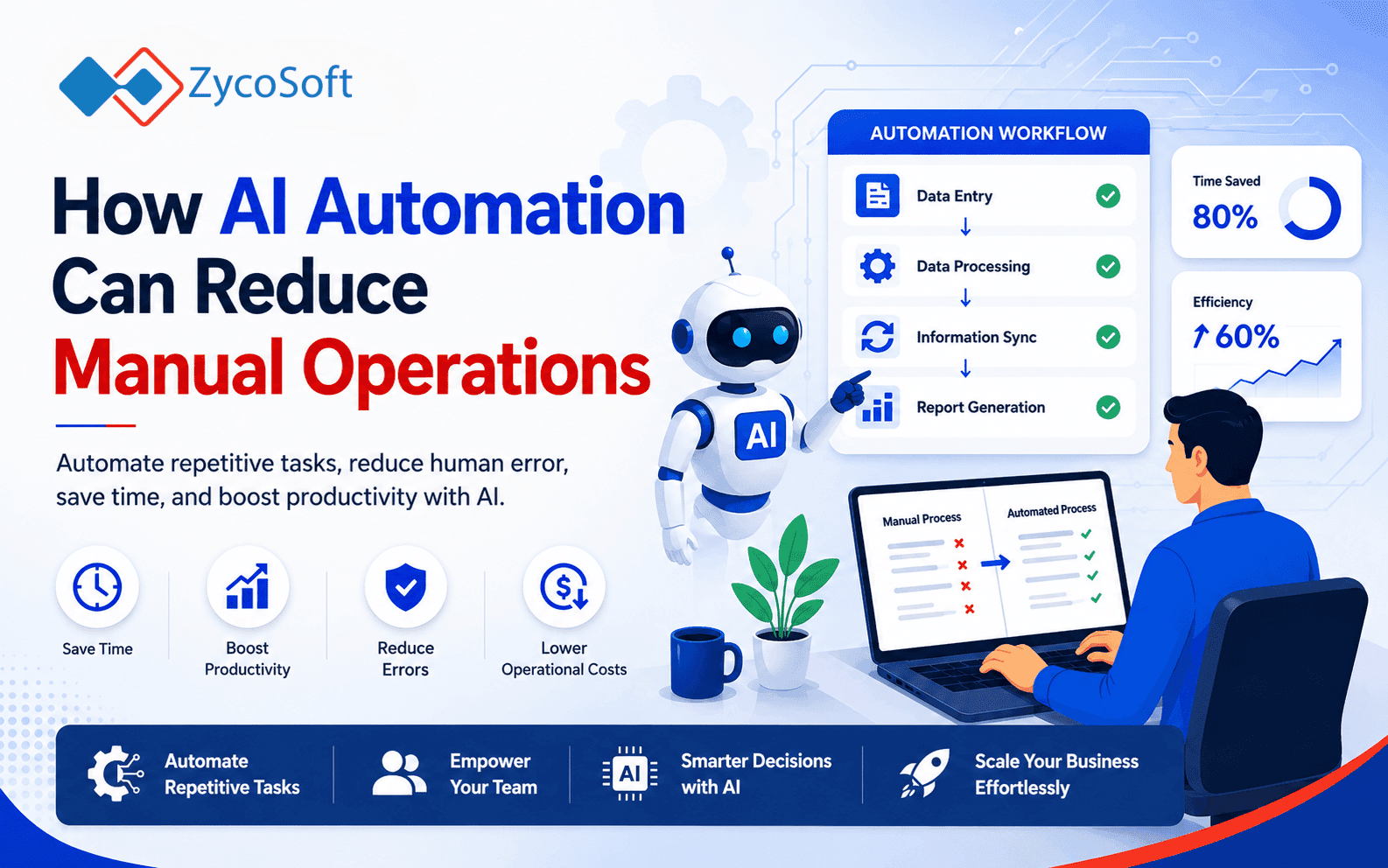
What Is AI Automation?
AI automation is the use of artificial intelligence to perform tasks that previously required human effort. Unlike basic rule-based automation that follows fixed instructions, AI automation learns from data, adapts to changing inputs, and handles complex decisions making it far more powerful than traditional software tools.
In simple terms: you set it up once, and it works for you around the clock without breaks, without errors, and without additional headcount.
Why Manual Operations Are Holding Your Business Back
Manual operations are expensive, slow, and error-prone. When your team spends hours every day on repetitive tasks like data entry, report generation, invoice processing, or customer follow-ups, they have less time for work that actually moves the business forward.
Here is what manual operations cost you every single day:
- Wasted employee hours on low-value repetitive tasks
- Human errors that lead to costly mistakes and rework
- Slow turnaround times that frustrate customers
- Higher operational costs as the business scales
- Bottlenecks that block growth and slow decision-making
AI automation solves all of these problems not someday, but right now.
How AI Automation Reduces Manual Operations
Here are the most powerful ways AI automation is eliminating manual work across industries today.
1. Automated Data Entry and Processing
Data entry is one of the most time-consuming and error-prone tasks in any business. AI tools can extract data from emails, PDFs, forms, and invoices automatically and push it directly into your CRM, ERP, or database without any human involvement. What used to take hours now takes seconds, with near-zero errors.
2. AI-Powered Customer Support
Most customer questions are repetitive. What are your hours? How do I reset my password? Where is my order? AI chatbots and virtual assistants handle these questions instantly, 24 hours a day, 7 days a week without a single human agent involved. Your support team is then free to handle complex issues that genuinely need a human touch.
3. Automated Report Generation
Pulling data from multiple sources, formatting reports, and sending them to stakeholders is a weekly drain on most operations teams. AI automation connects to your data sources and generates accurate, formatted reports automatically daily, weekly, or monthly and delivers them to the right people without anyone lifting a finger.
4. Smart Email and Follow-Up Automation
Following up with leads, sending onboarding emails, chasing unpaid invoices these are critical tasks that often fall through the cracks because they are manual. AI-powered email automation handles all of it based on triggers and behavior. The right message goes to the right person at the right time, every time.
5. Invoice and Finance Processing
AI can read incoming invoices, match them to purchase orders, flag discrepancies, and route them for approval all automatically. Finance teams that once spent days on manual reconciliation now spend hours, with fewer errors and faster closing cycles.
6. HR and Recruitment Automation
Screening hundreds of resumes manually is exhausting and inconsistent. AI recruitment tools scan applications, rank candidates based on your criteria, schedule interviews, and send follow-up emails cutting hiring time dramatically while improving the quality of shortlisted candidates.
7. Inventory and Supply Chain Management
AI monitors stock levels in real time, predicts demand based on historical data, and automatically triggers purchase orders when inventory runs low. Businesses using AI for inventory management see fewer stockouts, less overstock, and significantly lower carrying costs.
8. Quality Control and Error Detection
In manufacturing, logistics, and data-heavy industries, AI detects errors and anomalies faster and more accurately than any human team. It flags issues before they become problems reducing defects, returns, and customer complaints.
Which Industries Benefit the Most from AI Automation?
AI automation is not limited to tech companies. It is transforming operations across every major industry:
- Retail and eCommerce: order processing, inventory, customer service
- Healthcare: patient scheduling, billing, records management
- Finance and banking: fraud detection, loan processing, compliance reporting
- Manufacturing: predictive maintenance, quality control, supply chain
- Real estate: lead follow-up, document processing, client communication
- Marketing agencies: reporting, campaign management, content scheduling
How to Get Started with AI Automation in Your Business
You do not need to automate everything at once. Start small, prove the value, and expand from there.
Step 1: Identify your biggest time drains
List the top five tasks your team does repeatedly every week. These are your highest-impact automation opportunities.
Step 2: Pick one process to automate first
Choose the task that takes the most time or causes the most errors. Start there. Build confidence before expanding.
Step 3: Choose the right tools
There are AI automation tools built for every business size and budget. Popular options include Zapier, Make, UiPath, HubSpot, and custom AI solutions built specifically for your workflows.
Step 4: Measure the results
Track time saved, error rates, and cost per task before and after automation. The numbers will make the case for expanding to other areas.
Step 5: Scale gradually
Once your first automation is running smoothly, move to the next process. Build a culture where your team sees AI as a tool that makes their work better not a threat to their jobs.
Common Mistakes to Avoid
- Automating a broken process: Fix the workflow first, then automate it. AI will just make a bad process faster.
- Trying to automate everything at once: Start focused. One process done well beats five done poorly.
- Ignoring your team: Bring your employees into the process early. Their input makes automation more effective and reduces resistance.
- Skipping the testing phase: Always test automation thoroughly before going live. One undetected error in an automated workflow can multiply quickly.
What AI Automation Cannot Replace
AI automation is powerful, but it is not a replacement for human judgment, creativity, or relationship-building. Strategic decisions, complex negotiations, creative problem-solving, and genuine human connection still require people. The goal is not to remove humans from your business it is to remove humans from tasks that do not need them, so they can focus on work that only they can do.
Final Thoughts
Manual operations are a ceiling on your business growth. Every hour your team spends on repetitive tasks is an hour not spent on strategy, innovation, and customer relationships. AI automation removes that ceiling. It is not a future technology it is available right now, at every budget level, for businesses of every size. The businesses winning today are the ones that started automating yesterday. The best time to start is now.
Why Choose Zycosoft for AI Automation Solutions?
Implementing AI automation is about more than adopting new technology—it's about improving efficiency, reducing manual work, and creating smarter business processes. By identifying repetitive tasks and automating the right workflows, businesses can save time, reduce operational costs, and improve overall productivity.
At Zycosoft, we help businesses leverage AI automation solutions to streamline operations and accelerate growth. As an experienced software development company, we design and develop custom AI-powered workflows, business process automation, intelligent web applications, and custom software solutions tailored to your organization's unique requirements.
Want to learn how AI can transform your business? Explore our AI Automation Services to discover our solutions, or Contact Zycosoft to schedule a free consultation. Whether you're automating a single workflow or building a complete AI-powered business system, our team is ready to help you achieve greater efficiency and long-term success.