
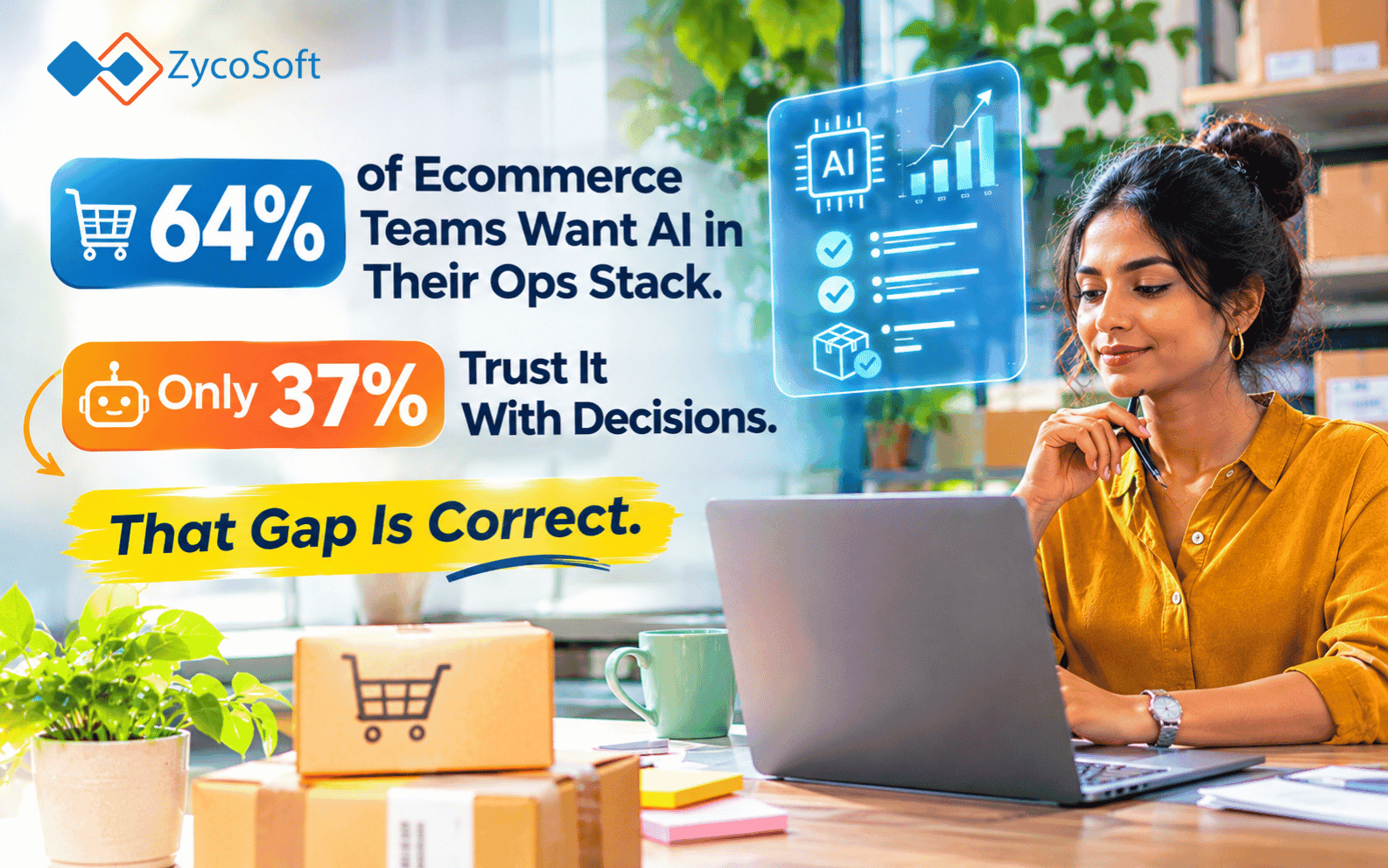
64% of Ecommerce Teams Want AI in Their Ops Stack. Only 37% Trust It With Decisions. That Gap Is Correct.
A new Linnworks survey of US ecommerce businesses, published November 12 2026, found that 64% of respondents say AI is a top factor when evaluating operations software. Only 37% would trust AI to make purchasing decisions. Another 37% would trust it to communicate with suppliers.
Those two numbers belong together. The gap between them is not a contradiction -- it is a reasonable read of what AI is actually good at.
The Linnworks Market Survey 2026 also found that 46% of respondents see AI as an opportunity for growth, and 62% say AI-driven personalization is already improving their customer experience. These teams are not AI skeptics. They are using it. They want more of it. They are just drawing a sensible line around specific types of decisions.
The question for anyone running ecommerce ops right now is: where exactly is that line, and are you drawing it in the right place?
What the Gap Actually Means
The instinct to keep AI away from purchasing decisions and supplier communications is correct. The reason has nothing to do with whether the technology is mature enough.
Those decisions carry consequences that are hard to reverse and require judgment that is not fully encoded anywhere. A purchasing decision involves reading supplier relationships, cash flow timing, demand signals that are partly soft, and risk tolerance that shifts by month. A supplier negotiation involves trust, precedent, and context that lives outside any system. These are not problems where "the logic is already written." They are problems where a human has to weigh things that are not on the spreadsheet.
AI runs well on deterministic logic. If condition A and B, then action C. When the logic is explicit and the failure modes are recoverable, AI is fast, consistent, and cheap. When the logic is implicit and the failure mode is a strained supplier relationship or a $200k overstock, a human needs to stay in the loop.
The 64% who want AI in their ops stack are right. The 37% who do not want it making purchasing calls are also right. Both things are true.
Where AI Should Own the Work :
There is a category of ecommerce ops tasks where human involvement is mostly overhead. The logic is known, the failure is catchable, and the volume makes manual handling the actual bottleneck.
Exception routing. An order flagged for a fraud review, an address mismatch, or a carrier exception follows a decision tree that someone wrote once and has been walking manually ever since. AI can own that routing. When a rule doesn't cover the case, it escalates. The human reviews the escalations, not the queue.
Ticket classification and triage. Support tickets in an ecommerce stack tend to cluster into five or six categories: WISMO, return requests, payment issues, product questions, escalations. Classification, priority scoring, and first-response drafts are all deterministic enough for AI to handle. The agent reviews the edge cases.
Demand forecasting inputs. AI is good at pattern recognition across large data sets, faster and more consistent than a buyer pulling spreadsheets. It surfaces signals. It does not decide what to order. The forecast goes to a human who checks it against context the model does not have.
Inventory alerts and reorder triggers. Setting threshold logic is boring, repetitive, and easy to get wrong when done manually across hundreds of SKUs. AI monitors it continuously. It fires the alert. A human reviews it before the PO goes out.
The pattern here: AI owns the work up to the point where a decision with real business consequence needs to be made. At that point it hands off.
Where Human Judgment Stays In :
Supplier negotiations, purchasing decisions, pricing strategy, and relationship-critical communications when something has gone wrong all stay with humans.
These are not places where the technology just needs more time. They are places where the judgment involved cannot be fully specified in advance. AI can prepare a buyer for a negotiation -- pulling contract history, pricing trends, and the supplier's recent performance. It should not send the email. That distinction is about accountability and context, not capability.
The Real Barrier Is Not Trust :
The survey found that 43% of ecommerce businesses cite disconnected systems as the number one barrier to automation -- ahead of cost, ahead of ROI uncertainty. That finding matters because it explains the trust gap.
If your order data is in Shopify, your supplier comms are in email, your 3PL is on a separate portal, and your inventory is in a spreadsheet, there is nothing for AI to operate on. You cannot automate a workflow that does not exist as a workflow. Connected data is the prerequisite. Better AI is not.
The Audit Question for This Week :
Look at your ops stack and ask one question: which of our recurring decisions are deterministic, and which require judgment we have not written down anywhere?
Deterministic decisions with high volume are where AI pays off immediately. Judgment calls with real financial or relationship consequences stay with humans, possibly assisted by AI-prepared context. That split is the whole framework.
The teams in this survey who want AI in their ops but are keeping it off purchasing decisions are reading the situation accurately. The ones who should worry are the teams trying to automate everything at once, before the underlying systems are connected.
If your ops stack is at the point where the systems are connected and you want to map what should be automated versus what should stay human, we can walk through it. Book a time at zycosoft.com/consultation.
Rate this article
Choose a star rating, then submit.
Frequently Asked Questions
Purchasing decisions involve supplier relationships, cash flow timing, and risk tolerance that shifts by context. These are judgment calls that cannot be fully encoded in advance. AI runs well on deterministic logic -- if A and B, then C -- but purchasing requires weighing things that are not on the spreadsheet. The 37% who would not hand purchasing to AI are reading the situation correctly.
AI should own exception routing (fraud flags, address mismatches, carrier exceptions), support ticket classification and triage, demand forecasting inputs (pattern recognition, signal surfacing), and inventory alerts and reorder triggers. These are deterministic, recoverable, and high-volume -- exactly the profile where AI is fast, consistent, and cheaper than manual handling.
The Linnworks survey found that 43% of ecommerce businesses cite disconnected systems as the top barrier to automation, ahead of cost and ROI uncertainty. If order data is in Shopify, supplier comms are in email, 3PL data is on a separate portal, and inventory lives in a spreadsheet, there is nothing for AI to operate on. Connected data is the prerequisite.
Ask one question: which recurring decisions are deterministic (the logic is written, the failure is recoverable), and which require judgment you have not written down anywhere? Deterministic, high-volume decisions are where AI pays off immediately. Judgment calls with real financial or relationship consequences stay with humans, possibly assisted by AI-prepared context.
Only with human review before the message goes out. Supplier communication involves trust, precedent, and relationship context that lives outside any system. AI can prepare a buyer by pulling contract history, pricing trends, and supplier performance. It should not send the email autonomously. The distinction is about accountability and context, not whether the AI is capable of writing a coherent message.
Comments
No comments yet. Be the first to share your thoughts.
Leave a comment
Comments are reviewed before they appear publicly.